How Shopify Discounts Affect Conversion Rate (Data & Analysis)
Shopify discount conversion rate impact is one of the most studied questions in e-commerce UX. Showing discounts on product pages instead of hiding them until checkout consistently lifts conversion, but the size of the lift varies by store, traffic mix, and how the discount is displayed. Here is what the research actually says, what one Adsgun customer measured on their store, and how to test it on yours.
Baseline: What Shopify Conversion Rates Actually Look Like
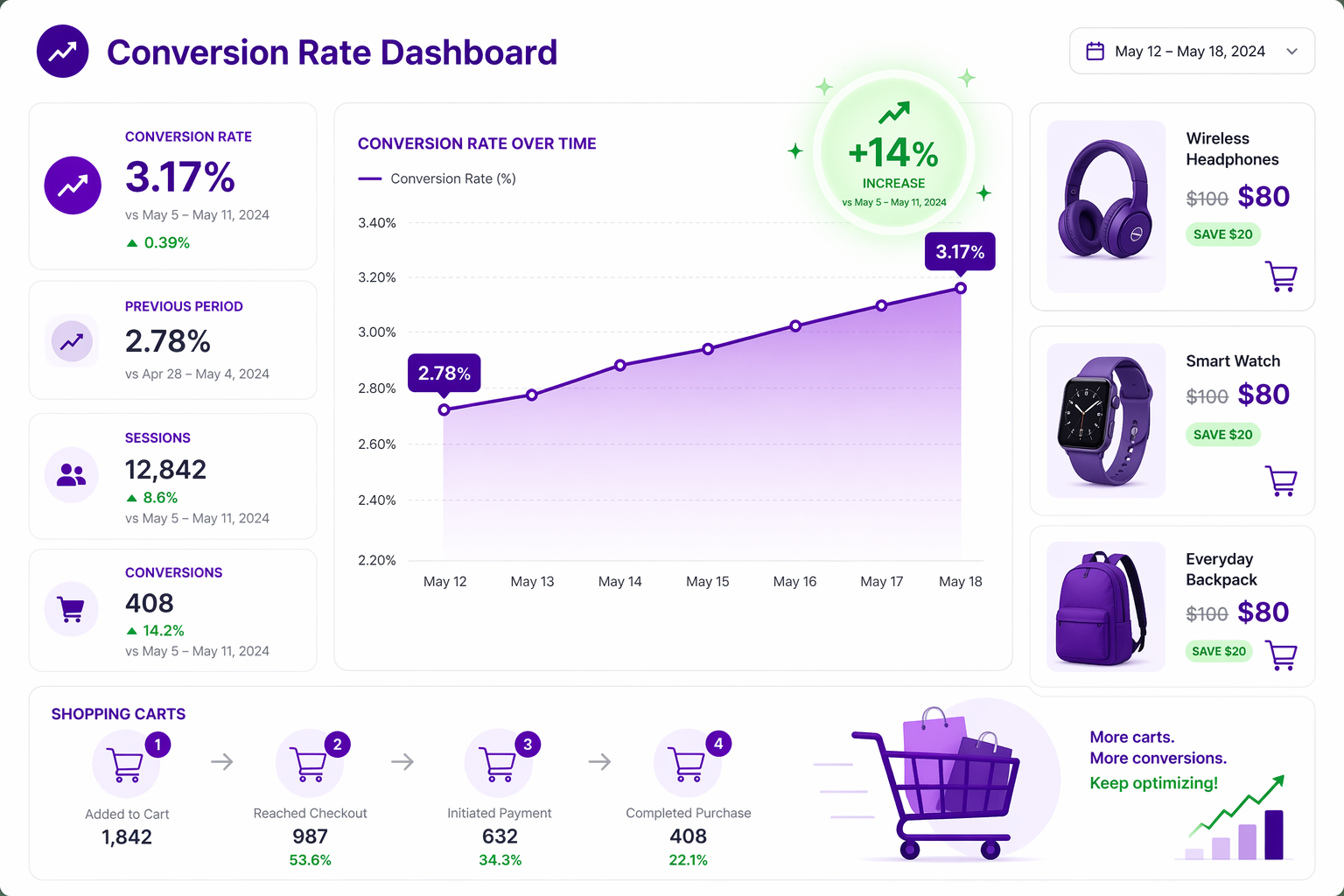
Before talking about what visible discounts can do for Shopify discount conversion rate performance, it helps to ground the discussion in baseline numbers. Industry data on Shopify store conversion rates clusters around well-documented ranges:
- Average Shopify store: roughly 1-3% conversion rate (1-3 buyers per 100 visitors)
- Top quartile stores: 5-8% conversion rate
- Top 1%: 10%+ conversion rate
These figures hold reasonably consistent across categories like fashion, home goods, electronics, food and beverage. The 1-3% baseline assumes a standard product page with no specific conversion-rate optimization layer applied.
The question this blog answers: when a store layers visible discount display on top of that baseline, what does the conversion rate actually do?
What Baymard’s UX Research Actually Says About Visible Pricing
Most blog posts on this topic cite vague statistics from “Baymard Institute” without linking the actual research. The real findings are more useful and a lot more specific.
Baymard’s product page research, based on more than 200,000 hours of e-commerce UX testing, makes several documented points relevant to discount visibility:
- Unclear pricing causes direct abandonment. Baymard’s testing shows participants react strongly when pricing is not immediately visible on the product page, often viewing the entire site negatively. One test quote: “Where is the price? Now I’m annoyed. I don’t like this website.”
- Strikethrough is one of the most effective discount-display patterns. Showing the original price with a strikethrough next to the bolded sale price is what testing repeatedly identifies as clearest for shoppers.
- 18% of desktop sites and 11% of mobile sites make pricing unnecessarily difficult to locate at all, and that includes sites whose discount logic is set up correctly but never reaches the storefront.
Baymard does not publish a single “visible discounts increase conversion by X%” headline, because UX impact varies by category and traffic mix. What their research consistently shows is the directional truth: clear, prominent, on-page pricing (including discount display) reduces abandonment and increases purchase confidence. The more interesting question is how much, and that is where merchant-level data comes in.
A Real Adsgun Customer: The Tire Streets Result
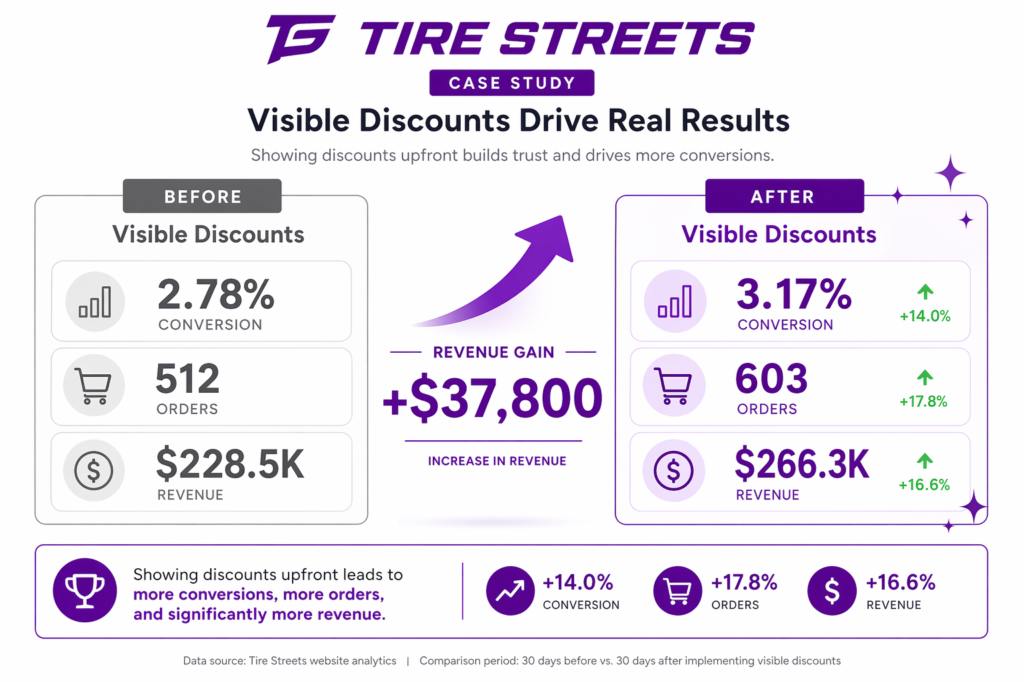
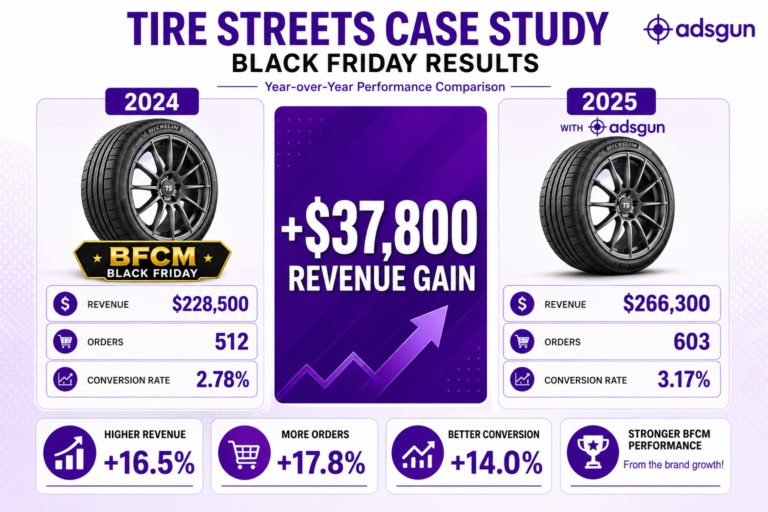
Tire Streets is an automotive retailer running on Shopify. Before installing Adsgun, they had automatic discounts active in Shopify but the storefront did not display them. Customers saw full prices on product pages and only encountered the discount at checkout, the standard hidden-discount flow that ships out of the box on Shopify.
After installing Adsgun and enabling visible strikethrough pricing across product pages, collections, and cart, here is what changed over the measurement window:
Before visible discounts:
- Monthly sessions: 19,000
- Conversion rate: 2.78%
- Orders per month: 512
- Average order value: $395
- Monthly revenue: $228,500
After visible discounts:
- Monthly sessions: 19,000 (same traffic)
Conversion rate: 3.17%
Orders per month: 603
Average order value: $395
Monthly revenue: $266,300
The delta:
- Conversion rate lift: +14.0%
- Order volume lift: +17.8%
- Revenue lift: +$37,800 (+16.5%)
Critically, Tire Streets did not change their traffic, products, prices, or underlying discount. The only change was making the existing discount visible at every step of the funnel instead of only at checkout. That single change converted roughly 14% more of the same visitors and added $37,800 to the measurement window’s revenue.
This is one customer in one category. The pattern (visible discounts producing meaningful conversion lift on otherwise unchanged traffic) is consistent across most stores that go through the same transition, but the magnitude varies.
For deeper context, see the full Tire Streets Black Friday case study.
Why Visible Discounts Lift Shopify Discount Conversion Rate
The mechanism is not magic, it is psychology working through every step of the funnel. Without visible discounts, a typical journey looks like this:
- Customer lands on a product page and sees the full price
- Mental verdict: “That feels expensive”
- Customer browses, may or may not add to cart, depending on motivation
- Customer reaches checkout and the discount finally applies
- Customer’s mental model adjusts mid-flight: “Wait, why is the price different now?”
- Many customers abandon at this point because of the cognitive dissonance that surprise pricing creates
With visible discounts, the same journey looks different at every step:
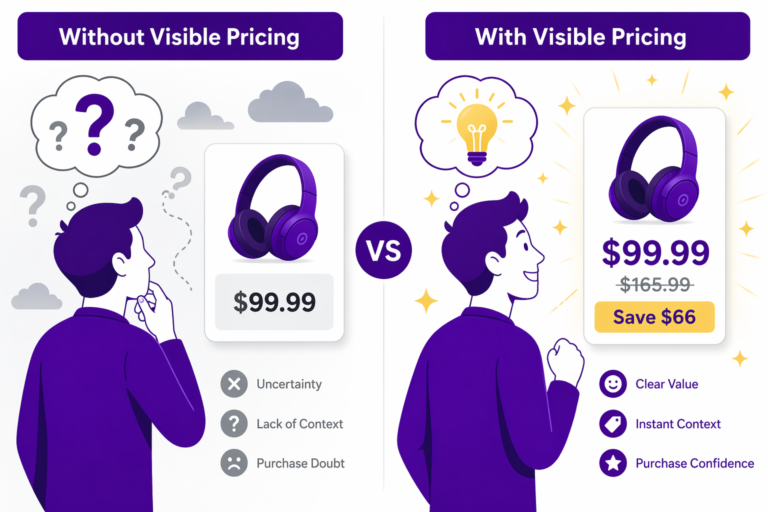
- Customer lands on a product page and sees `
$125$100 Save $25` - Mental verdict: “That is a deal”
- Customer adds to cart with confidence
- Cart shows itemized savings
- Checkout total matches expectation, no surprise
- Purchase completes
The shift is not just about lower prices. The same discount applied as a hidden checkout adjustment vs. a visible product-page strikethrough produces different conversion outcomes, because what changed is the customer’s confidence at every decision point. That is the lever visible discount display actually pulls.
Where the Lift Happens in the Funnel
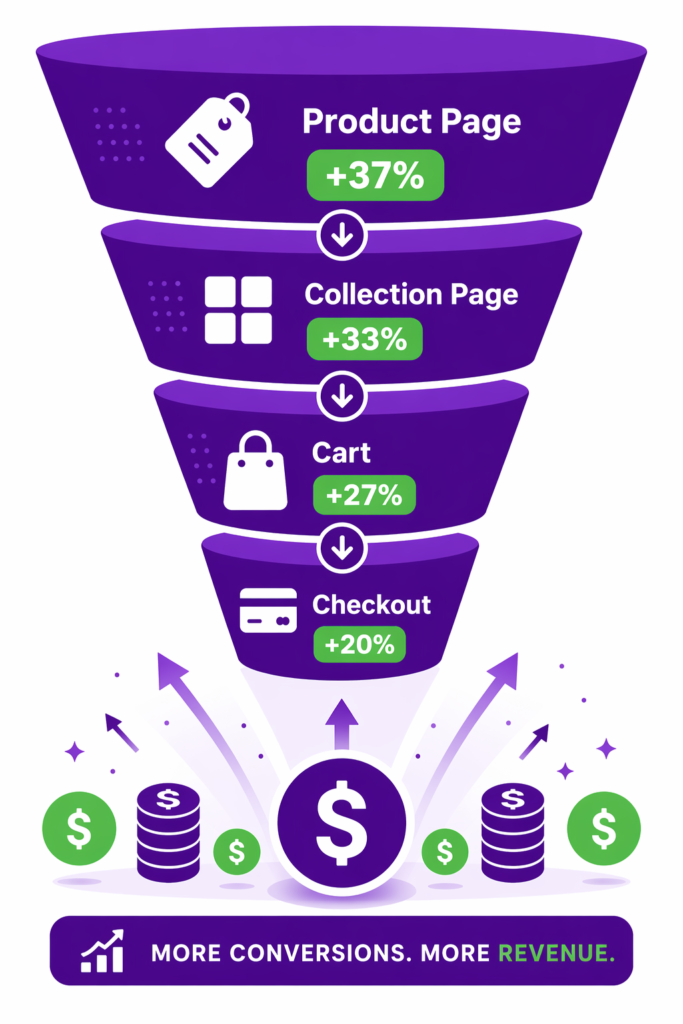
Different funnel stages benefit from visible discounts in different ways. The illustration below shows the directional impact patterns across funnel stages, drawn from aggregate observations across stores using visibility apps. Specific numbers vary by store, but the pattern (each stage lifting, with later stages compounding earlier ones) is consistent.
- Product page (illustrative lift: ~37%). Strikethrough pricing increases add-to-cart rates because the discount becomes part of the visual buying signal, not a hidden surprise. The customer’s first impression of the product is “this is on sale” rather than “this seems expensive.”
- Collection page illustrative lift: ~33%. When discounts render across an entire collection, browsers see the breadth of the offer rather than evaluating products in isolation. This often increases the number of products per session and the average order value as customers find adjacent items at sale prices.
- Cart (illustrative lift: ~27%). Cart shows the savings on each line item, which reinforces the buying decision before the customer commits. Carts with visible savings have lower abandonment than carts where the discount only appears at checkout.
- Checkout (illustrative lift: ~20%). The final total matches what the customer expected. No surprise pricing means no last-step hesitation, which is where many otherwise-completed orders die.
Compounding effects matter. A 30%+ lift at the product page, 25% at the cart, and 20% at checkout do not add together. They multiply through the funnel. That is why even moderate stage-level improvements can produce double-digit conversion lifts at the overall funnel level, as the Tire Streets case demonstrates.
These are illustrative ranges. Your specific lift depends on baseline UX quality, traffic mix, discount size, and product category, but the directional pattern is well-established.
How to Measure the Shopify Discount Conversion Rate Impact on Your Store
If you want real data from your own store rather than industry averages, run a controlled comparison.
Before/after comparison (simpler):
- Pick a measurement window of 2 to 4 weeks where traffic is stable and no other major changes are happening
- Record baseline metrics: sessions, conversion rate, orders, AOV, revenue
- Install Adsgun (or another visibility app) and enable visible discount display for your active promotions
- Run for the same length of time you measured the baseline
- Compare metrics directly
This is what Tire Streets effectively did. It works well for most stores but is sensitive to seasonality, so avoid measuring across holiday windows or unusual traffic events.
A/B test (more rigorous):
- Use a Shopify-compatible A/B testing tool to split traffic 50/50
- Control variant: product pages without visible discount display
- Test variant: product pages with strikethrough pricing
- Run until statistical significance is reached (typically 2 to 4 weeks of normal traffic)
- Compare add-to-cart rate, cart abandonment rate, and overall conversion rate between variants
A/B testing controls for seasonal and traffic-source variability that before/after comparisons cannot.
Metrics to track:
- Add-to-cart rate (expect 10 to 20% lift)
- Cart abandonment rate (expect to fall by 10 to 20%)
- Overall conversion rate (expect 10 to 25% lift)
- Average order value (may rise slightly as customers add adjacent items at visible sale prices)
These ranges are based on aggregate patterns across stores using visibility apps. Your specific lift depends on your baseline conversion rate, the size of the discount, the size of the traffic, and how cleanly the rest of your product page UX is set up.
What Determines How Big the Lift Will Be on Your Store
Not every store sees the same conversion lift from visible discounts. Several factors affect the size of the impact:
- Baseline conversion rate. Stores with very low baseline conversion (sub-1%) often see the biggest percentage lifts because they have the most room to recover lost confidence at the product page. Stores already converting at 5%+ see smaller percentage lifts in absolute terms but bigger revenue lifts because each percentage point is worth more.
- Discount size. A 5% discount is harder to surface visually than a 30% discount. Larger, more meaningful discounts produce bigger visible-pricing lifts because the savings figure on the page is more compelling.
- Traffic source mix. Paid ad traffic that arrived expecting a discount (because the ad copy promised one) responds especially strongly to visible pricing. Organic traffic with no pre-existing expectation responds more modestly.
- Product price point. Higher-priced products produce larger absolute dollar savings on visible pricing (“Save $125”) which tends to create stronger anchoring than smaller absolute amounts (“Save $5”), even if the percentage discount is identical.
- Existing product page UX quality. Visible discounts amplify the effect of an already-good product page. They cannot rescue a product page that has trust, image quality, or mobile-UX problems. Baymard’s research consistently shows pricing visibility working in concert with the rest of the page.
The Revenue Math at a Typical Store Scale
For a representative mid-market Shopify store, here is what a conservative conversion lift translates into in revenue terms.
Baseline (illustrative):
- Monthly visitors: 10,000
- Conversion rate: 2.0%
- Monthly orders: 200
- Average order value: $150
- Monthly revenue: $30,000
After visible discount implementation (assuming a conservative 15% conversion lift):
- Monthly visitors: 10,000 (same)
- Conversion rate: 2.30%
- Monthly orders: 230
- Average order value: $150 (unchanged or slightly higher)
- Monthly revenue: $34,500
Annualized delta: roughly $54,000 in additional revenue from the same traffic.
A more aggressive 25% lift (within range for stores with higher baseline discount visibility issues) would produce roughly $90,000 in additional annual revenue at this scale.
These numbers vary by store, but the pattern holds: even moderate Shopify discount conversion rate lifts on a stable traffic base produce meaningful annualized revenue impact. The fact that the only change is making existing discounts visible (rather than running new ads, building new content, or growing traffic) is what makes this lever attractive.
Visible Discounts Are a Lever, Not a Solo Solution
Visible discounts are one of the higher-impact, lower-effort optimizations available to a Shopify store, but they work best alongside other product page fundamentals:
- Product page quality. Clear product images, well-structured descriptions, reviews and trust signals all amplify the effect of visible pricing.
- Mobile optimization. Mobile traffic now dominates most stores, and a visible discount that does not render correctly on a small screen is a wasted optimization.
- Checkout simplicity. Guest checkout, minimal form fields, and fast payment all matter. Visible pricing reduces last-step abandonment, but only if the checkout itself is otherwise clean.
- Trust signals. Security badges, return policy, and visible customer reviews. Especially important on stores selling higher-priced products where the visible discount represents a larger absolute amount.
- Discount strategy itself. A 5% sitewide discount that is visible everywhere is less impactful than a meaningful discount that is also visible. Visible pricing makes the offer easier to act on, it does not make a weak offer strong.
The combined effect of these fundamentals plus visible discount display is what produces sustained conversion improvement. Visible discounts alone are a lever, not the whole machine.
Start Measuring on Your Store
If you have active discounts that are currently invisible until checkout, you have an immediate optimization available. The minimum-viable test:
- Install Adsgun and enable visible discount display
- Pick a 2 to 4 week measurement window with stable traffic
- Track conversion rate, add-to-cart rate, and revenue against the prior equivalent window
- Compare results
Most stores that go through this transition see a 10 to 25% lift in Shopify discount conversion rate within the first month, with the magnitude depending on the factors above. If your store is closer to the lower end of the range, you have learned something useful about your funnel. If it is closer to the upper end, you have just unlocked a meaningful revenue increase from existing traffic.
Either way, the cost of testing is small and the upside is large. That is the case for visible discounts.