How Tire Streets Made $37,800 More Revenue on Black Friday Without More Traffic
Same Black Friday discount. Same traffic estimate. One change: making the discount visible on product pages, collections, and cart instead of hiding it until checkout. The Tire Streets case study shows what happens when a Shopify Black Friday case study isolates the visibility variable, $37,800 in additional revenue from the same campaign budget and the same number of visitors. Here is how it played out.
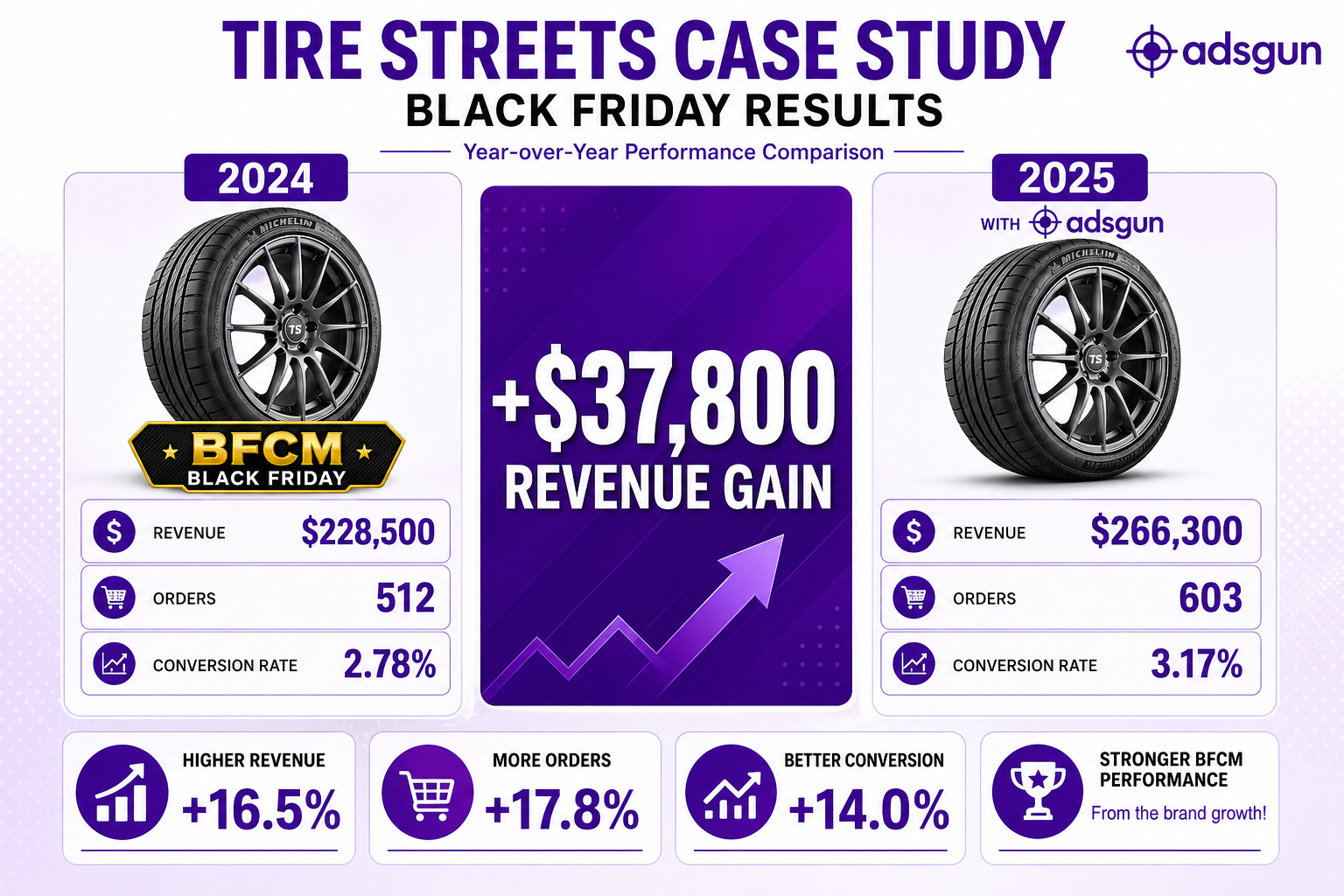
In 2024, Tire Streets ran their Black Friday Cyber Monday campaign with a 40% storewide discount. Solid results: 19,000 sessions, 512 orders, 2.78% conversion rate, $228,500 in revenue.
In 2025 they ran it again. Same traffic estimate, same 40% discount, same promotional budget across Facebook ads, email, and organic social. One thing was different: this time they used Adsgun to display the discount everywhere across the storefront, not just at checkout.
The 2025 numbers: 603 orders (+18%), 3.17% conversion rate (+14%), $266,300 in revenue (+$37,800).
Same number of people arriving. 91 more orders. $37,800 in additional revenue, on identical traffic and an identical underlying offer. This is what happens when a Shopify black friday case study isolates the visibility variable from everything else.
The Setup: Tire Streets Before Adsgun
Tire Streets is an automotive accessories retailer running on Shopify. They sell tires, wheels, suspension components, and adjacent products. Their average order value across the BFCM window sat around $446, reflecting the higher price points typical of the automotive category.
For BFCM 2024, they ran a straightforward Black Friday campaign: 40% discount storewide, promoted through paid ads, email, and organic social, applied through Shopify discount codes at checkout.
The performance was good. A 2.78% conversion rate is above the 2-3% baseline that most ecommerce categories average. 512 orders during the BFCM window is solid. But here is what was happening behind those numbers that the team did not initially see: customers were not seeing the discount until checkout.
The 40% discount was real. The campaign was working. But Shopify’s native discount system only applies discounts at checkout. On product pages, customers saw full prices. On collection pages, full prices. In the cart before completing, full prices. Only at the final step did the 40% off become visible. Most of the funnel ran at MSRP from the customer’s point of view.
The Change: Visible Pricing With Adsgun
In September 2025, two months before BFCM, Tire Streets installed Adsgun. They recreated the BFCM discount inside Adsgun’s promotion system, which connected the existing Shopify discount to a storefront display layer. The discount now rendered as:
- Product pages: `
$333.15$199.99` with a “Save $133.16” badge - Collection pages: strikethrough display on every product card
- Cart: strikethrough pricing on every line item plus a total savings tally
- Checkout: consistent display of the deal through the final step
The discount amount stayed identical (40% off). The campaign mechanics stayed identical. The only thing that changed was visibility, when in the customer journey the discount became visible.
For a tire listed at $333.15 MSRP, the strikethrough went from invisible-until-checkout to visible-on-arrival. Same dollar amount saved. Different psychological framing.
BFCM 2025 Results: The Numbers
The year-over-year comparison, with traffic held constant and discount mechanics held constant:
| Metric | BFCM 2024 (no visibility) | BFCM 2025 (with Adsgun) | Change |
|---|---|---|---|
| Sessions | 19,000 | 19,000 | flat |
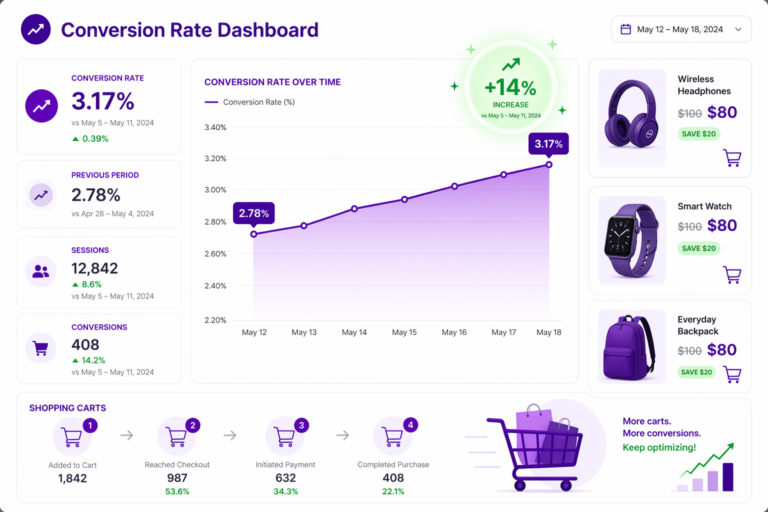
| Conversion rate | 2.78% | 3.17% | +14.0% |
| Orders | 512 | 603 | +17.8% |
| Average order value | ~$446 | ~$442 | flat |
| Revenue | $228,500 | $266,300 | +$37,800 (+16.5%) |
Same number of visitors. 91 more of them became customers. Those 91 additional orders generated $37,800 in additional revenue.
Nothing else changed. Discount stayed at 40%. Product catalog stayed the same. Marketing channels and ad spend stayed the same. The only variable: visible pricing replaced hidden pricing.
Why It Worked: The Customer Journey Difference
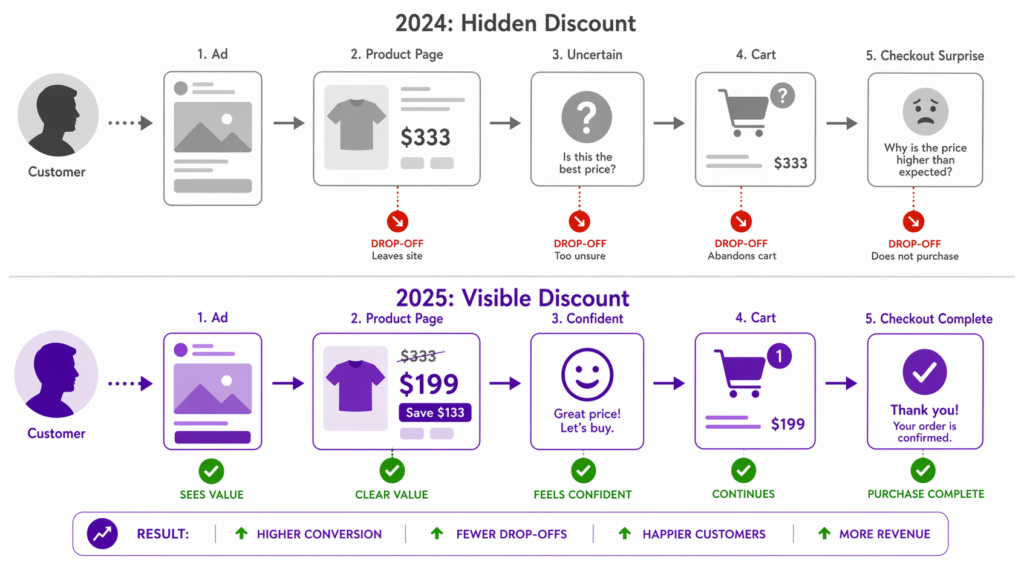
The mechanism is psychological, not technological. Both BFCM 2024 and BFCM 2025 ran the same offer. What changed was when in the funnel the customer encountered the offer.
BFCM 2024 customer journey (hidden discount)
- Customer sees a Facebook ad: “Black Friday Sale, 40% Off Everything.”
- Customer clicks through. Product page loads.
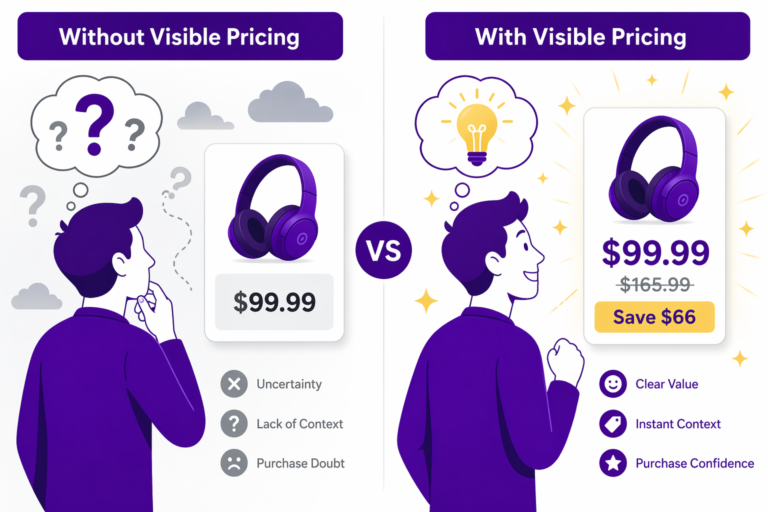
- Customer sees a tire listed at $333.15 with no discount indicator anywhere on the page. Their internal monologue: “Is this the sale price? Was it more before? Is 40% off actually a good deal?”
- The discount exists in the customer’s mind (from the ad copy), but not on the screen. The anchoring effect has nothing to anchor to.
- Customer either browses with uncertainty, abandons, or proceeds to cart and discovers the discount only at checkout.
- Customers who reach checkout convert at a reasonable rate. But most carts get abandoned before that step, and many visitors leave product pages without ever reaching the cart.
BFCM 2025 customer journey (visible discount)
- Customer sees the same Facebook ad.
- Product page loads. Customer sees the same tire, but now with `
$333.15$199.99 Save $133.16` displayed prominently. - The deal is confirmed instantly. The original price acts as a visual anchor; the sale price becomes the reference. The customer is no longer in evaluation mode (“is this expensive?”) but in confirmation mode (“yes, this is the price I want to pay”).
- Customer adds to cart. Cart shows the savings line item, reinforcing the deal.
- Checkout total matches the customer’s expectation, no surprise pricing, no second-guessing.
- Conversion happens at a higher rate because the friction points that killed BFCM 2024 conversions (uncertainty, anchoring failure, surprise pricing at checkout) are removed.
The difference: 91 additional customers in a single BFCM window.
Why Visible Discounts Matter More Than Most Merchants Realize
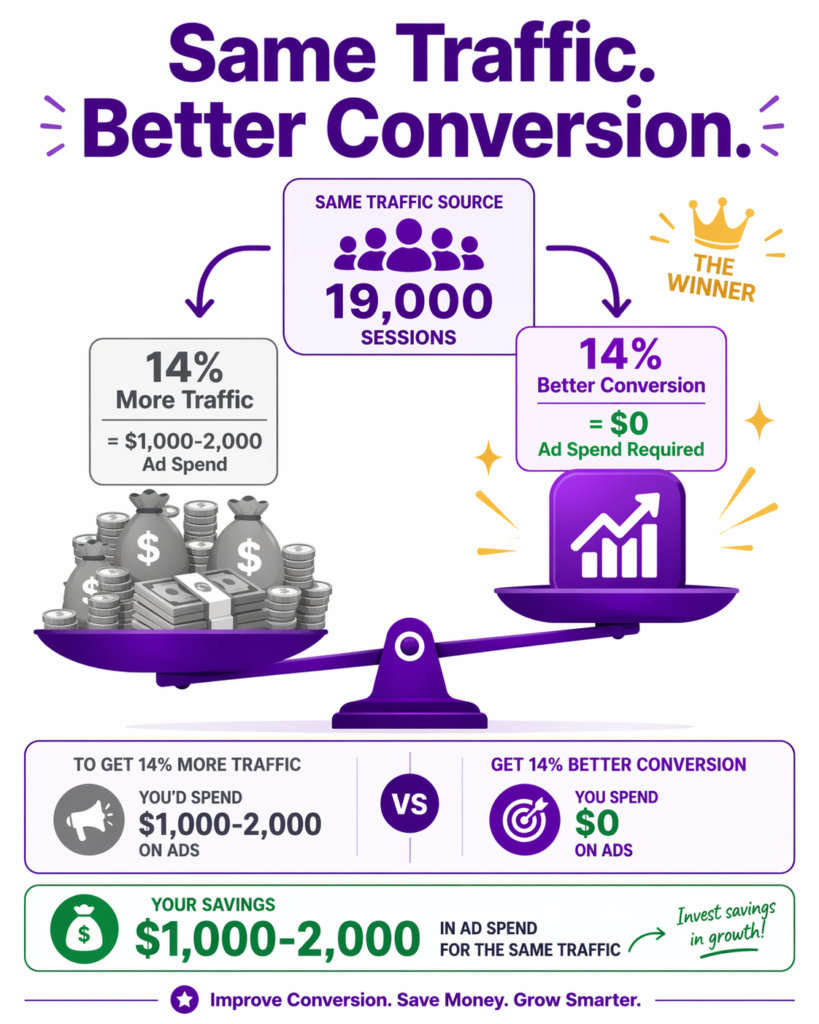
The default playbook in ecommerce when conversion is low is “spend more on ads.” Tire Streets had already proven that framework wrong by accident. They had the traffic. The 40% discount was real. The campaign budget was working. The bottleneck was not awareness or pricing, it was the moment the customer first encountered the offer.
This is a hidden conversion lever that most merchants overlook because it does not look like one. Visible discounts are a Conversion Rate Optimization play, not a marketing acquisition play. They lift conversion on existing traffic without requiring an extra dollar of ad spend.
The math is striking. To get 14% more traffic at Tire Streets’s scale (an extra ~2,660 sessions for the BFCM window) at the kind of CPMs typical of automotive Facebook traffic, the additional ad spend would land somewhere in the $1,000-$2,000 range, and that traffic would still need to convert at the existing rate to produce extra orders. To get 14% better conversion required no additional ad spend at all, just a setup change two months ahead of the campaign.
The directional point is consistent: conversion rate improvements compound on every other dollar in the funnel. Traffic improvements have to be paid for, every time, forever.
How Other Stores Can Replicate This
If your store is running BFCM (or any major sale event) and the discount only becomes visible at checkout, the same lever Tire Streets pulled is available to you. The setup work matters more than the campaign size.
Step 1: Audit your current promotion setup. Pull up a product page during your active campaign on a private browser session. Can you see the discount? Or does the price only drop in the cart or at checkout? If it is the latter, you are operating like Tire Streets did in 2024.
Step 2: Install a visibility tool. Adsgun, or another app that connects real Shopify discounts to storefront display, ensures your existing discounts render as strikethrough pricing across product pages, collections, cart, and checkout. No theme edits, no per-product manual updates.
Step 3: Test before BFCM, not during. Tire Streets installed in September for a November campaign. That two-month buffer let them validate the setup on smaller summer promotions before the campaign that mattered most. Running a test promotion ahead of time produces a baseline conversion lift number specific to your store, which is the foundation for accurate BFCM forecasting.
Step 4: Plan inventory and ad budget around the higher conversion expectation. If your test promotion produced a 12% conversion lift, your BFCM forecast should reflect that lift. Stocking inventory for the old conversion rate while the new conversion rate is active is a common mistake; you sell out faster than expected and leave revenue on the table.
Step 5: Layer additional strategies once visibility is solid. Once visible pricing is in place, [layer additional pricing strategies on top](https://adsgun.com/ecommerce-sale-pricing-strategies/) for compounding effect: VIP early access for email subscribers, channel-specific discount codes, scheduled promotion windows, and free gift thresholds.
What Tire Streets Said They Would Do Differently for 2026
Looking at the BFCM 2025 results, the team identified five things they would change for next year:
- Start setup earlier. Two months was enough but tight. Six months out gives time to test on multiple smaller promotions and refine the visible-pricing implementation before the campaign that matters.
- Add VIP early access. Email subscribers and loyalty members get the BFCM discount 24 hours before the public campaign opens. Captures high-LTV customers at slightly deeper discounts and creates social-proof buzz before the public sale.
- Use a real campaign-end deadline. Tire Streets ran a fixed BFCM window in 2025. They plan to add a visible countdown timer to the campaign banner for 2026, tied to the actual end date so the urgency cue is honest.
- Segment by channel. Email subscribers should not get the same discount depth as cold paid traffic, because their unit economics are different. Channel-specific promotions preserve margin where margin matters and deepen offers where they drive more loyalty.
- Stock for higher conversion. They sold through inventory faster than expected, which is a good problem to have but still a problem. The BFCM 2026 forecast will reflect the new conversion baseline, not the pre-Adsgun one.
The Bottom Line
Same people, same product, same discount. Different visibility. Different result.
$37,800 of additional revenue. One BFCM window. One visibility change.
The Tire Streets shopify black friday case study is not unique because the lift was extraordinary; it is informative because the only variable they changed was the one most stores never touch. The discount engine in Shopify works the way it works regardless of plan or campaign size. Whether customers see the discount before checkout or only after is a setup decision, and the decision compounds across every visitor in every campaign for as long as the store is running.
If your BFCM 2026 plan does not yet include making your discounts visible across the entire storefront, that is the change worth making before you adjust anything else.