Shopify Pricing Strategy: How to Price for Maximum Conversion
Pricing is not just a number, it is a signal. Learn how anchoring, loss aversion, and visible discounts can transform your Shopify pricing strategy into a conversion engine.
The Psychology of Price Perception
Price is not a number, it is a signal. A $50 product and a $75 product marked down to $50 are identical items, but the discounted version converts higher. Why? Because humans do not evaluate absolute price, we evaluate relative price. A high-performing Shopify pricing strategy starts here, with how customers perceive value rather than how merchants calculate cost.
This is anchoring, and it is one of the most powerful concepts in pricing psychology.
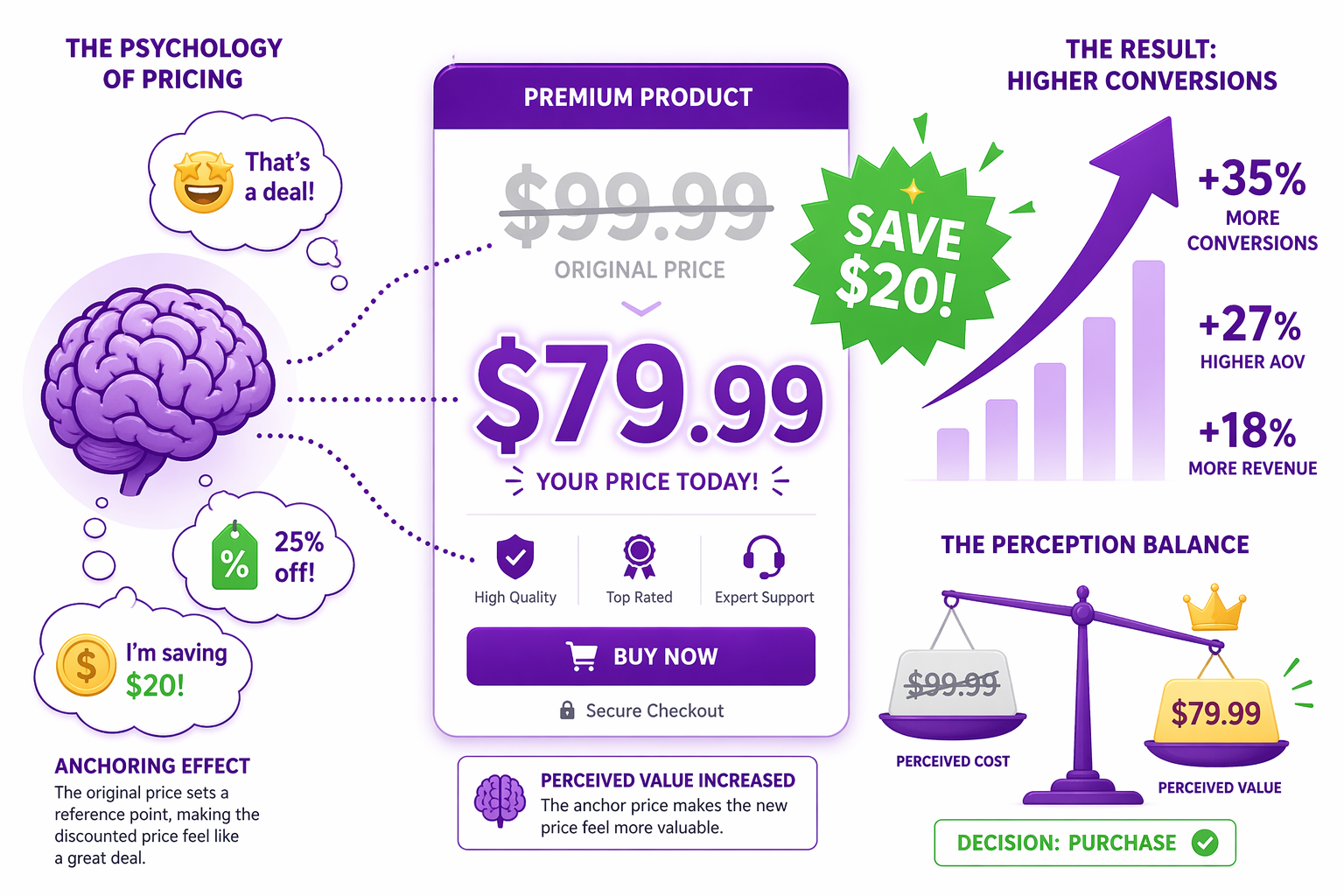
Anchoring is the cognitive bias where your first exposure to a number becomes your reference point for everything that follows. If I show you a product originally priced at $100, then discounted to $60, you evaluate $60 relative to that $100 anchor. Your brain thinks: “30% off, that is a deal.” But if I simply list the product at $60 with no reference point, your brain thinks: “Is $60 expensive or cheap?” without context.
The foundational research on anchoring comes from Daniel Kahneman and Amos Tversky, whose work on judgment under uncertainty earned Kahneman the 2002 Nobel Prize in Economic Sciences. Decades of replications since have shown that the same product presented as “regularly $100, now $60” converts significantly higher than the same product flatly listed at $60. The original price is the anchor that makes the new price feel like a win.
Charm Pricing and the Left-Digit Bias
Charm pricing ($99 instead of $100) exploits the left-digit bias. Your brain processes $99 as meaningfully cheaper than $100, even though the difference is one dollar. The left-digit effect is so strong that $19.99 performs better than $20, and $99.99 performs better than $100, even for higher-ticket items. For products under $100, .99 endings work best. For products over $100, the effect weakens but still exists.
Loss Aversion in Your Shopify Pricing Strategy
Loss aversion is Kahneman’s most famous finding: losses hurt roughly twice as much as equivalent gains feel good. If I offer you a 50/50 chance to win $100 or lose $100, most people decline. But frame it as “save $100 off your purchase,” and the same deal feels appealing. This is why discounts, even modest ones, drive disproportionate conversion in any Shopify pricing strategy.
Pricing Frameworks for a Smart Shopify Pricing Strategy
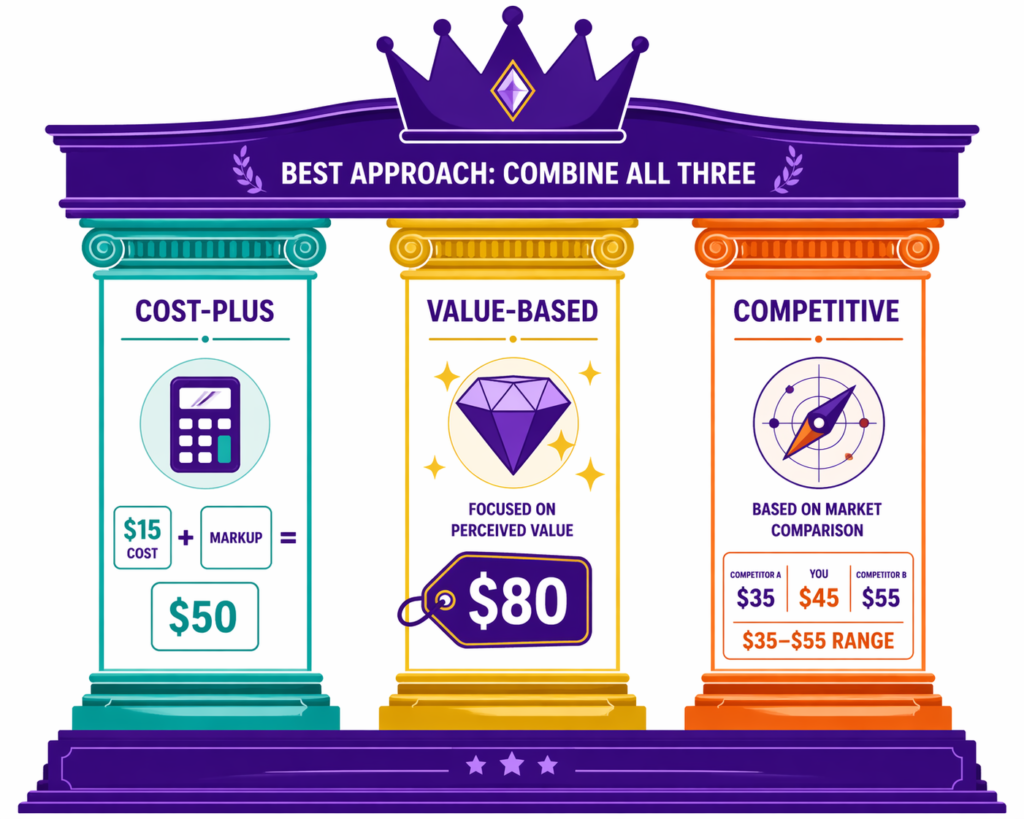
Cost-plus pricing starts with your cost and adds a markup. A sweater costs you $15, you sell it at $50 (a 233% markup, roughly 70% margin). This is simple but ignores market realities. If competitors sell the same sweater at $35, your $50 price will lose.
Value-based pricing sets the price based on perceived value to the customer. If your sweater is made from premium fabric, has excellent reviews, and celebrities wear it, you might price it at $80 even though the cost is still $15. Customers pay for the value you have created, not just the cost to produce.
Competitive pricing sets your price based on what competitors charge. You research competitor prices and price within plus or minus 10% of the average. This is reactive but realistic, because your customer will compare you anyway.
The strongest pricing approach combines all three: cost-plus to ensure margins, competitive pricing to stay realistic, and value-based pricing to capture the premium you have earned.
But underneath all of this sits the pricing psychology layer: how you present the price matters as much as what the price actually is.
The Role of Promotions in Pricing Strategy
Discounts serve multiple purposes.
Margin protection. You price your sweater at $50 normally, which protects your margin. When you offer 20% off to a new customer, you are protecting the margin relative to what they might otherwise have paid (which could be $50 at a competitor). The discount feels like a deal because they are comparing it to something, not evaluating it in a vacuum.
Conversion acceleration. Some customers were always going to buy your sweater at $50. Others will not buy until it is $40. By offering a time-limited or channel-limited discount, you capture the second group without affecting the first.
Inventory management. Discounts move inventory. If you have 200 units of a sweater and need to clear space for new inventory, you discount to move volume. This is reactive discounting and should be used sparingly to avoid training customers to wait for sales.
Strategic discounting (protect margin) and race-to-the-bottom discounting (destroy margin) are worlds apart. A strategic discount is targeted, time-limited, and shows the original price prominently. Race-to-the-bottom is blanket discounting on everything, always, which trains customers to never buy full price and destroys your margins. If you want a deeper playbook, our guide to ecommerce sale pricing strategies walks through seven layered tactics that compound.
Protecting Brand Value While Offering Discounts
The risk of discounting is brand devaluation. If people never see your sweater at full price, they stop believing in the full price. It becomes artificial, a reference point with no reality behind it.
High-end brands protect this by:
- Limiting who can access discounts (VIP members only, not public)
- Limiting when discounts run (specific times, not always)
- Limiting scope (specific items or categories, not everything)
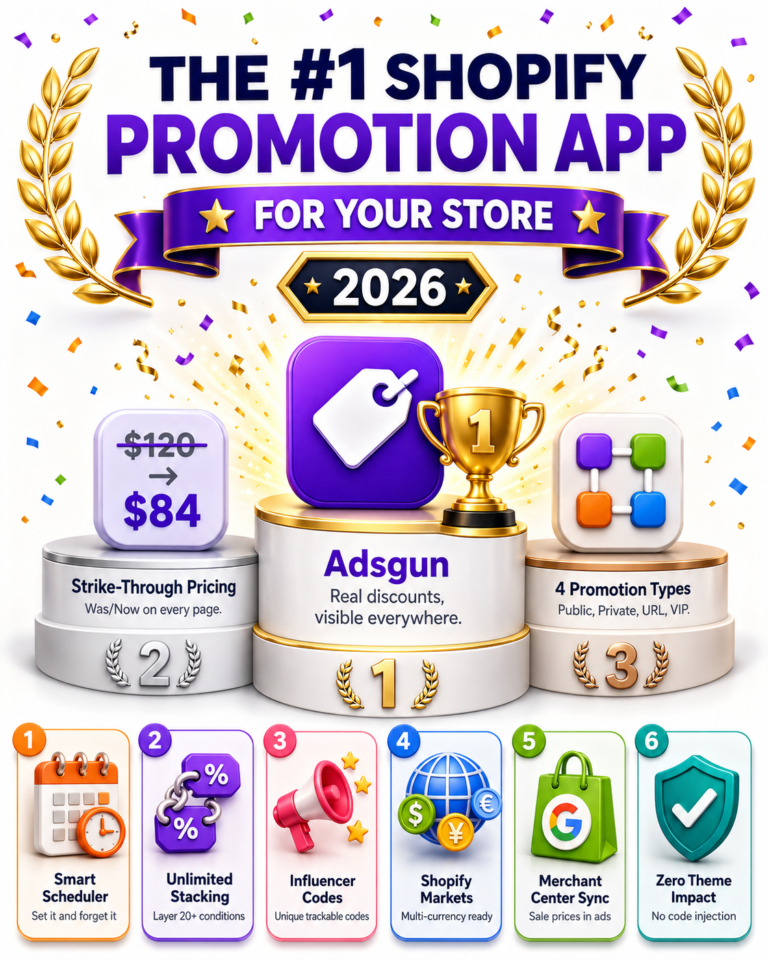
Adsgun enables all three with its four promotion types.
Public Promotions
Show the discount to everyone, everywhere. Use for major sales only (BFCM, seasonal clearance).
Private Promotions
Show the discount only to customers who have the link. Use for VIP tiers, email subscribers, or loyalty members. This makes the discount feel exclusive, which protects brand value. The full mechanics are covered in our breakdown of Shopify private promotions.
URL-Targeted Promotions
Show the discount only to customers who arrive via a specific URL parameter. Use for paid ads, affiliate links, and specific marketing campaigns. This lets you offer different discounts on different channels: paid traffic gets a deeper discount to improve ROAS, while organic traffic sees a shallower discount to protect margin. We unpack the full setup in Shopify URL discount parameters.
Customer Account Promotions
Show the discount only to logged-in customers meeting specific criteria (purchase history, customer tag, location). Use for loyalty rewards and repeat customer incentives.
The Power of the “Original Price” Anchor
This is where strategy crystallizes into action.
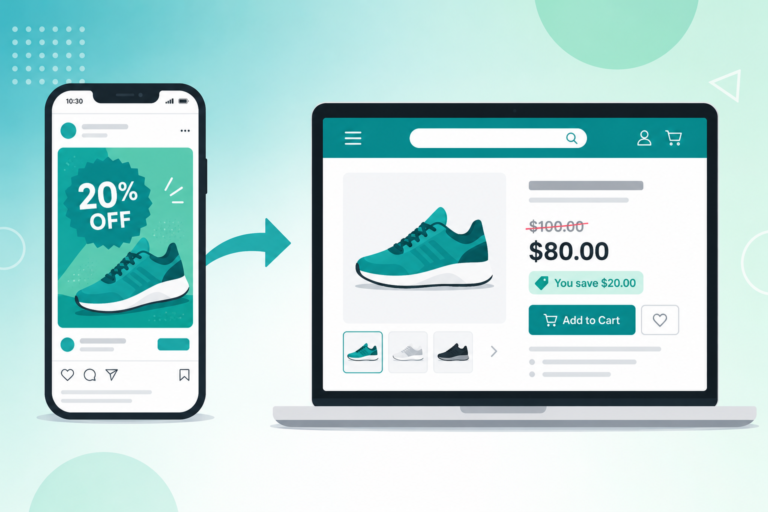
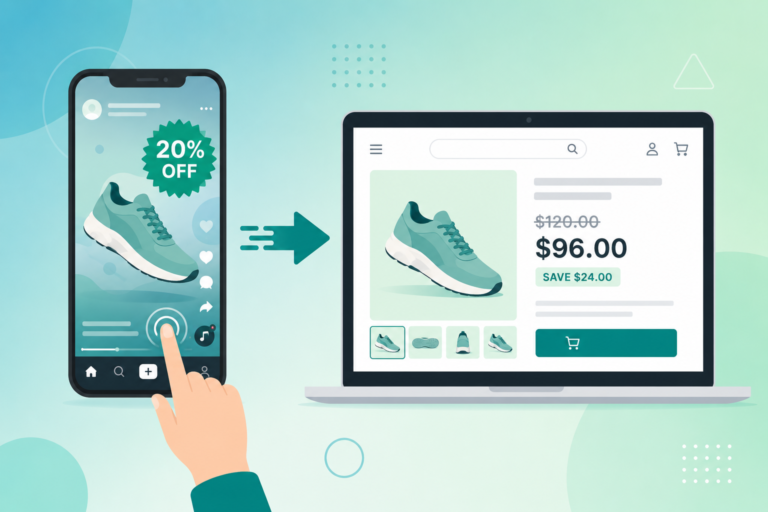
When you show “Was $79.99, Now $59.99,” the anchor of $79.99 sets the reference point. Your customer thinks: “I am getting 25% off. That is a good deal. I should buy.” Without the anchor, the customer sees $59.99 and thinks: “Is that expensive?” That is ambiguous, and it requires external comparison.
The strike-through creates visual weight. The original price in lighter color with a line through it draws the eye. The new price pops. This visual distinction is intentional, and it cues the brain that a good deal is present.
But here is the challenge: Shopify does not show strike-through pricing natively unless you use Compare at Price. And compare at price has major limitations:
- It is a manual field (you have to enter it for every variant every time you change it)
- It does not integrate with your discounts (you cannot automatically show the compare price based on an active discount)
- It distorts discount analytics (Shopify cannot track that the discount was the driver)
This is why Adsgun exists. It automatically detects your active Shopify discounts and displays strike-through pricing that is always accurate, always tied to real discounts, and always tracked in analytics.
Price Display: The Conversion Multiplier
How you display price is as important as the price itself.
- Strike-through with a savings callout (“Was $99, Now $79, Save $20”) typically converts higher than just showing $79
- Dollar amount saved (“Save $20”) tends to outperform percentage saved (“Save 20%”) for products under $100, because people grasp dollar amounts more easily at lower price points
- Urgency language (“Sale ends Friday”) paired with a visible discount can lift conversion further than the discount alone
- Placement on the product page (above the fold, near add-to-cart) matters more than placement in collections
The combination of all four, clear strike-through, dollar savings, placement above the fold, and proximity to add-to-cart, can drive a 20-35% conversion improvement over simply showing the lower price.
Shopify Pricing Strategy: Implementation on Your Store
Here is how to execute strategic pricing on Shopify.
- Step 1: Set base pricing. Use value-based pricing as your anchor. What is your product actually worth to the customer? Price at that point.
- Step 2: Create strategic discounts. Use Shopify’s discount types (automatic for margin-based, codes for attribution-based). Set different discount levels for different channels and customer segments. If you are running codes, our guide on auto-applying Shopify discount codes shows how to remove the friction of manual entry.
- Step 3: Display with Adsgun. Adsgun reads your discounts and displays strike-through pricing everywhere. Choose which promotion type to use (public for site-wide sales, private for VIP, URL-targeted for paid channels).
- Step 4: Measure impact. Shopify’s discount reporting (not distorted by compare at price) shows you exactly how much each discount contributed to conversion and revenue.
- Step 5: Optimize. Which discount levels drive incremental revenue without hurting margins? Which channels justify deeper discounts? Use the data to adjust.
The result is strategic pricing that drives conversion, protects margin, and maintains brand value.
Why Visible Discounts Outperform Hidden Ones
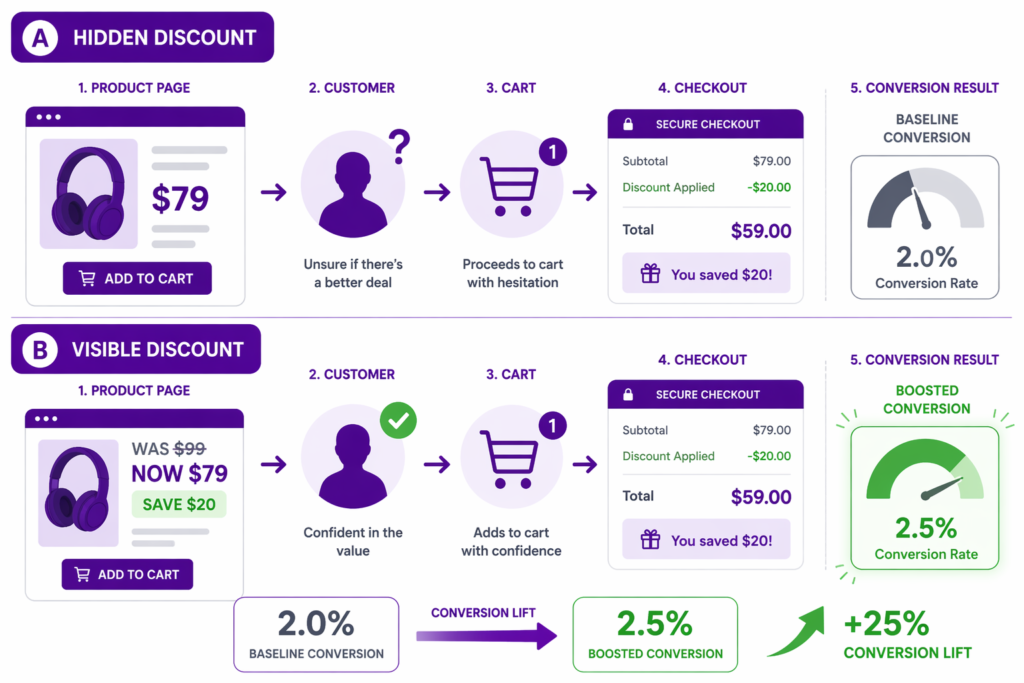
A hidden discount (code-only, or discount only visible at checkout) converts at the baseline rate. A visible discount (strike-through pricing on every page) converts at baseline plus 10-25%, depending on discount depth and product price.
Why? Because visibility influences the decision earlier in the journey. When a customer sees “Was $99, Now $79” on the product page, they are more likely to add to cart. They are more likely to complete the purchase. The discount becomes part of the value proposition before they commit. The same effect reduces cart abandonment at the same time, because customers no longer hesitate over whether the deal is real.
A discount hidden until checkout is a surprise, not a driver. It does not change the buying decision, it just sweetens an already-made decision.
This is why the visible pricing layer, and getting it right, matters more than the discount value itself.