Ecommerce Sale Pricing: 7 Strategies That Actually Increase Conversions
Most stores run sales. Few run them strategically. The difference between a flat 40% off and a layered ecommerce sale pricing strategy that compounds psychological levers across every customer touchpoint is real, and it shows up in conversion rates. Here are seven strategies that work independently and compound when stacked, with the honest mechanism behind each.
Most ecommerce stores run sales. Very few run them strategically.
The difference between “we are having a 40% off sale” and “we are running a layered pricing sequence that compounds psychological advantage at every customer touchpoint” is not just semantics. It is the difference between a decent sales lift and a transformative one.
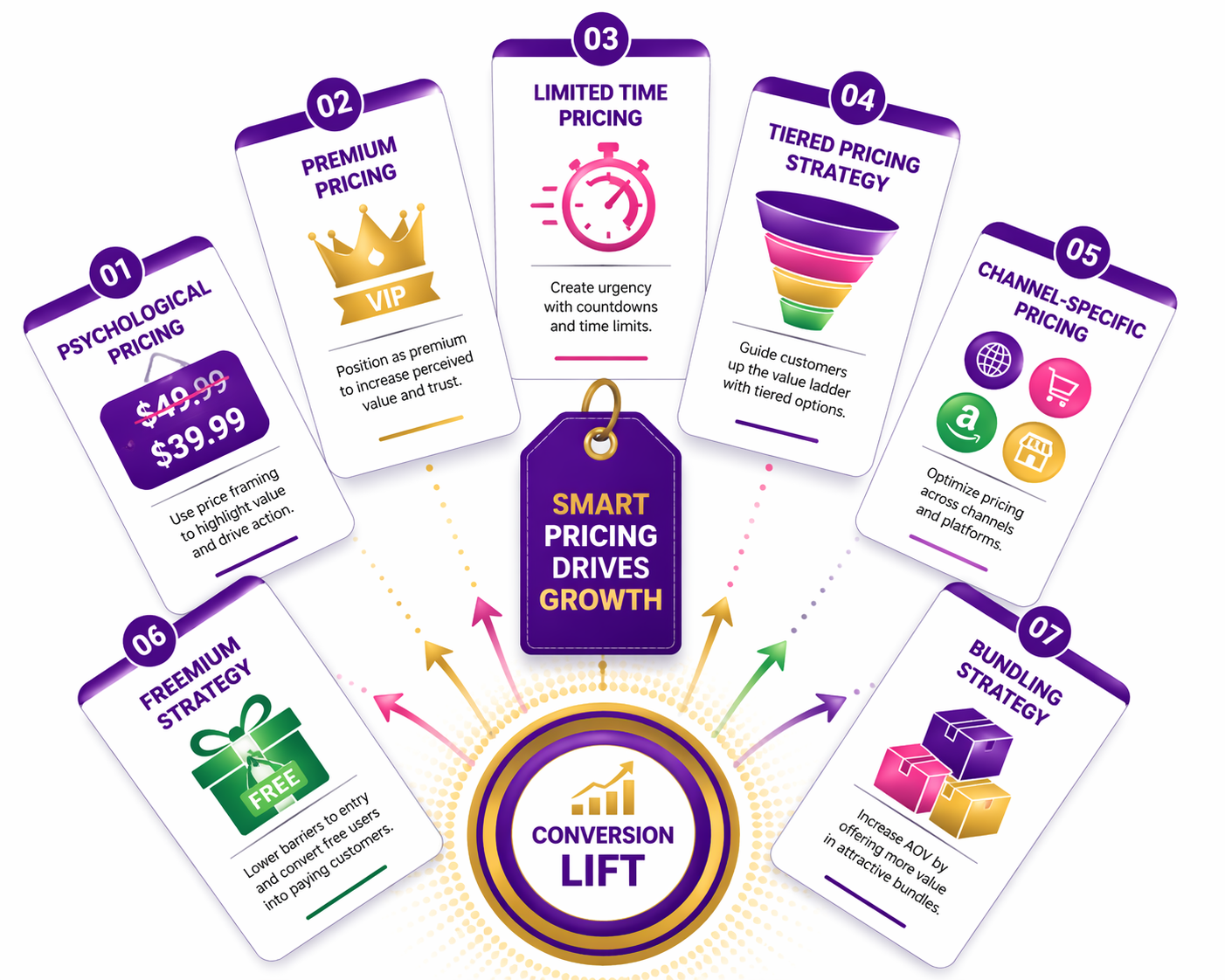
Effective ecommerce sale pricing strategies are not about cutting prices as deep as possible. They are about presenting value in ways that build confidence, create urgency, and move different customer segments to action at different times. Each of the seven strategies below works independently. Used together, they compound.
Strategy 1: Visible Strike-Through Pricing Across the Funnel
The baseline. Strike-through pricing on product pages, collection pages, cart, and checkout. So the customer knows from the moment they arrive that a discount exists.
Most Shopify stores still hide their discounts until checkout. Shopify itself documents this limitation: “To display savings from discounts with crossed-out prices on product pages and collection pages, you need to use a third-party discount app.” That single architectural decision means the average store running a discount has shoppers browsing at full prices for the entire pre-checkout journey.
Why it works: price anchoring (the original price becomes the reference), transparency (customers see the deal immediately), and psychological momentum (customers who see the deal early are more likely to proceed through the entire funnel). The psychology underneath is well-documented in behavioral economics, going back to Tversky and Kahneman’s anchoring research from 1974.
Implementation: use a discount tool that renders pricing updates across all storefront surfaces automatically. Adsgun does this natively. Any discount you create displays as strike-through pricing on every page without theme edits or manual updates.
What to expect: directionally, stores switching from hidden to visible discounts typically see 10 to 25% conversion lift, with magnitude depending on baseline UX, traffic mix, and discount size. The Adsgun customer Tire Streets measured a 14% conversion lift on identical traffic after enabling visible discounts.
Strategy 2: Customer-Segment Discount Tiers
Not all customers have equal lifetime value. VIP buyers (loyal repeat customers, high-AOV purchasers, long-term email subscribers) deserve different pricing than first-time visitors arriving from cold traffic.
A two-tier structure that works in practice:
- Public discount: 20% off everything (visible to all traffic)
- VIP discount: 35% off for tagged customer accounts (email list, loyalty members, repeat customers)
This setup accomplishes three things simultaneously: it makes VIP customers feel rewarded, it incentivizes email list signup (because new visitors discover the gap and want the better tier), and it captures higher margin from the price-insensitive top of your traffic. Public traffic does not need 35% off to convert; giving them 20% preserves margin you would otherwise leave on the table.
Why it works: perceived fairness and exclusivity. Customers who get the VIP rate feel they are being recognized for being on your list. Customers in the public tier still get a meaningful discount, so the structure does not feel punitive to them either.
Implementation: requires a discount system that supports customer tags. When a customer is tagged (via email signup, loyalty program enrollment, or admin tagging), a different discount applies automatically. Adsgun’s Customer Account promotion type handles this without requiring developer time.
The honest caveat: segmented discount structures only work if the customer segments are real. A “VIP” tier that includes 80% of your customers is just a flat discount with extra steps. Reserve the VIP rate for customers who genuinely earned it.
Strategy 3: Time-Limited Visibility With Real Deadlines
Time-limited offers work because they activate loss aversion. The fear of missing the deal is a sharper feeling than the pleasure of getting it. Strike-through pricing on its own communicates “this is on sale right now.” Pair it with a visible deadline and customers move faster.
Two approaches work, with different tradeoffs:
Store-wide deadline: “Sale ends Sunday at midnight” or a banner countdown. Easy to set up, honest by construction (the sale really does end at the same time for everyone), and benefits from social-proof effects (other shoppers see the same deadline).
Per-session timer: A countdown specific to each customer’s session (“This discount is valid for the next 4 hours on your device”). More psychologically intense per individual visitor, but only honest if the per-session deadline is real, that is, if the discount actually expires for that customer when the timer hits zero.
The honest caveat that most pricing-strategy posts skip: per-session timers that “reset” every time the customer returns are deceptive, and savvy shoppers learn to ignore them. If you use session-based urgency, the deadline must be tied to a real expiry mechanism, not a UI illusion.
Why it works (when honest): loss aversion plus scarcity. Cialdini’s scarcity principle is one of the more reliably-replicated levers in persuasion research. Time-bound offers move customers from “I will think about it” to “I should decide now.”
Implementation: schedule a discount with a real end time, then surface the deadline visibly via a banner countdown or product-page widget. Adsgun supports both store-wide and session-based timer displays through its scheduling layer.
Strategy 4: Consistent Discount Display Across the Funnel
Show the discount once and some customers miss it. Show it at every step and the impact compounds.
Consistent discount display means:
- Product page: strike-through pricing plus savings amount
- Collection page: strike-through visible across product cards
- Cart: strike-through pricing plus total savings across all line items
- Checkout: final discount confirmation plus total savings
Each repetition reinforces the value narrative. By the time the customer reaches checkout, they have seen the deal four times and internalized it as real. The opposite (a discount that appears, disappears for a stage, then reappears) creates cognitive friction. Customers second-guess whether the deal is genuinely active or whether they misread something earlier.
Why it works: repetition increases believability, and consistency removes the moments of doubt that drive abandonment. Every step where the discount is visible is a step where the customer is not recalculating whether the deal is real.
Implementation: use a discount tool that renders consistently across every storefront surface. Most apps handle product page well but break down at the cart or checkout. Adsgun renders consistently on all four stages by reading the actual Shopify discount and displaying it natively at each touchpoint.
Strategy 5: Channel-Specific Discount Targeting
Email subscribers did not arrive the same way Google Ads traffic did. They have different intent, different lifecycle stage, and different willingness to pay. Charging them all the same discount leaves margin on the table on one side and overpays on the other.
Channel-specific discount structures let you allocate discount depth where it matters:
- Email list:** 25% off via private discount link (rewards loyalty, drives list growth)
- Google Ads:** 15% off (preserves ROI on paid media where margin matters most)
- Influencer or affiliate links:** 30% off, URL-targeted (exclusive to drive volume from specific creators)
- Organic social:** 20% off public discount
Why it works: efficiency. You stop subsidizing customers who would have converted at a lower discount, and you start matching the depth of the offer to the cost-and-quality of the traffic source. Email traffic with high LTV and low acquisition cost can afford a deeper discount because the unit economics still work. Cold paid traffic with high acquisition cost cannot afford the same depth.
Implementation: create multiple promotions, each tied to a unique URL parameter or discount code that targets one channel. With Adsgun, URL-targeted promotions apply automatically when traffic arrives from a recognized source (UTM parameters or direct URL match) without requiring code entry.
The honest caveat: channel-specific pricing only works if customers do not encounter the gap. If your email subscribers see the email-only price and then visit the site through organic search and see a different price, they notice. Channel discounts work cleanly when they are tied to the customer’s identity (logged-in account) or arrival path (URL parameter), not when they are arbitrary public differences.
Strategy 6: Free Gift Thresholds
Instead of a percentage discount on every order, offer a free gift unlocked at a threshold. “Spend $75 or more and get a free [item].” A small-cost item ($5-10 wholesale) framed as a free gift psychologically feels more substantial than the equivalent percentage discount, because it registers as a reward, not a price cut.
Why it works: reciprocity and the endowment effect. Customers who receive a “free” item perceive it as something they own, which subtly increases their commitment to the purchase. The threshold also lifts AOV because customers add items specifically to qualify for the gift.
Implementation: configure a discount with a minimum order value condition that adds a free product to the cart automatically when the threshold is met. The cart should display the gift as a clearly-marked free line item (“Free with purchase”) with the retail value visible in the savings total. This makes the value of crossing the threshold concrete.
The honest caveat: free gifts work when the gift is genuinely desirable and the threshold is achievable. A free gift that is obviously low-value (a sticker, a marketing leaflet) reads as a marketing trick. A threshold that is far above your typical AOV makes most customers ignore the offer. The best implementations pair an item your customers would plausibly want with a threshold that nudges them roughly 20-30% above your typical cart value.
Strategy 7: Visible Cumulative Savings in the Cart
Customers who add multiple items at a discount often do not realize how much they have saved cumulatively until the cart shows it explicitly.
A cart that displays “Your savings: $127.83” or “Bundle 3 items and save $47.50” turns abstract individual discounts into a concrete, compelling number. Customers who see a flat 20% off on each line item may underestimate their total savings; customers who see a single dollar figure with their cumulative savings have something tangible to anchor on.
Why it works: makes the cumulative value of the order visible at the moment of decision. The same discount feels more compelling presented as one large savings figure than as several smaller percentage labels. It also reframes the cart from “money I am about to spend” to “money I have already saved,” which is psychologically much easier to commit to.
Implementation: surface total savings prominently in the cart and at checkout, broken down by source if multiple promotions apply. Adsgun’s cart layer adds this view automatically when discounts are active.
How the Strategies Stack
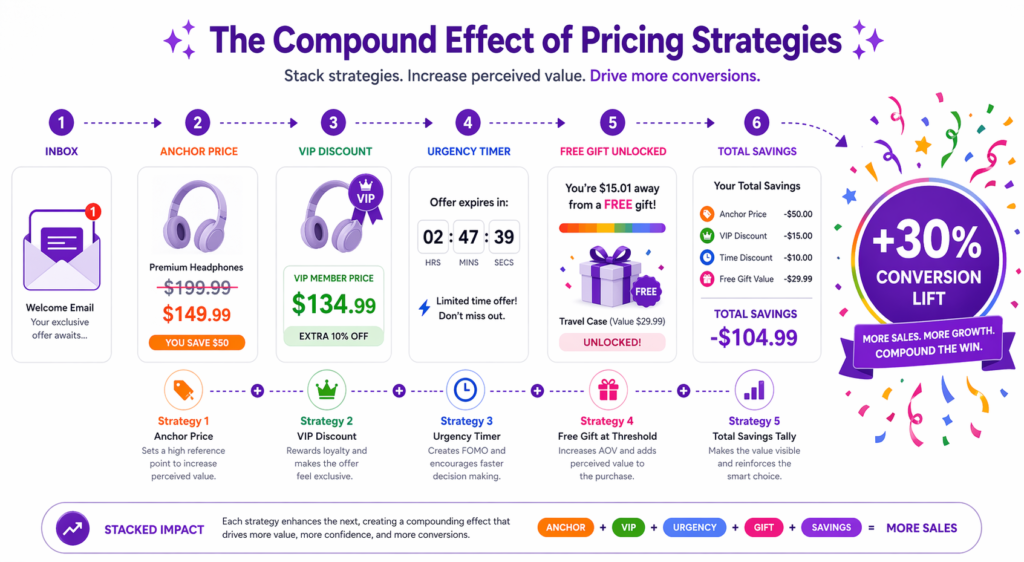
These seven strategies are not mutually exclusive. The real lift comes from running them together as a coordinated system.
A worked example. A customer arriving through a creator’s affiliate URL sees:
- Visible strike-through pricing across all product pages (Strategy 1)
- The 30% influencer discount automatically applied via URL targeting (Strategy 5)
- A real countdown timer showing the campaign window (Strategy 3)
- Consistent discount display through cart and checkout (Strategy 4)
- A free gift unlocked at $100 cart total (Strategy 6)
- Total savings displayed in the cart as the line items accumulate (Strategy 7)
If that customer is also a returning email subscriber tagged as VIP, Strategy 2 layers an additional VIP discount on top, stacking through Shopify’s combinations system.
That is six to seven strategies firing at once on a single customer journey. Each individual lever is modest. Compounded, they meaningfully change the conversion math.
A Note on Realistic Expectations
A note on the conversion-lift numbers that pricing-strategy posts often quote: most “X% lift from Strategy Y” claims are either anecdotal, vendor-marketing-derived, or misapplied averages. The honest summary across these seven strategies is directional rather than precise:
- The biggest single lift typically comes from Strategy 1 (making discounts visible at all). Stores moving from hidden to visible discounts often see double-digit conversion improvement on identical traffic.
- The remaining strategies (2 through 7) each contribute incrementally, with sizes varying by store. Layering them produces compounding gains, but the compounding is multiplicative, not additive, so the gains are smaller per added strategy than the first one.
- The total achievable lift across a well-implemented stack is meaningful (often 15 to 30% conversion improvement on the same traffic), but the realistic range is wide and depends heavily on baseline UX, traffic quality, and discount depth.
Test each strategy against your own baseline before treating any number as a benchmark. The compound is real; the specific magnitude is yours to discover.
The Bottom Line
Random discounting is expensive. Strategic discounting is profitable, and the difference between the two has more to do with how the discount is presented than how deep it goes.
The stores that see the biggest conversion improvements are not necessarily offering the deepest discounts. They are presenting their discounts strategically: making them visible, making them feel earned, making them feel time-bounded, making them tailored to the channel and segment they are reaching.
Test the seven strategies above individually first to learn how each one moves your customers. Then layer them. The gains compound at the intersection.