How to Write Shopify Discount Copy That Converts (With Real Examples)
A Shopify discount copy that converts playbook with four copywriting rules, real examples across product pages, email subject lines, cart messages, and announcement bars, plus A/B test ideas you can run today.
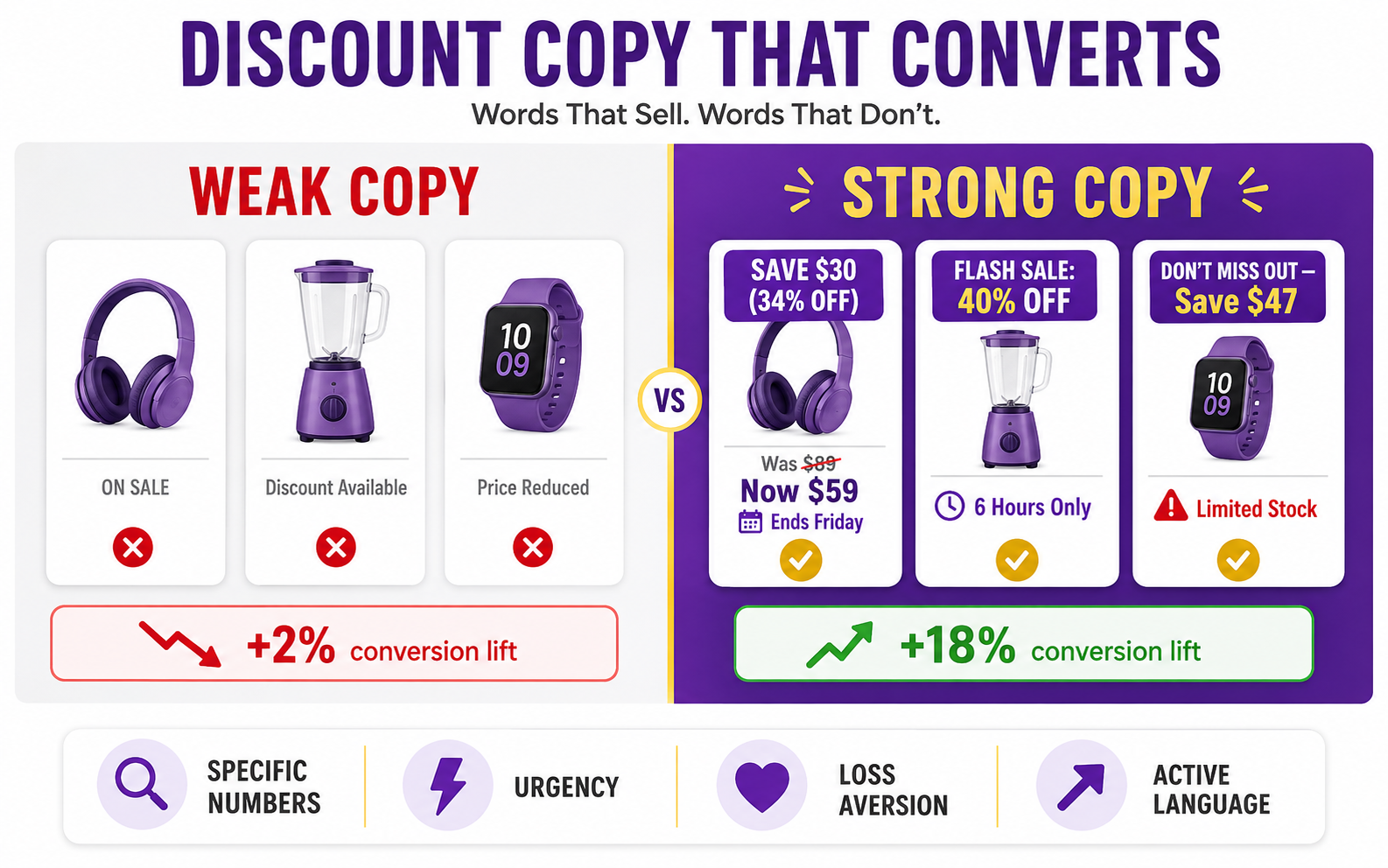
Most Shopify stores run great discounts and ruin them with weak copy. “On Sale” does not sell. “Save $30 (34% off). Ends Friday” does. This Shopify discount copy that converts playbook covers the four copywriting rules behind the difference, real examples across product page badges, email subject lines, cart messages, and announcement bars, plus the A/B tests that prove which version wins in your specific store. By the end, you have a copy framework you can apply to every active promotion you run.
The Principles of Effective Shopify Discount Copy That Converts
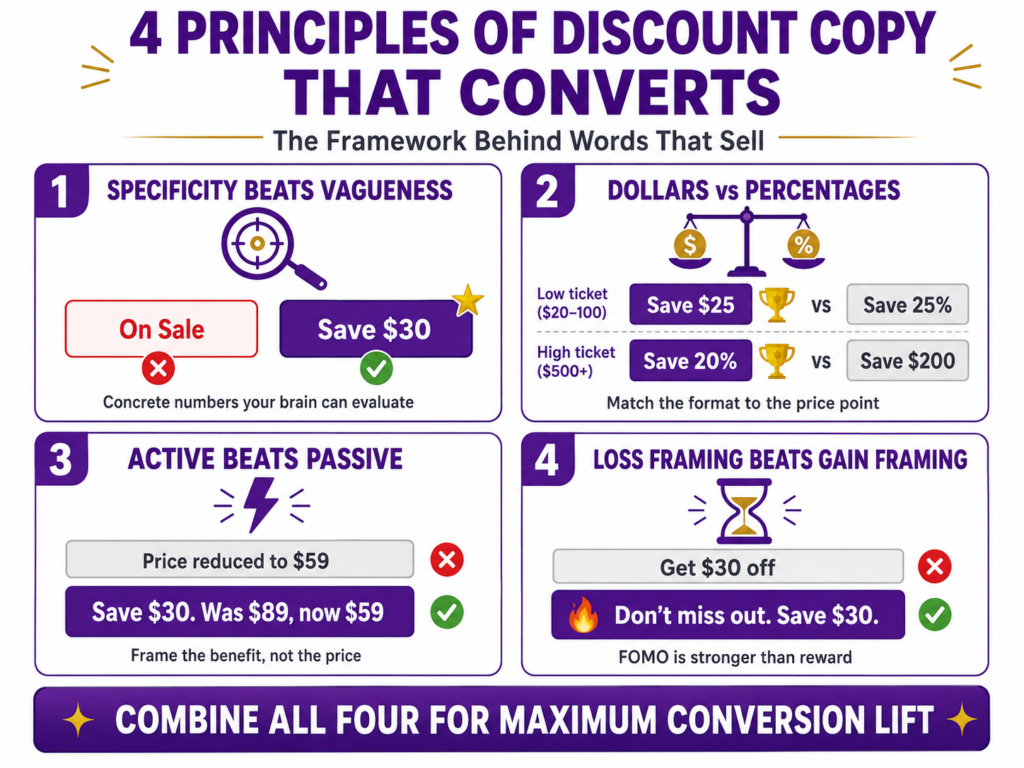
Effective discount copy is not creative writing. It is a small set of repeatable rules. Four principles do most of the work, and most weak discount copy fails by breaking one of them.
Principle 1: Specificity Beats Vagueness
- Vague: “On Sale”
- Specific: “Save $30”
Specificity is proof. “$30” is a concrete number your brain can evaluate. “On sale” is marketing noise that your brain has been trained to ignore after a decade of e-commerce.
Principle 2: Dollar Amounts for Low-Ticket, Percentages for High-Ticket
For low-ticket products ($20-100):
- “Save $25” beats “Save 25%”
- People grasp dollar amounts faster on small items
For high-ticket products ($500+):
- “Save 20%” beats “Save $200”
- Percentages feel fairer on expensive items, while $200 might still feel like the product is overpriced
The underlying psychology is anchoring, the same mechanism behind strike-through pricing that lifts conversion 10-25%. The format you pick controls how the savings register.
Principle 3: Active Language Beats Passive
- Passive: “Price reduced to $59”
- Active: “Save $30. Was $89, now $59”
Active language frames the benefit (you save $30) rather than just stating the new price. Same product, same discount, two different messages. Active wins almost every time.
Principle 4: Loss Framing Beats Gain Framing
- Gain-based: “Get $30 off”
- Loss-based: “Do not miss out. Save $30.”
Loss aversion is more powerful than reward seeking. “Do not miss out” activates FOMO. “Get $30 off” is neutral. The principle is the same one that drives 48% of cart abandonment from unexpected costs: humans react harder to perceived loss than to equivalent gain.
Shopify Discount Copy by Context
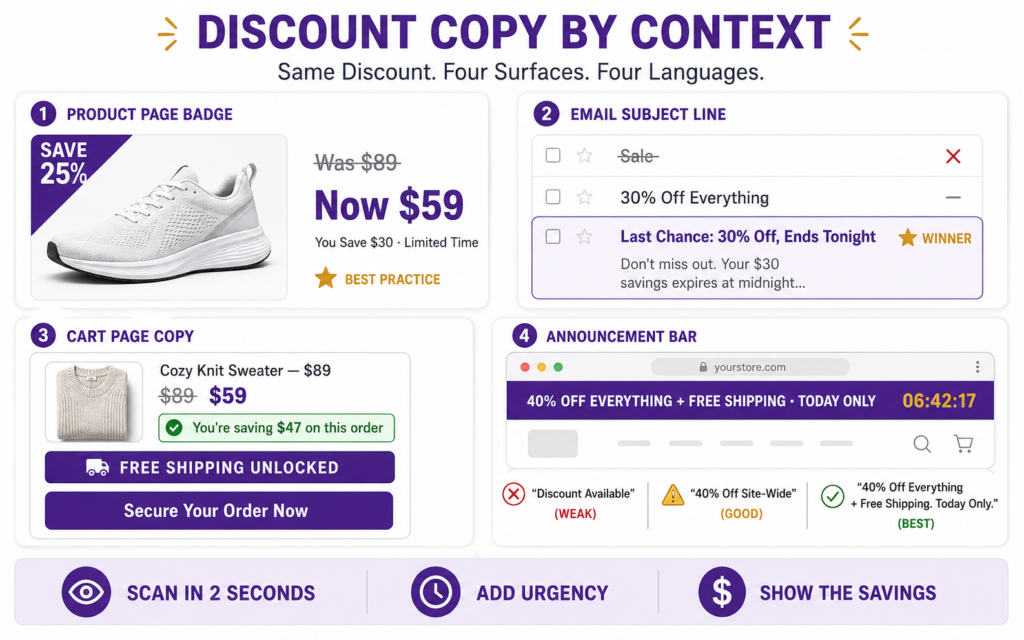
The four rules apply differently depending on where the copy lives. The product page has different constraints than the email subject line, which has different constraints than the announcement bar. Each surface needs its own treatment.
On Product Pages
Badge copy (small, on product image):
- “SAVE 25%” (simple, easy to scan)
- “ENDS FRIDAY” (if time-limited)
- “SALE” (if no space for detail)
Savings callout (below price or near add-to-cart):
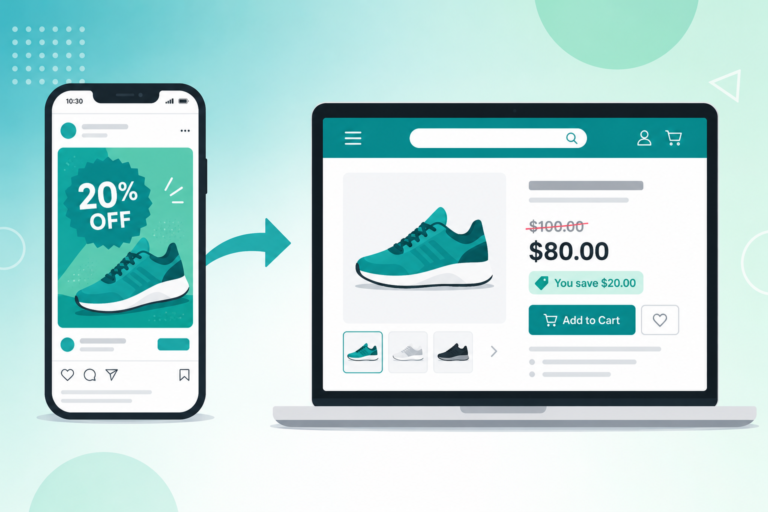
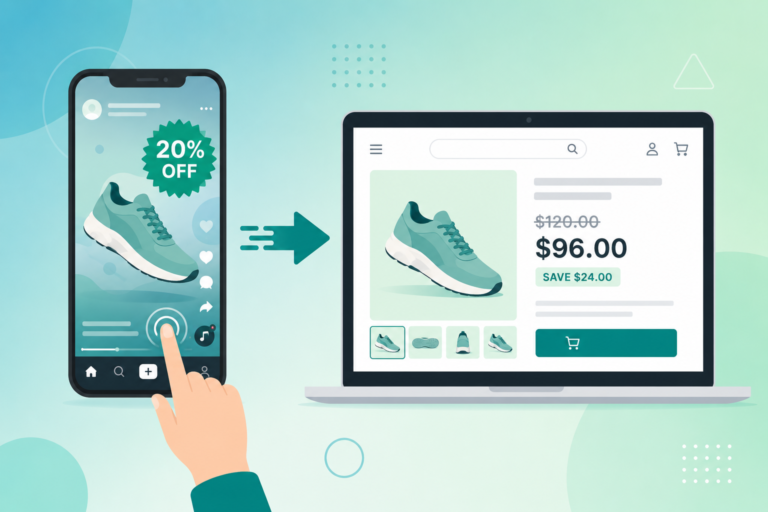
- Good: “Was $89. Now $59. Save $30.”
- Better: “Was $89. Now $59. Save $30 (34% off)”
- Best: “Was $89. Now $59. You Save $30. Limited Time.”
The “best” version layers specificity ($30), percentage (for skeptics who want to verify), and urgency (limited time). Adsgun renders all three lines automatically once you set them in the product page discount display settings.
In the Cart
- “You’re saving $47 on this order” (reinforce the deal)
- “Free shipping!” (if applicable)
- “Secure your order now” (urgency, assurance)
This cart-stage copy targets the exact psychological moment where most shoppers hesitate. The savings reminder reinforces the decision; the urgency closes it.
In Email Subject Lines
High-converting subject lines for discounts:
- Bad: “Sale”
- Good: “30% Off Everything”
- Better: “Save $100 on Your Favorite Styles”
- Best: “Last Chance: 30% Off, Ends Tonight”
The “best” version combines specific discount (30%), specific benefit (your favorite styles), and urgency (ends tonight). For more email-specific patterns, see our Shopify email discount strategy guide.
More examples that consistently outperform generic subject lines:
- “Exclusive: 25% Off for You” (personalizes to the recipient)
- “Your $47 Savings Awaits” (specific dollar amount, sense of ownership)
- “Flash Sale: 40% Off, 6 Hours Only” (urgency, time window)
- “We Messed Up. Here’s 20% Off to Make It Right” (authentic, human)
In Email Body
- Opening: “You’re getting our best discount of the year: 40% off everything.”
- Middle: “We overstocked this season’s collection. Instead of storing it, we’re passing the savings to you.”
- CTA: “Shop the sale. Ends midnight Friday.”
This structure works because it opens with the specific offer (40%), explains why the discount exists (authentic reason, not generic “we love you”), and closes with urgency (ends midnight Friday). Customers respond to honesty about why a discount exists.
In Announcement Bars
Short, scannable copy for the top-of-page banner:
- Bad: “Discount Available”
- Good: “40% Off Site-Wide”
- Better: “40% Off Everything + Free Shipping. Today Only.”
The banner has 2 seconds to grab attention. Specific offer (40%), scope (everything), and urgency (today only). Pair this with Adsgun’s promotion scheduler to auto-rotate the banner copy based on which sale is active.
A/B Testing Discount Copy
You cannot guess which copy converts best for your specific store and audience. The principles point you in the right direction, but only testing tells you the magnitude of the lift.
Test 1: Specificity
- Version A: “SAVE BIG”
- Version B: “SAVE $25”
Hypothesis: Version B (specific) converts higher because the dollar amount triggers concrete evaluation rather than vague pattern-matching.
Test 2: Urgency Level
- Version A: “30% Off”
- Version B: “30% Off. Ends Friday.”
- Version C: “30% Off. Ends Friday at Midnight.”
Run all three against control. Version C usually wins because more specific urgency creates a harder deadline in the shopper’s mind.
Test 3: Frame (Loss vs Gain)
- Version A: “Get 30% Off”
- Version B: “Don’t Miss Out. Save 30%”
Loss-framed (B) usually wins with cold traffic (paid ads, first-time visitors). Gain-framed (A) often wins with warm traffic (email subscribers, repeat customers). Match the frame to the audience temperature.
Track click-through rate, conversion rate, and AOV for each variant. Winning copy scales across the entire store. For a fuller view of the metrics that matter, see our Shopify CRO 2026 playbook.
Adsgun’s Customizable Discount Copy
Adsgun lets you customize the exact language for every discount display across the storefront. Same Shopify discount, different surface copy for different audiences:
- Badge text: “SALE” vs “SAVE 20%” vs “LIMITED TIME”
- Savings message: “Save $30” vs “You Save $30” vs “Limited Time Savings”
- Strike-through label: “Was $99” vs “Regular Price $99”
- Urgency language: off, “Ends Friday,” or “Limited Time”
Test different combinations in Adsgun settings, track which combination drives the highest conversion lift, and lock in the winner. The customization layer is what turns generic discounts into channel-specific copy that actually converts. The full feature set lives in the Adsgun complete guide.
Shopify Discount Copy FAQ
Should I use exclamation marks?
Sparingly. One exclamation mark is fine (“Save $30!”). Multiple convey desperation, which kills perceived brand quality. Salesforce’s email engagement research consistently shows that overuse of exclamation marks correlates with lower open and click rates.
Is all-caps better for badges?
Yes, for badges. “SAVE 30%” scans faster than “Save 30%” on a small product-image badge. Use caps for badges (where scan-speed matters) and title case for longer copy (where readability matters).
What if my discount is modest, like 5% off?
Use dollar amounts instead of percentages. “$5 off” feels better than “5% off” because the absolute number is more concrete. Also consider reframing the same value differently: “Free Shipping” is often equivalent in dollar value to a 5% discount but feels meaningfully better to the customer.
Should I mention the original price or just the sale price?
Always mention the original price. The anchoring effect requires both numbers to work. “Was $89, now $59” outperforms “Now $59” every time, because the savings only register when the brain has both numbers to compare. This is the entire mechanism behind Adsgun’s visible pricing display, and the same logic that explains why hiding discounts behind compare-at-price tends to underperform a properly displayed Shopify discount.