Strike-Through Pricing Psychology: Why Crossed-Out Prices Sell More
Strike-through pricing leans on real behavioral economics: anchoring (Tversky and Kahneman), loss aversion, and Cialdini's scarcity principle. The strike through pricing psychology has been studied for decades, and the modern application on Shopify product pages turns those findings into measurable conversion lift. Here is what the research actually says, where it is overstated, and how to apply it well on your store.
What Strike-Through Pricing Actually Is
The price you see first is not just a number, it is a reference point that shapes how every subsequent price feels. In ecommerce, that reference (whether visible on the page or hidden until checkout) determines whether customers feel they are getting a deal or being misled.
That is the core of strike through pricing psychology, and the behavioral research behind why it works is older, more robust, and more nuanced than most pricing posts make it sound.
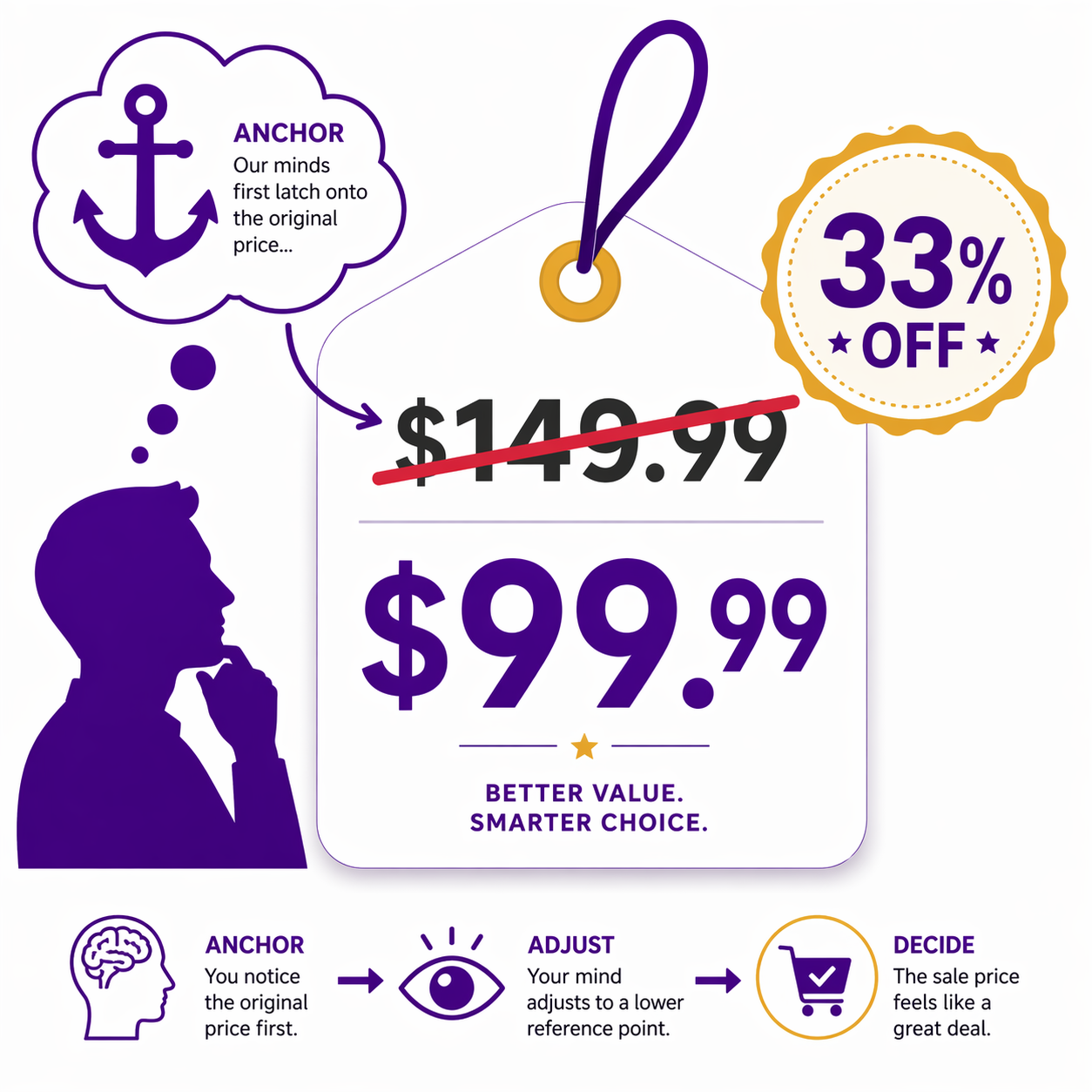
Strike-through pricing is the visual technique of showing the original price crossed out next to the current sale price. `$149.99 $99.99` tells a different story than just `$99.99`, even though the customer pays the same amount in both cases. The strikethrough is doing psychological work: it gives the brain something to compare against.
Where did the technique come from? Long before ecommerce, physical retailers used the same idea on paper price tags. A clerk would mark through the old price by hand and write the new one underneath. The store was saying “this was $100, we reduced it, look at what you are saving.” That visual transparency built trust. It also demonstrated, decades before behavioral economics formalized it, the principle now known as the anchoring effect.
In ecommerce, strike-through pricing does the same psychological work, but at scale, instantly, and without a salesperson in the loop.
The Anchoring Effect: How the Original Price Becomes a Reference
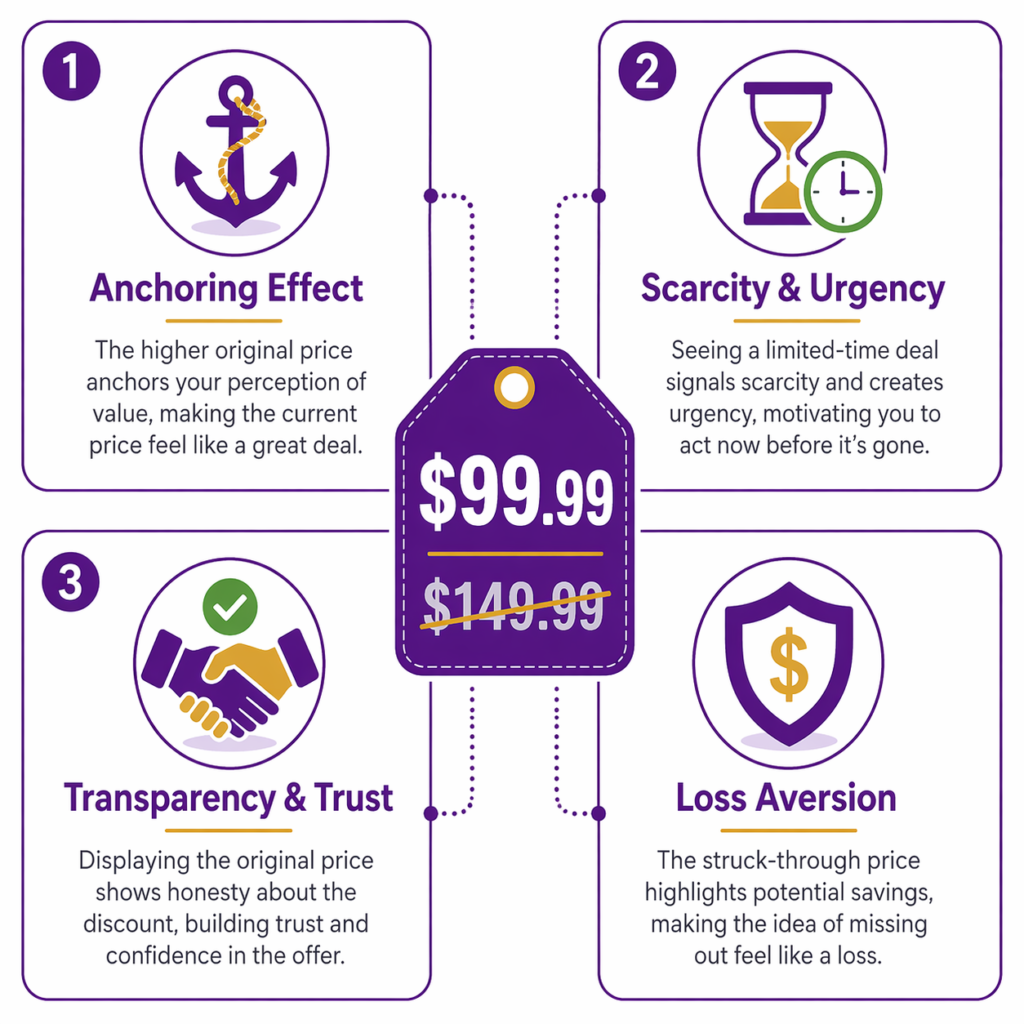
The anchoring effect was first documented in Tversky and Kahneman’s 1974 paper, one of the foundational works in behavioral economics. The classic experiment: participants spun a wheel of fortune that landed on a random number, then estimated the percentage of African countries in the United Nations. People who saw a higher random number consistently gave higher estimates, even though the spin was clearly unrelated to the question.
The mechanism the authors proposed: people latch onto whatever number they see first (the “anchor”), then adjust from there, but the adjustment is usually insufficient. The anchor exerts gravity on the final answer.
Apply this to pricing. A customer who sees `$149.99 $99.99` mentally anchors to $149.99 first, then registers $99.99 as a 33% reduction from that anchor. Their experience of $99.99 is “cheap relative to $149.99.” A different customer who only sees `$99.99` has no anchor at all. They have to evaluate $99.99 in absolute terms, which is a much harder cognitive task and tends to produce more “this seems expensive” reactions in testing.
The honest caveat, because the original research deserves it: anchoring is robust in the lab, but field studies on real purchase decisions show the effect is sometimes smaller than the headline numbers in pop-economics books suggest. Anchors influence judgment, but they do not override product quality, trust signals, or competitive prices. Strike-through pricing leans on a real psychological effect, it does not perform magic on a bad offer.
What it does do well is convert a flat price (a number with no context) into a contextualized price (a number measured against a reference). Customers buy contextualized prices more readily because the comparison is already done for them.
Scarcity, Urgency, and Loss Aversion
Strike-through pricing does more than anchor a number. It also signals that the current price is temporary, which activates a different set of psychological levers.
When a customer sees `$99.99 $149.99` on a product page, they read two messages in parallel:
- “This item is discounted right now” (value message)
- “This price will not last forever” (urgency message)
The second message is where loss aversion comes in. Tversky and Kahneman’s prospect theory established that people feel losses roughly twice as strongly as equivalent gains. The pleasure of saving $50 is real but moderate. The fear of missing the chance to save $50 is sharper. Strike-through pricing makes the second feeling possible because the saving is visible right there on the page, ready to slip away.
Robert Cialdini’s Influence framework identifies scarcity as one of six universal principles of persuasion. When something appears limited (in availability or in time), people value it more highly and act on it faster. Strike-through pricing communicates scarcity implicitly: there is a current sale price and an original price the item will return to. Pair that with a countdown timer or “limited time” language and the urgency layer compounds.
The mechanism is straightforward. Sustained, flat pricing on a product page communicates “this is the normal state of things and will probably stay that way.” Strike-through pricing communicates “this is temporary.” The same product can produce very different decision speeds depending on which signal customers see.
Trust and Transparency
There is a less obvious psychological lever at work that strike-through pricing pulls more than most merchants realize: transparency builds trust, and trust is upstream of conversion.
When a customer sees `$149.99 $99.99 Save $50` on a product page, they are seeing the merchant’s math out in the open. “Here is what we say it is worth. Here is what we are actually charging. Here is what you save.” That visible accounting reads as honest, even if the customer cannot independently verify the original price.
Compare that to a store that displays only the sale price on the product page and reveals the discount at checkout. The customer’s natural reaction: “Why was this hidden? Are they running a deal everyone gets, or is this a trick to make me feel special at checkout?” That kind of low-grade suspicion is corrosive to conversion in ways that are hard to measure but show up in cart abandonment data.
The principle generalizes beyond pricing. People extend more trust (and more loyalty) to businesses that show their work. Pricing transparency is one way of doing that, and strike-through is the simplest visual implementation of pricing transparency on a Shopify product page.
Why Strike-Through Pricing Matters More Online Than In-Store
In a physical store, a salesperson can do urgency and value-demonstration verbally. “This jacket is down from $200 to $120 today, we only have three left.” The urgency is personalized and adapts to the customer.
Online, you have none of that. There is no salesperson reading the customer’s body language. There is no peer pressure from other shoppers in the aisle. The cues that physical retail builds in environmentally have to be built into the page itself.
Strike-through pricing is the closest digital equivalent to the verbal urgency a salesperson creates. It is doing real work in your conversion funnel that nothing else on a flat product page is doing.
There is also the comparison-shopping dynamic. Online customers open multiple tabs, check competitor prices, and consult review sites. The cognitive cost of switching from your store to a competitor is roughly zero, one click. Strike-through pricing creates a real switching cost: the customer has anchored to your reference price, and leaving your tab means leaving that anchor behind. Starting fresh on a competitor’s flat-price product page means re-evaluating in absolute terms, which most shoppers will not do for a five-dollar saving.
That asymmetry is one of the reasons stores running visible discount display tend to retain comparison shoppers better than stores that hide their discounts until checkout.
The Strike Through Pricing Psychology in Practice on Shopify
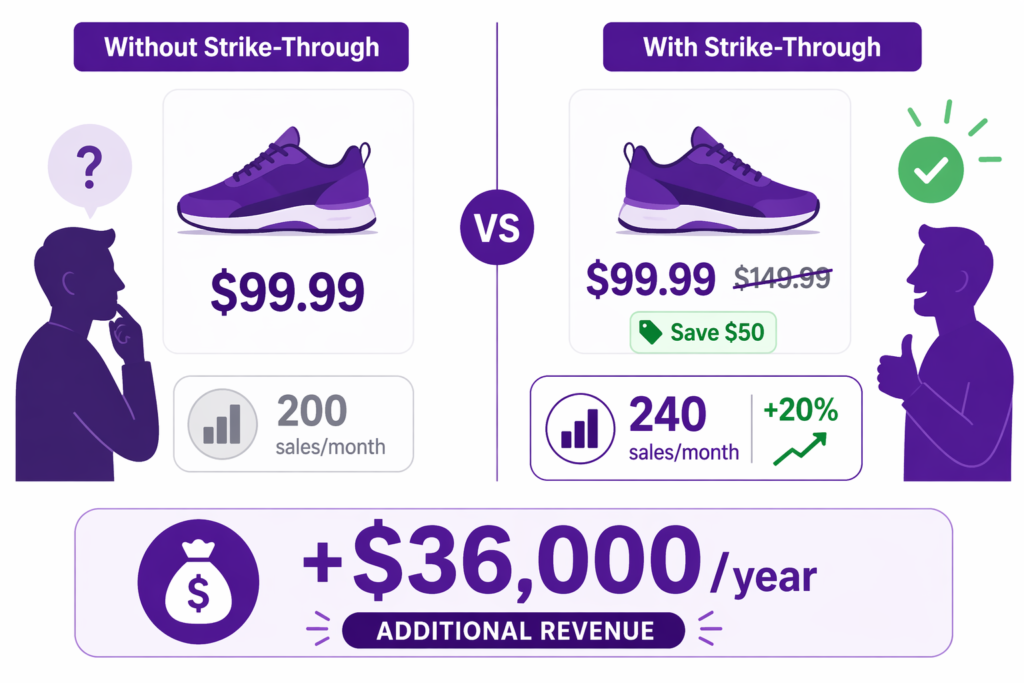
The research is clear that visible discount display moves conversion. The size of the lift depends on the store, the discount, the traffic mix, and the rest of the product page UX, but the directional effect is consistent across most Shopify stores that switch from hidden to visible discounts.
A real Adsgun customer, Tire Streets, provides a concrete data point. Before installing Adsgun, they had automatic Shopify discounts active but their product pages did not display them. After enabling visible strike-through pricing across product pages, collections, and cart, conversion lifted from 2.78% to 3.17% (a +14% relative lift) over a 30-day measurement window on identical traffic. Order volume rose from 512 to 603 (+17.8%), and revenue grew by $37,800 in the same window.
That is one customer in one category (automotive). The pattern (visible strike-through pricing producing meaningful conversion lift on otherwise unchanged traffic) shows up consistently in stores that go through the same transition. Magnitude varies. The aggregate range across stores using visible discount display tends to land somewhere between 10 and 25% conversion improvement, with outliers in either direction depending on baseline UX quality and discount size.
The math at typical store scale: a store doing 10,000 monthly visitors and 2.0% baseline conversion (200 monthly orders) lifting 15-20% from visible pricing produces an extra 30-40 monthly orders. At a $75 average order value, that is $2,250 to $3,000 of additional monthly revenue, $27,000 to $36,000 annualized, from the same traffic.
The reason that math works is the strike through pricing psychology described above, anchoring plus scarcity plus transparency plus loss aversion, all activated simultaneously by a visual treatment that takes a single line of CSS to render.
How to Implement Strike-Through Pricing Correctly on Shopify
This is where most Shopify merchants go wrong. They use Shopify’s built-in Compare-at price field to fake a sale: bump the Compare-at price up, leave the Price as the “discounted” amount, and let the theme render strikethrough on the product page.
This works at first, but it has three problems:
- It distorts your analytics. Shopify treats your Price field as the actual price. The “discount” never gets recorded as discount spend in [Sales by discount reports](https://adsgun.com/shopify-gross-revenue-wrong-compare-at-price/), so your gross revenue under-reports and your discount tracking disappears.
- It is fragile to revert. Every product you discount this way needs its Price and Compare-at price manually restored when the sale ends. For a few products this is fine. For 1,500 SKUs, it is a multi-hour cleanup project, and missing one means that variant stays on sale indefinitely.
- It loses the trust value when customers can verify history. Web archives, price-tracking browser extensions, and cached search results can show shoppers what your “original price” actually was last week. If the Compare-at price was inflated for the sale, sophisticated shoppers spot the gap and the trust effect inverts.
The correct implementation uses real Shopify discounts and a separate visibility layer to render the strike-through:
1. Create a real discount in Shopify (a discount code or automatic discount, not a Compare-at price modification)
2. Use a display app like Adsgun to render that discount as visible strike-through pricing on product pages, collection pages, cart, and checkout
3. Keep the underlying Price field at the product’s actual normal price
This approach preserves clean analytics (gross revenue and discount spend are tracked correctly), reverts cleanly (disable the discount, the strikethrough disappears everywhere), and stays consistent with whatever the customer sees in their order history later.
The visual the customer experiences is the same in both implementations. The difference is what happens behind the scenes and what your reporting looks like a quarter later.
Strike-Through Pricing Best Practices
Once the underlying discount is real, the strike-through display itself benefits from a few execution details:
- Show the original price prominently, not as an afterthought in small grey text. The whole point is anchoring; a faintly visible strike-through anchors weakly.
- Display savings in both dollars and percentage when the absolute amount is meaningful (`Save $50 — 33% off`). Percentages are easier to compare across products; dollar amounts feel more concrete.
- Maintain consistency across the funnel. If the strikethrough is visible on the product page but disappears in the cart, customers second-guess whether they actually got the deal. Visibility throughout the funnel matters, not just at the entry point.
- Pair with an end date or “limited time” copy when honest. Scarcity language amplifies the urgency layer of the psychology, but only when the deal genuinely is time-limited. If “limited time” runs every week of the year, customers learn to ignore it.
- Avoid fake-anchor abuse. Compare-at prices that were never actual selling prices are a short-term win and a long-term trust loss. Use original prices that reflect what the product really sells for outside of promotional periods.
The Bottom Line
Strike through pricing psychology is not a marketing trick, it is the application of well-documented behavioral economics (anchoring, loss aversion, scarcity, transparency) to a visual element that takes seconds to add to a product page. The research backing each individual mechanism is decades old and has been replicated in lab and field settings.
What the research is honest about is that the effect size depends on context. Strike-through pricing applied to a real, meaningful discount on a well-designed product page produces measurable conversion lift. Strike-through pricing applied to a fake compare-at-price markup or a poorly-designed page produces less, and sometimes erodes trust over time.
Implemented well, on real discounts, with consistent display through the funnel, strike-through pricing is one of the highest-leverage low-effort optimizations available to a Shopify store. The psychology is sound. The execution is what determines whether it shows up in your conversion data.