How to Increase Shopify Conversion Rate Without Spending More on Traffic
Most merchants try to increase shopify conversion rate by buying more traffic. The math rarely works because acquisition costs scale with volume while conversion stays flat. The cheaper play is fixing the visibility gap on existing traffic, where most stores are leaving money on the table without realizing it. Here is what that gap looks like, what it costs your store, and the highest-leverage way to close it.
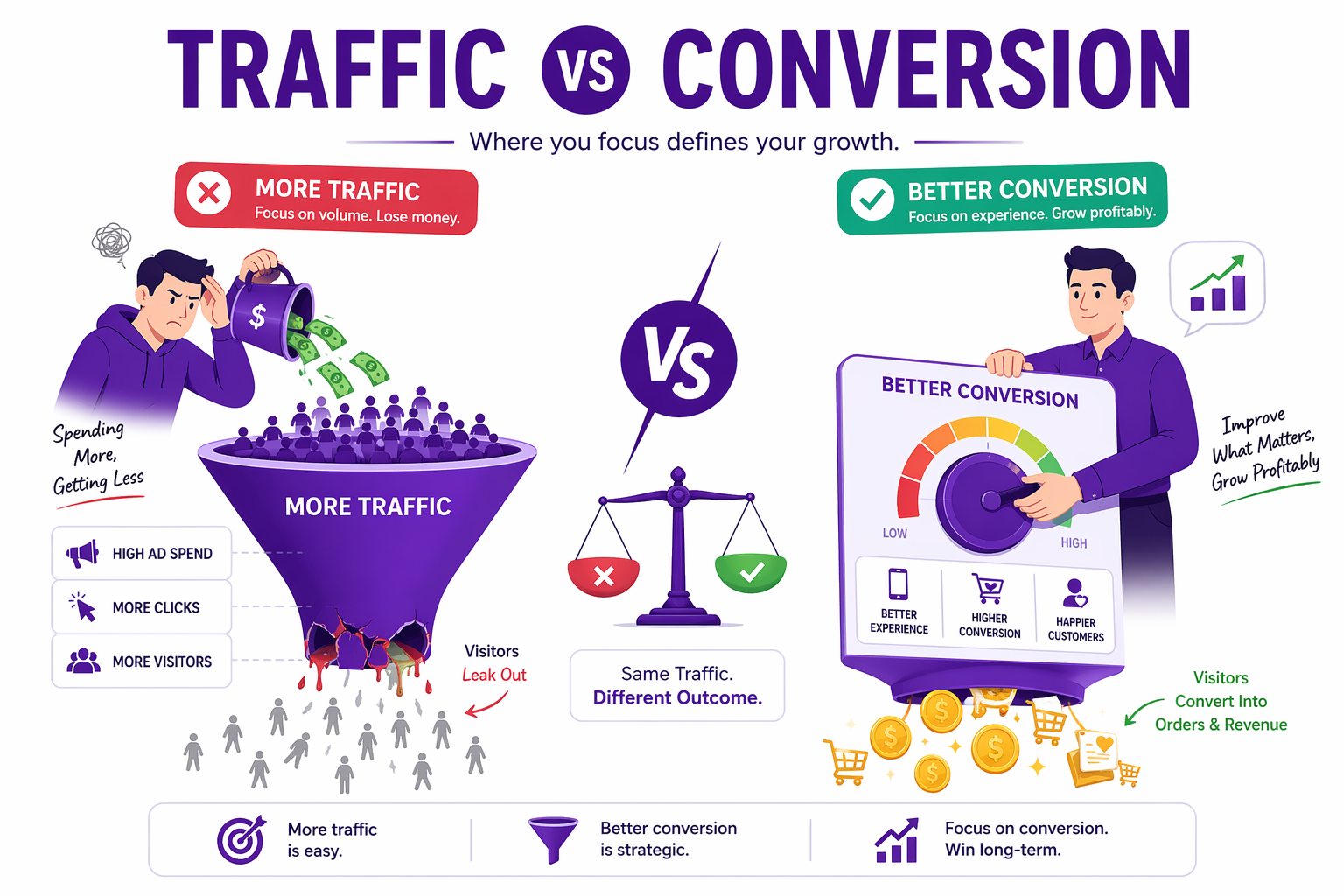
Most ecommerce merchants stuck on a stagnant conversion rate reach for the same fix: buy more traffic. The logic is intuitive but backwards. If your traffic grows while your conversion rate stays flat, the problem is not how much traffic you have. The problem is that the traffic you already have is not converting efficiently. Buying more traffic before fixing the conversion problem just acquires more customers who leave at the same rate. That is expensive and demoralizing. The real opportunity is to increase shopify conversion rate with the visitors already arriving at your store. That is Conversion Rate Optimization (CRO), and one of the highest-leverage, cheapest CRO levers most stores ignore is fixing the discount visibility gap.
The Traffic Trap
Here is the math that explains why “buy more ads” rarely produces the result merchants expect.
Starting point. A typical mid-market Shopify store:
- 10,000 monthly visitors
- 2.0% conversion rate
- 200 orders per month
- $75 average order value
- $15,000 monthly revenue
Approach 1: buy more traffic. Increase ad spend to push monthly traffic to 11,000 visitors (a 10% lift). Conversion rate stays at 2.0%.
- 11,000 visitors × 2.0% = 220 orders
- 220 × $75 = $16,500 monthly revenue
- $1,500 in additional monthly revenue
The cost of those extra 1,000 visitors at typical paid CPC for a mid-market store ($2-4 per acquisition) lands in the $2,000-$4,000 range, which means the gross revenue lift either breaks even or runs at a loss before any other costs are factored in.
Approach 2: increase conversion rate on existing traffic. Same 10,000 visitors, but conversion lifts from 2.0% to 2.28%, a 14% relative improvement (the same lift Tire Streets achieved by switching from hidden to visible discount display).
- 10,000 visitors × 2.28% = 228 orders
- 228 × $75 = $17,100 monthly revenue
- $2,100 additional monthly revenue, $25,200 annualized
- $0 additional ad spend
Same starting traffic, larger revenue gain, no additional acquisition cost. The gain compounds month over month while the traffic-acquisition gain has to be paid for every single month.
This is why CRO produces a higher long-run ROI than acquisition for most stores. Acquisition costs scale linearly with traffic. Conversion-rate gains compound.
Why Shopify Stores Underconvert
Before fixing conversion, it helps to understand why it gets stuck. The four most common contributors:
- Unclear value proposition. Customers land on a product page and cannot quickly tell what differentiates this store from a dozen alternatives. Customers compare prices, features, and trust signals across multiple tabs; if your differentiator is not visible at a glance, you lose.
- Slow page load. Akamai research, popularized through Kissmetrics’ analysis, found that a one-second delay in page load can cause a roughly 7% reduction in conversions. Modern Core Web Vitals reinforce the same finding: slower stores convert worse, full stop.
- Poor mobile experience. Mobile traffic dominates most ecommerce categories now, but many stores still treat mobile as a secondary experience. Friction in mobile navigation, slow mobile checkout, or cramped product pages on small screens all eat conversion.
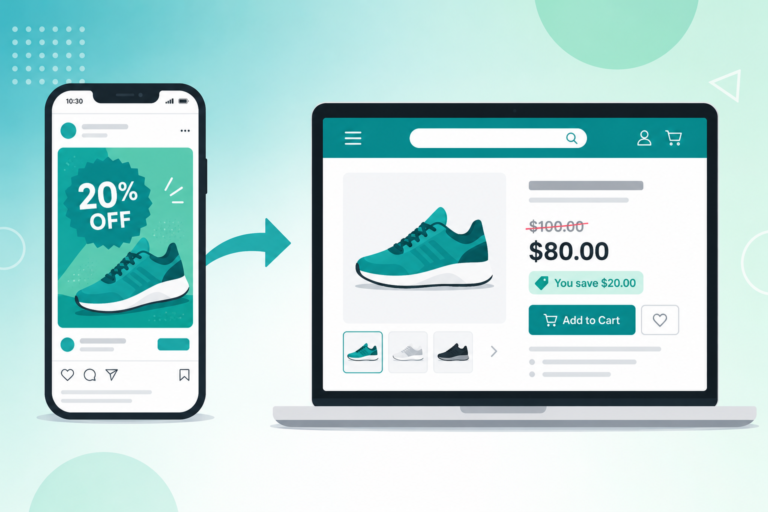
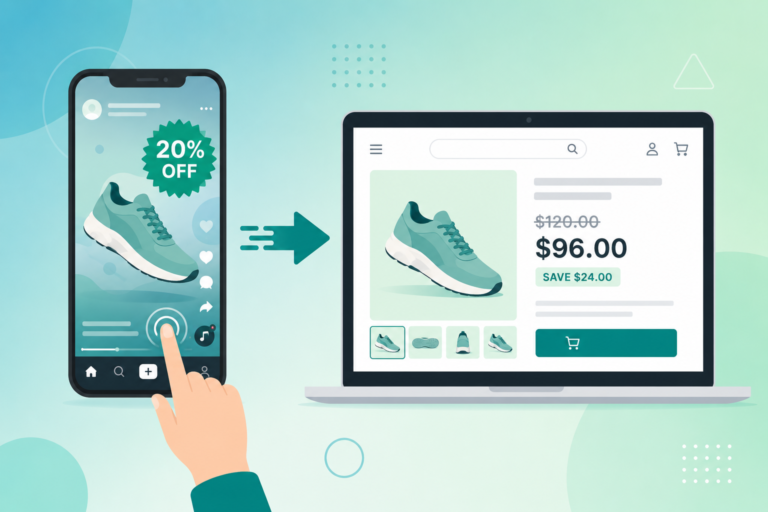
- Hidden discount display. Discounts exist on the store, but customers do not see them until checkout. Decision uncertainty rises, urgency does not get triggered, and customers who would have converted in a visible-discount setup leave instead.
The first three are structural problems that take time and resources to fix. The fourth is a setup problem you can solve with a single tool installation.
The Hidden Discount Problem: Where Most Stores Lose Conversions
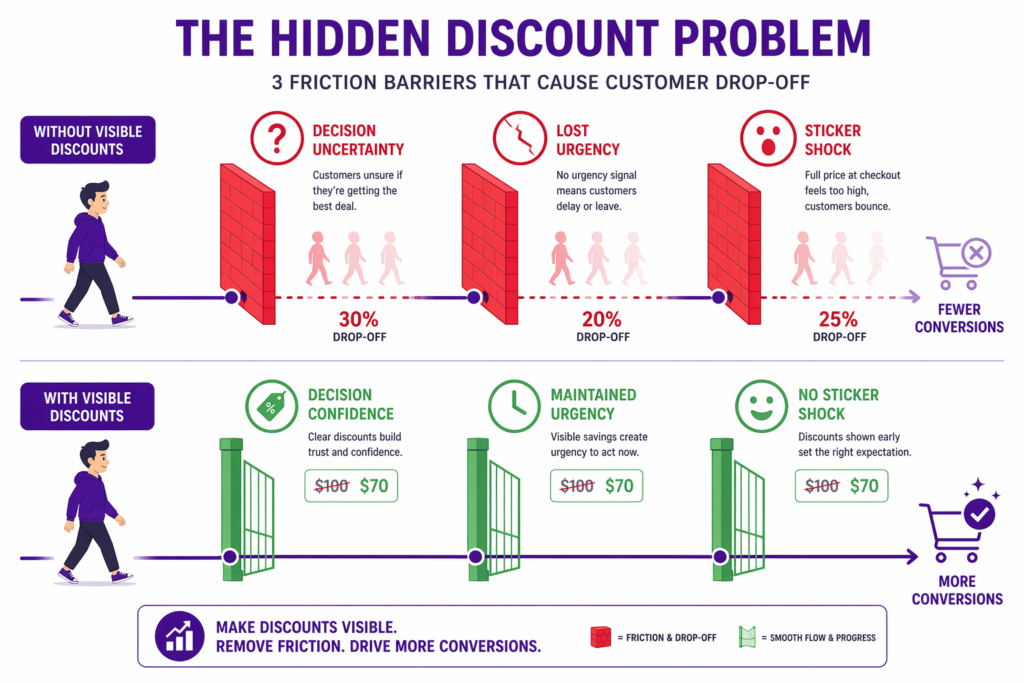
If your store is running discounts (and most are), and customers see those discounts only at checkout, you are creating friction at three specific places in the funnel.
- Friction point 1: Decision uncertainty. Product page shows $99.99 with no indication of any discount. The customer’s internal monologue is “Is this the sale price? Is it a good deal? What was it before?” Without an anchor to compare against, the decision is harder than it needs to be. Ambiguity correlates strongly with bounce.
- Friction point 2: Lost urgency. Discounts work partly because they create scarcity (a sense the price is temporary). That signal only fires when customers see the discount. If urgency does not surface until checkout, by then most browsers have already drifted toward “I will think about it” and most of them will not come back.
- Friction point 3: Sticker-shock recovery. For customers who do reach checkout, the discount finally appears. Some respond well; the deal feels like a pleasant surprise. Others react with suspicion: “Why was this hidden? Is this a manipulation tactic?” That suspicion is a trust break at the worst possible moment.
The fix is straightforward: make the discount visible at the product page, where the buying decision actually happens. Shopify’s own documentation confirms native Shopify cannot do this on its own; a third-party app is required to display strikethrough pricing on product pages and collection pages.
What 1% Conversion Improvement Is Actually Worth
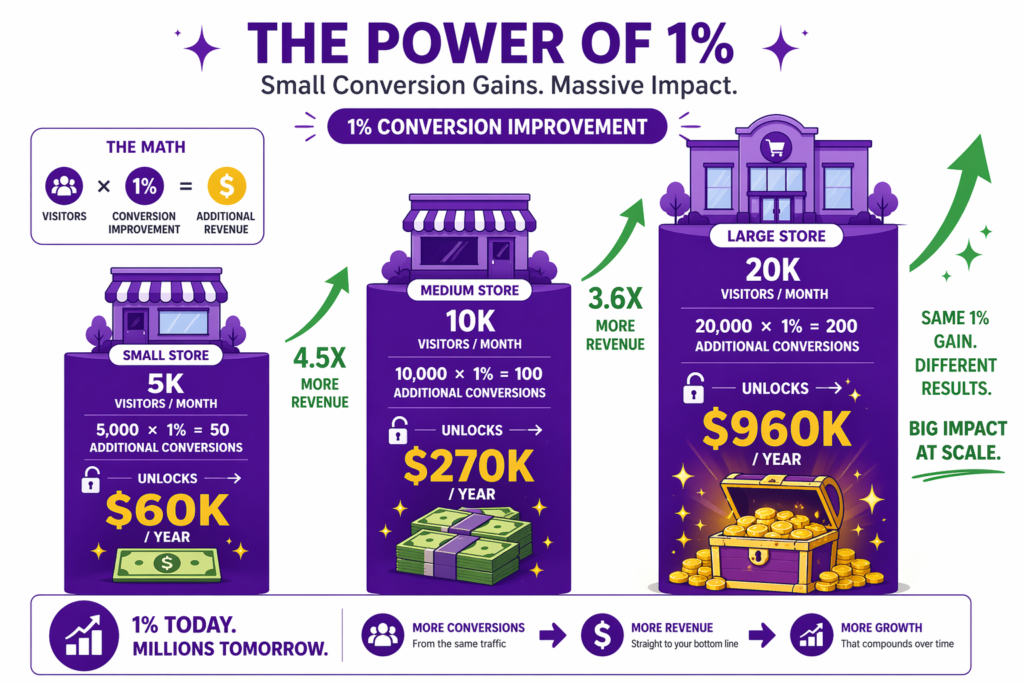
The compounding effect of small CRO gains is not always intuitive. Concrete math at three store sizes:
Small store: 5,000 monthly visitors × 1% additional conversion = 50 additional orders/month. At $100 average order value, that is $5,000 monthly, $60,000 annualized from the same traffic.
Medium store: 10,000 monthly visitors × 1% = 100 additional orders/month. At $225 AOV (typical for stores that have grown into mid-market product mixes), that is $22,500 monthly, $270,000 annualized.
Larger store: 20,000 monthly visitors × 1% = 200 additional orders/month. At $400 AOV (common for established stores with premium or B2B-leaning product mixes), that is $80,000 monthly, $960,000 annualized.
The same 1% improvement produces dramatically different absolute dollar impact depending on scale. The rate-of-improvement is multiplied by your existing traffic and AOV. That is what makes CRO an asymmetric lever as your store grows: every percentage point of conversion improvement is worth more next year than it was last year.
Tire Streets got a 14% relative improvement, not 1%, in their year-over-year BFCM comparison. On their numbers (19,000 sessions, ~$446 AOV), that lift translated to $37,800 in additional revenue from a single BFCM window. Different store, different scale, but the principle is the same: existing traffic is the cheapest leverage you have.
Why Visible Discounts Move the Needle
The Tire Streets story is the cleanest single proof point because the only variable they changed was visibility. Same traffic, same 40% discount, same campaign budget. The product page either showed the discount on arrival or did not. The version that showed it converted 14% better.
That improvement came from removing the three friction points described above:
- Decision uncertainty disappears when the strikethrough price is visible (`
$333$199 Save $133`) - Urgency surfaces at the moment the customer is making the buying decision, not three pages later
- There is no sticker-shock recovery at checkout because the price the customer sees never changes
No page-speed work, no mobile-UX overhaul, no new value proposition. Just discount display moved from checkout to product page.
That single change moved conversion 14% on identical traffic.
How to Implement Visible Discounts the Right Way
Step 1: Audit what your customers actually see. Open a private browser session and visit a product page during your active promotion. Three possibilities:
- Full price only, no indication of any discount (the hidden-discount problem)
- A “compare at price” set without an actual discount running (confusing, also distorts gross revenue analytics)
- Strikethrough original price next to the sale price, displayed prominently (the correct setup)
Most stores fall into one of the first two buckets.
Step 2: Use real Shopify discounts, not Compare-at-price modifications. Compare-at-price-only setups distort your reporting, are painful to revert, and lose trust value when customers can verify pricing history. Real discount codes or automatic discounts preserve clean analytics and revert with one click.
Step 3: Add a visibility layer that displays consistently. The discount needs to render on:
- Product pages (where the buying decision happens)
- Collection pages (where browsing happens)
- Cart (where the customer commits)
- Checkout (where consistency confirms the deal is real)
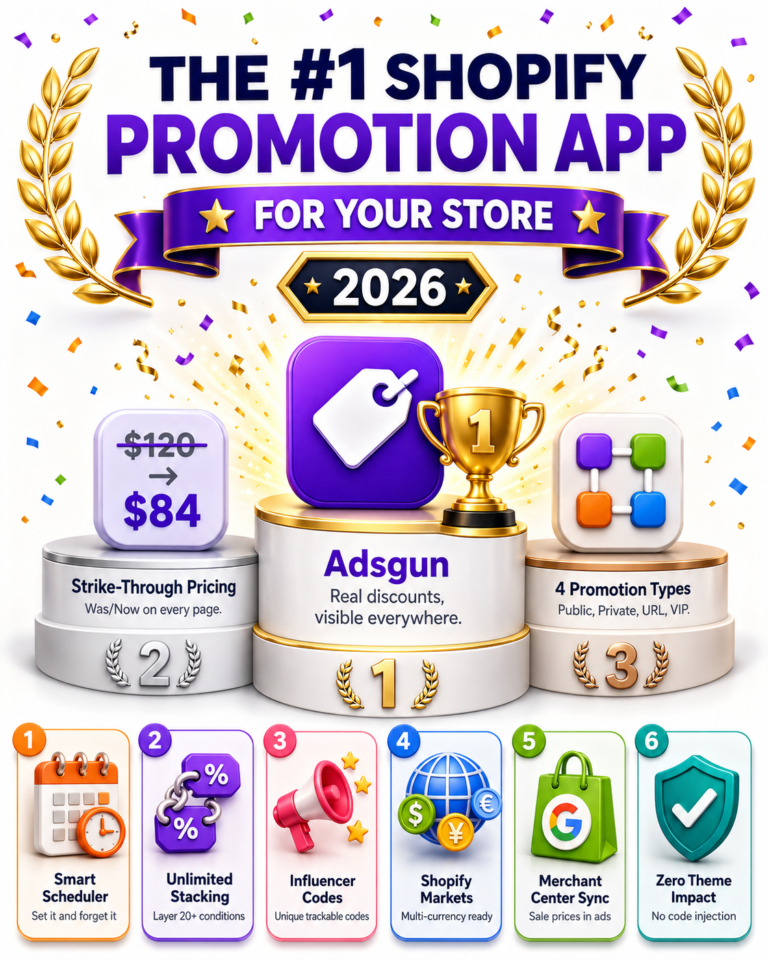
Adsgun reads your existing Shopify discounts and renders them as strikethrough pricing across all four surfaces automatically. No theme edits, no manual updates, no per-product configuration.
Step 4: Measure baseline before launch. Record current conversion rate, AOV, and cart abandonment rate over a representative two- to four-week window before flipping on visible pricing. After two to four weeks of data with visibility on, compare against the baseline. The delta is your store-specific CRO win.
Step 5: Layer additional pricing strategies once visibility is solid. Once visible discounts are working, the layered playbook adds compounding gains:
- Customer-segment discount tiers (VIP customers see deeper discounts)
- Real-deadline urgency (visible countdown for time-limited campaigns)
- Channel-specific discount targeting (different depths for email vs paid traffic)
- Free gift thresholds (lifts AOV alongside conversion)
Visibility is the foundation. The other strategies amplify it; they do not replace it.
Other CRO Levers Worth Pursuing After Visibility
Visible discounts are the highest-leverage, lowest-effort CRO fix available to most Shopify stores, but they are not the only fix. Once visible pricing is in place and the baseline lift is measured, the next priorities, in rough order of effort-to-impact ratio:
- Page speed. Optimize images, reduce JavaScript, leverage CDN caching. The roughly 7% conversion impact per second of delay compounds with every other optimization.
- Mobile UX. Test on actual devices, not just browser emulation. Streamline product page navigation, simplify mobile checkout, ensure touch targets are appropriately sized.
- Social proof. Customer reviews, user-generated content, trust badges, ratings. Trust signals reduce decision uncertainty and pair well with visible pricing.
- Value proposition clarity. Make it obvious within five seconds why a customer should buy from your store rather than a competitor. Shipping speed, warranty, customer service quality, product selection, exclusive availability.
- Checkout optimization. Reduce form fields, add trust badges at checkout, surface return policy and shipping cost early. 70% of carts are abandoned and most of that abandonment is preventable.
These are sustained-effort projects. Visible discounts are the install-and-measure project. Start there, then layer the rest as bandwidth allows.
The Bottom Line
Most merchants are running a losing version of the same playbook: acquire more traffic at higher costs, convert it at the same rate, and wonder why the numbers do not improve.
The winning version is the inverse: acquire traffic efficiently, then convert it at the highest possible rate. Visible discounts are one of the simplest ways to start playing the second game. Install a tool. Show the deal. Measure the lift.
No additional ad spend, no structural overhaul, no new traffic sources. Just visibility in front of the visitors already arriving at your store.
The highest-leverage way to increase shopify conversion rate is fixing what your existing traffic cannot see.