How Shopify Discounts Affect Your Profit Margins (With Numbers)
How Shopify discount profit margin really works, with real Tire Streets case study data and the four dangerous discount patterns to avoid.
Every Shopify merchant runs discounts. Few actually understand how they hit the bottom line. This guide walks through the Shopify discount profit margin math step by step, with real case study numbers, the four dangerous discount patterns that quietly destroy margin, and a clean framework for deciding when a discount is worth running.
The Margin Math That Matters
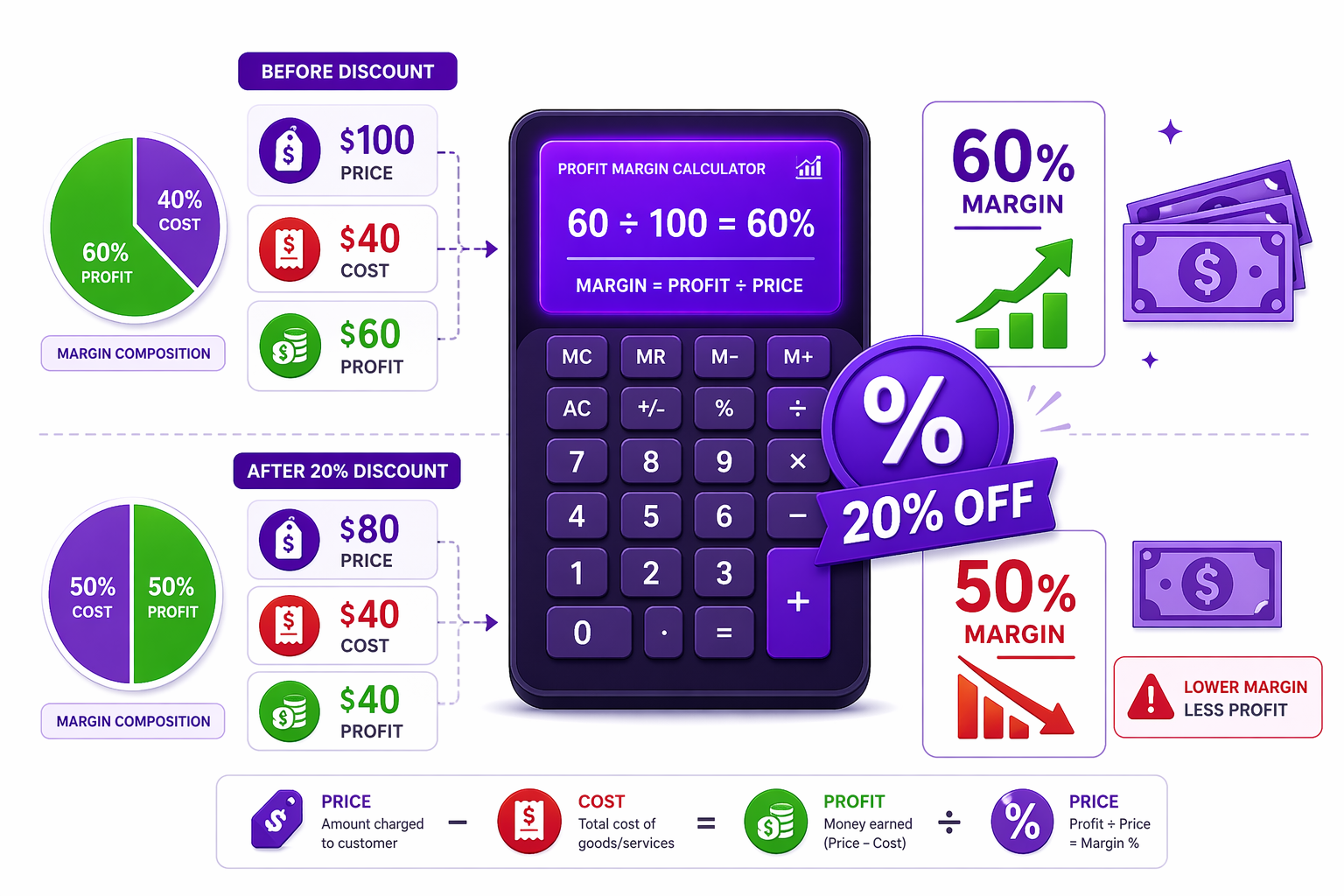
Here’s what confuses most merchants about Shopify discount profit margin: when you offer a 20% discount, your profit margin doesn’t drop by 20%.
Let’s do the math.
You sell a product for $100. Your cost is $40, profit is $60 and your margin is 60%.
You offer a 20% discount. New price: $80.
New profit: $80 – $40 = $40.
The new margin is 50% ($40 profit divided by $80 selling price). You dropped from 60% to 50% margin. That’s a 10 percentage point drop, not a 20 percentage point drop.
Here’s the formula:
New Margin = ((Selling Price – Cost) – Discount) / (Selling Price – Discount)
Or more simply:
- Original: ($100 – $40) / $100 = 60% margin, $60 profit per unit
- With 20% off: ($80 – $40) / $80 = 50% margin, $40 profit per unit
You lose $20 profit per unit sold at the discounted price. But if the discount drives a 25% increase in units sold, you break even on total profit and win on revenue. For a deeper look at the psychology that drives those incremental conversions, see our breakdown of strike-through pricing psychology.
Tire Streets: A Real Shopify Discount Profit Margin Example
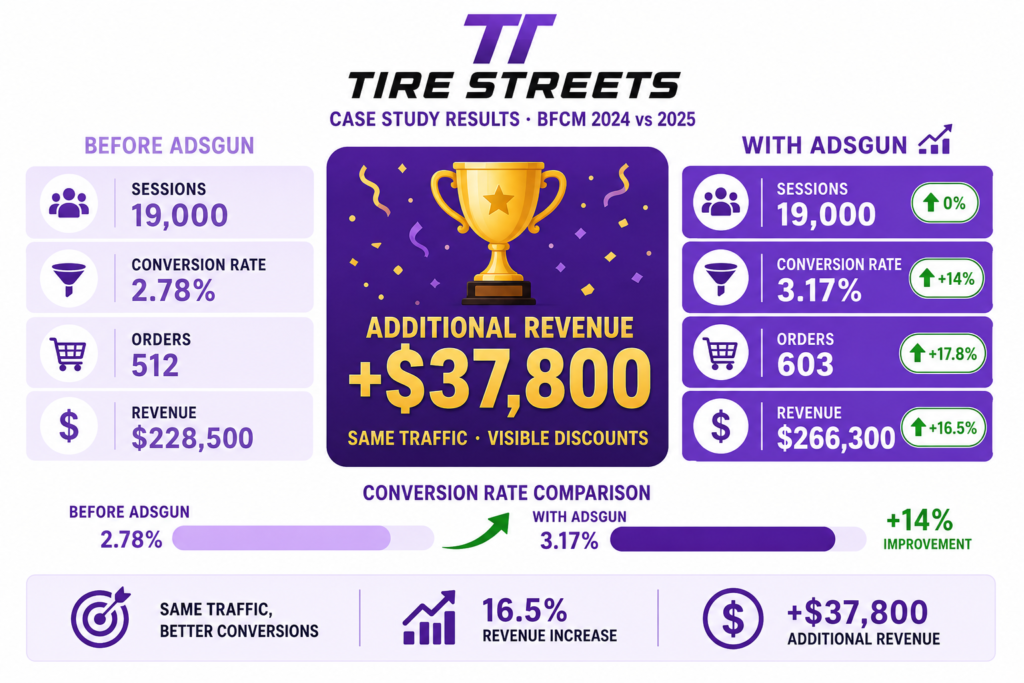
Let’s use real data. Tire Streets, a Shopify automotive retailer running Adsgun, lived this exact dynamic during their Black Friday Cyber Monday campaigns.
BFCM 2024, before Adsgun (discounts hidden, visible only at checkout):
- 19,000 sessions
- 2.78% conversion rate
- 512 orders
- Average order value approximately $446
- Total revenue: $228,500
BFCM 2025, with Adsgun (discounts visible everywhere):
- 19,000 sessions (identical traffic)
- 3.17% conversion rate (+14% improvement)
- 603 orders (+17.8% increase)
- Average order value approximately $442 (essentially flat)
- Total revenue: $266,300
Margin impact. Assume a 65% blended gross margin (typical for apparel, beauty, and many DTC categories). Before Adsgun, gross profit was $228,500 × 65% = $148,525. With Adsgun, gross profit was $266,300 × 65% = $173,095. The difference: +$24,570 in additional gross profit on identical traffic and the exact same 40% discount.
For categories closer to 35% gross margin like automotive accessories, the same revenue lift produces roughly $13,230 in incremental gross profit. The principle holds at every margin level: the 91 additional orders carry the same per-unit margin as the original 512, and they did not require any new ad spend or deeper discounts to capture.
You can read the full Tire Streets BFCM case study for the campaign-level breakdown.
This is the core mechanism. Discounts do not reduce total profit when they drive enough incremental conversions to outweigh the per-unit margin loss. Visibility is what unlocks those incremental conversions.
Dangerous Discounts: When They Really Do Hurt
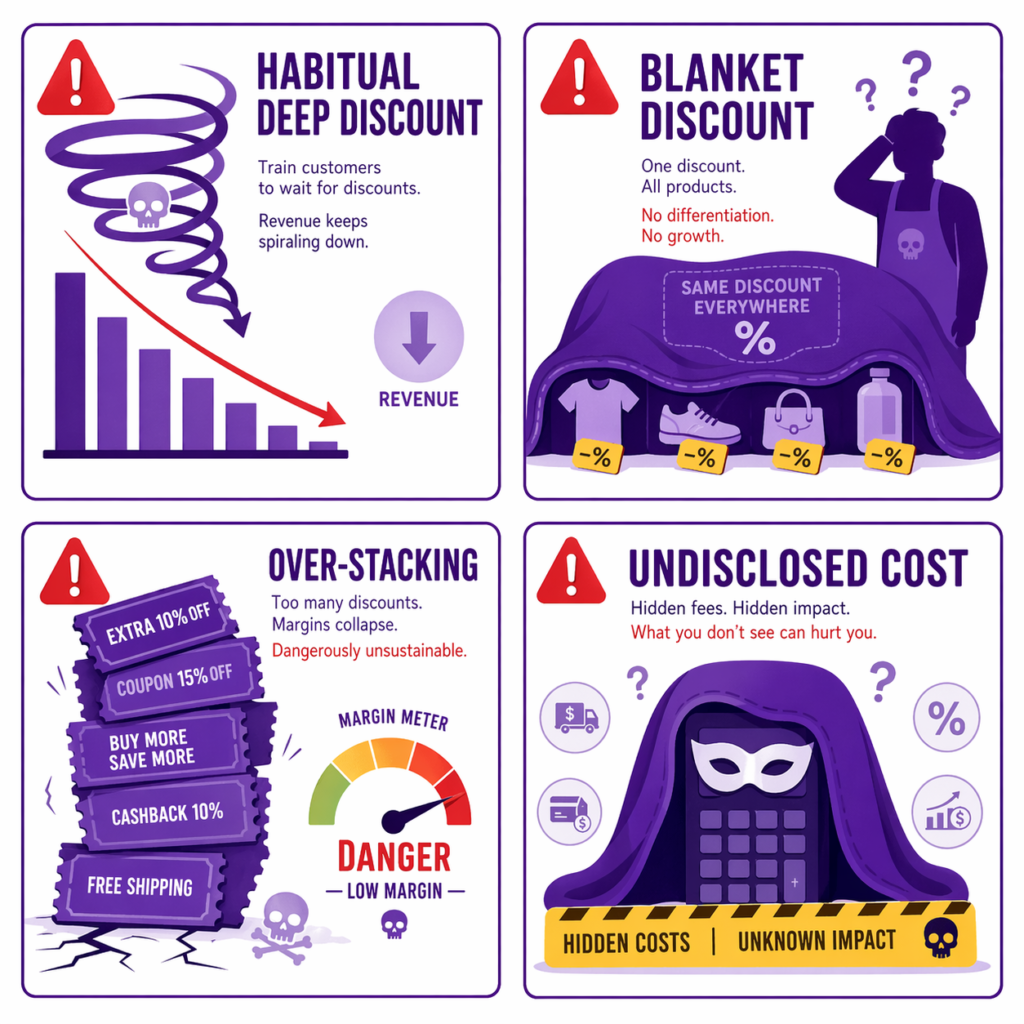
Not all discounts are equal. Some create incremental sales; others cannibalize full-price sales.
The Habitual Deep Discount
You run a 30% off sale in January. Traffic goes up 40%. You think: “This works.” You run another sale in February. And March. By summer, customers no longer buy at full price. They have been trained to wait for sales.
This is the race-to-the-bottom spiral. You have moved from strategic discounting (margin protection) to chronic discounting (margin destruction). Your baseline conversion rate drops because you have trained customers that full price is not real.
The Blanket Discount
You discount everything equally. All products get 20% off. This is inefficient because:
- Some products have thin margins and you cannot afford 20% off
- Some products are already moving well and the discount is wasted
- Customers with price sensitivity get the same discount as customers willing to pay full price
The Over-Stacking Promotion
Multiple automatic discounts stack too deep. A customer qualifies for “15% off orders over $100” AND “Free shipping” AND a discount code AND a loyalty discount. Combined, they are paying 30 to 40% less. That is unintentional, not margin-protecting.
The Undisclosed Cost
If you offer a discount but don’t track the ROI correctly, you can’t separate incremental revenue (revenue you wouldn’t have had without the discount) from cannibalized revenue (revenue you would have had at full price). You assume all discounted orders are incremental, which overstates the discount ROI and encourages more discounting.
Smart Discount Strategy: Targeted, Visible, Channel-Specific
The opposite of dangerous discounting:
Targeted Discounts
Not all customers, not all products. New customers get 15% off (first-time incentive). Existing customers get 10% off (loyalty). High-AOV customers get free shipping (threshold incentive). This protects margin on volume you were already going to capture. You can layer this with customer tag-based promotions so the right segment automatically sees the right price.
Visible Pricing That Protects Your Shopify Discount Profit Margin
Using Adsgun, you show the discount before checkout. This drives incremental conversions because the visibility itself is part of what convinces customers to buy. Invisible discounts are largely wasted. The customer was going to buy anyway, and the discount just costs you margin without driving incremental orders.
Channel-Specific Discounts
Paid ads (higher customer acquisition cost) justify a deeper discount. Organic traffic (lower customer acquisition cost) justifies a shallower discount. Use Adsgun’s URL-targeted promotions for Google Ads traffic to offer 20% off on the paid landing page but only 10% off for organic traffic. Both convert higher than full price, but you protect margin on traffic you were not paying for.
For a full breakdown of the layered approach, see our guide on ecommerce sale pricing strategies.
Calculating Discount ROI Correctly
Here’s the formula that matters:
Discount ROI = (Incremental Revenue – Discount Cost) / Discount Cost
Incremental revenue is the revenue you would not have had without the discount. This is where most merchants fail. They count all discounted revenue as incremental, which is wrong.
A better approach: measure conversion rate with and without the discount. If your baseline conversion rate is 3% and Adsgun improves it to 4%, that’s a 33% uplift. That uplift × your traffic × your AOV gives you incremental revenue. Subtract the discount cost (total discount given across all orders) and calculate ROI.
Example:
- 10,000 sessions
- Baseline 3% conversion = 300 orders
- With visible discount 4% conversion = 400 orders
- Incremental orders: 100
- AOV: $300
- Incremental revenue: 100 × $300 = $30,000
- Discount cost: 400 orders × average discount $45 = $18,000
- Net incremental profit: $30,000 – $18,000 = $12,000
- ROI: $12,000 / $18,000 = 67%
This means for every dollar spent on discounts, you netted $0.67 in incremental profit. That’s healthy.
Tracking Discount ROI in Shopify
Shopify’s native discount reporting shows:
- Times applied (number of orders using the discount)
- Gross savings (total discount value)
- Discounted revenue (revenue after discount)
To calculate ROI:
- Discount cost: Times applied × average discount per order
- Discounted revenue: This is gross revenue at the discounted price
- Compare at price distortion: If using compare at price instead of a real discount, you’ll see $0 discount cost in Shopify. This is exactly why compare at price is bad. It hides the true discount in your reporting. See our compare at price guide for the full breakdown.
Real Shopify discounts (not compare at price) show accurate numbers. Use those numbers to fuel your optimization decisions.
Margin Safety Rules: Protect Your Shopify Discount Profit Margin in 2026
- Rule 1: Never discount below your true cost. If an item costs you $50 and you sell it for $60 (a roughly 17% margin), don’t offer 30% off. That becomes a $42 selling price, which is below cost. You lose money on every sale.
- Rule 2: Maintain a 40% minimum margin baseline. If your business-wide margin is 70%, don’t let discounts push your weighted average below 40%. This sounds conservative, but it accounts for shipping, payment processing, returns, fraud, and other costs that quietly eat margin.
- Rule 3: Limit blanket discounts to 20% off max. If you’re discounting your entire catalog, cap it at 20%. Anything deeper usually violates rule 2 on most SKUs.
- Rule 4: Use channel-specific discounts to protect margins. Organic traffic (often higher-value, often repeat customers) doesn’t need a deep discount. Paid traffic (higher acquisition cost) justifies deeper discounts.
- Rule 5: Track every discount. If you can’t measure the ROI of a discount, don’t run it. Every promotion should have a documented expected lift and an actual measured lift, with margin safety rules enforced before the campaign goes live.
The Bottom Line
Discounts aren’t inherently bad. They’re bad when they’re habitual, blanket, unmeasured, or invisible. They’re good when they’re strategic (specific audience), visible (Adsgun), and measured (ROI-tracked).
The merchants winning in 2026 aren’t discounting less. They’re discounting smarter. And smart discounting starts with visibility.