Shopify Influencer Marketing: Codes, Links & Attribution
Build a Shopify influencer marketing program that tracks who actually drives sales — unique codes per creator, auto-apply private links, and per-influencer ROI.
Why Shopify Influencer Marketing Fails Without Attribution
Most stores work with influencers but never know which influencer drove which sale, and that single gap quietly kills the channel. They hand out a 20% discount code and hope it drives sales. But when 5 influencers all share the same code, or use a generic SAVE20, the merchant cannot tell:
- Which influencer’s audience actually buys
- What the ROI on each influencer partnership really is
- Which influencers to scale versus replace
The result is wasted budget on underperforming creators and underinvestment in your real winners. According to the Influencer Marketing Hub 2026 Benchmark Report, measuring ROI and attribution complexity together account for nearly 16% of the biggest challenges reported by marketers, which is exactly why Shopify influencer marketing attribution is worth fixing early rather than late.
The Unique Code Per Influencer Solution
Here is the correct approach: every influencer gets a unique discount code.
Setup process:
- Identify influencers you want to work with, or who you are already working with
- For each influencer, create a discount code in Shopify with their name: INFLUENCER_SARAH, INFLUENCER_MARCUS, and so on
- Give each influencer their code to share with their audience
- Influencer mentions: “My followers get 20% off with code INFLUENCER_SARAH”
- In Shopify discount reports, see how many times each code was used
This single step gives you full attribution. For a deeper walkthrough of code naming, payouts, and per-creator tracking, see the Adsgun guide on Shopify influencer discount codes.
Creating Unique Codes: Best Practices
Naming convention: Use the influencer’s name or handle, not generic names. INFLUENCER_SARAH is better than SAVEBIG or INFLUMARCH.
Code structure: The first part is the influencer or campaign name, the second part is the discount value or campaign. Examples:
- INFLUENCER_SARAH_20 (20% off, Sarah’s followers)
- SARAH_WELCOME_15 (15% off, welcome campaign)
- TIKTOKTALES_25 (25% off, TikTok creator)
- INSTAGRAM_FUSION_10 (10% off, Instagram campaign)
Make it memorable: Codes should be easy to spell and easy to remember. INFLUENCER_SARAH is better than INFL_STR_INFLU. Your influencer’s audience will type this quickly, often on mobile.
Discount depth: Typically 15 to 20% for mid-tier influencers, 10 to 15% for small creators, and 20 to 30% for large or exclusive partnerships. Shopify’s own discount methods documentation covers how to set each of these up as a real, trackable discount rather than a manual price change.
Tracking Performance: The Shopify Discount Report
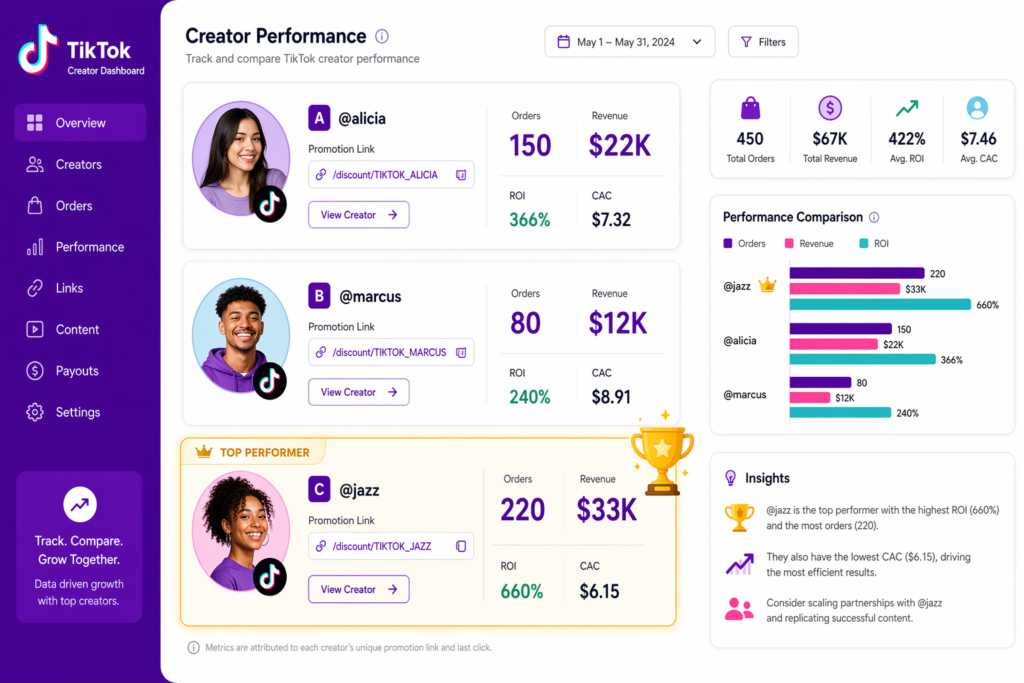
In your Shopify admin, go to Discounts. Open each influencer’s code and Shopify shows:
- Times applied (number of orders using the code)
- Gross savings (total discount value)
- Discounted revenue (revenue after discount)
Calculate ROI per influencer:
Revenue from influencer = Discounted revenue (from Shopify)
Discount cost = Times applied × average discount
Influencer payment = amount you paid them
Total cost = Discount cost + Influencer payment
Profit = Revenue minus Total cost
ROI = Profit / Total cost
Reading the Numbers: What Healthy Shopify Influencer Marketing ROI Looks Like
Example (a healthy partnership):
- INFLUENCER_SARAH code used 120 times
- Discounted revenue: $18,000 (120 orders, $150 average, minus discount)
- Discount cost: 120 × $30 (20% of $150) = $3,600
- Sarah’s payment: $500
- Total cost: $3,600 + $500 = $4,100
- Profit: $18,000 minus $4,100 = $13,900
- ROI: $13,900 / $4,100 = 3.4x return on investment
This means Sarah’s campaign was healthy. For every dollar you spent, you made $3.40 back.
Example (an underperformer): another influencer’s code was used 20 times, made $2,000 revenue, cost $500 paid plus $400 in discounts for $900 total. Profit is $1,100 and ROI is 1.2x. That barely clears break-even after you factor in your own time. Renegotiate or replace.
The Private Link Approach: Better Than Codes
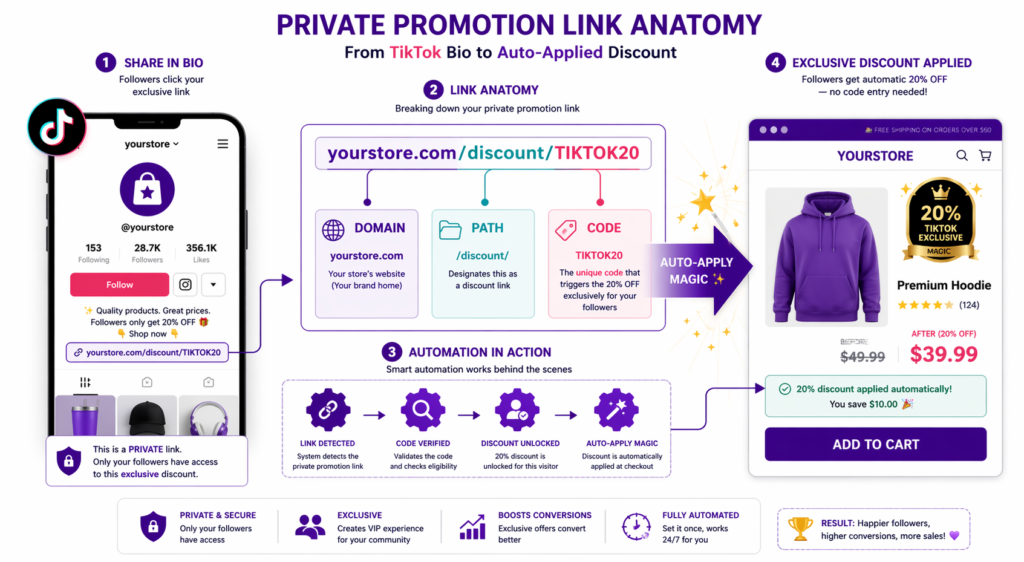
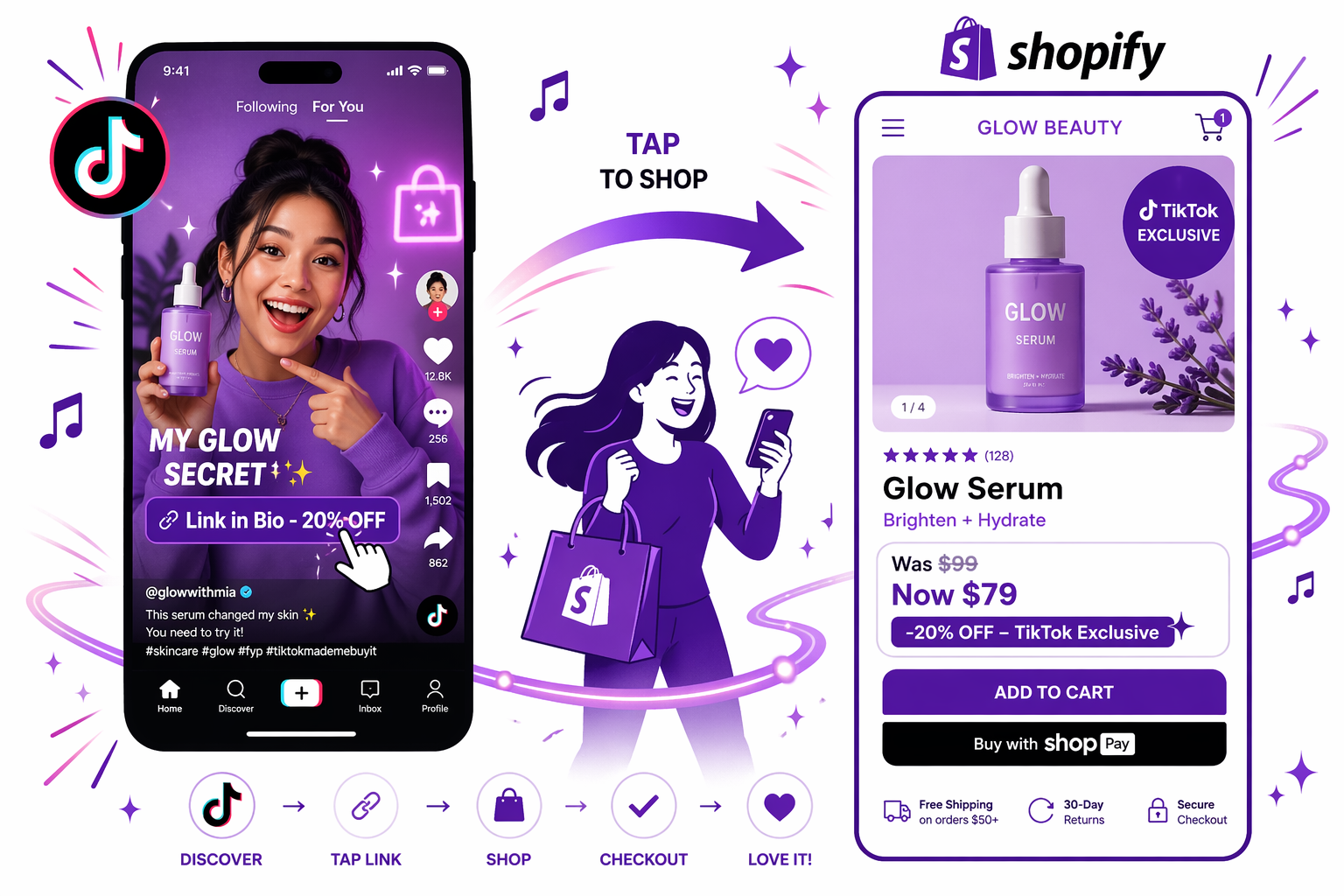
While unique discount codes work, private promotion links are even better. A private link auto-applies the discount, so the influencer’s audience does not have to enter a code.
Process:
- Create a discount in Shopify (e.g., 20% off)
- In Adsgun, create a private promotion linked to that discount
- Adsgun generates a link: yourstore.com/discount/INFLUENCER_SARAH
- Influencer shares this link in their bio, in captions, or in DMs
- Followers click, land on your store with the discount auto-applied
- Adsgun displays the savings visually, no code entry required
Advantage over codes:
- No code entry friction, followers do not have to remember or type the code
- Still trackable, the click applies the code in the background
- Better conversion, frictionless flows always convert higher
- Influencer can share a full link, a shortened version like bit.ly/sarah-discount, or just “link in bio”
Private links typically lift conversion by 15 to 30% over “use code INFLUENCER_SARAH” because there is no friction. For the full storefront walkthrough, see the Adsgun guide on Shopify private promotions.
Bulk Code Generation: Scale to Many Influencers
If you work with 20 or more influencers, creating codes manually becomes tedious. Use bulk code generation, which is available in apps like Adsgun or through Shopify’s native discount feature.
Process:
- In Adsgun or a third-party app, specify base code name “INFLUENCER_”, number of codes (say 20), and discount value (say 20%)
- Generate the batch: INFLUENCER_001, INFLUENCER_002, all the way to INFLUENCER_020
- Export the list
- Assign one code per influencer and track assignments in a spreadsheet
- Monitor performance in Shopify
This scales your influencer program from 5 creators to 50 or more without manual setup per code. Combined with auto-apply Shopify discount codes, each generated code becomes a one-click link that the influencer can drop straight into their bio.
Long-Term Influencer Relationships: Exclusive Ongoing Codes
The best influencer programs create long-term relationships, not one-off campaigns.
Structure:
- Month 1: Influencer launches with their code, drives 100 orders, gets paid $500 plus commissions
- Month 2: Same influencer continues using their code, drives 80 orders, gets paid per performance
- Months 3 to 12: Ongoing relationship, exclusive access to new products before public launch, tiered commissions based on performance
This creates the right incentive for the influencer to keep promoting (they make more money if they drive more sales) and exclusivity for your brand (top influencers are locked in, not shopping around).
Track cumulative performance per influencer over time, then scale budgets to your top performers.
FAQ: Shopify Influencer Marketing Attribution
Should all influencers get the same discount?
Not necessarily. Experiment: some get 15%, some 20%, some 25%. See which discount depth drives the most revenue-efficient orders. Big influencers with large, cold audiences might need 25%. Niche influencers with warm audiences might only need 15%.
What if an influencer shares their code publicly?
It stops being exclusive. If INFLUENCER_SARAH’s code gets posted on a deal site, non-followers start using it and you cannot track audience quality anymore. For true exclusivity, use private links that are harder to share, or pair the code with a Shopify URL discount parameter so each channel sees its own offer.
How do I know if an influencer is buying their own followers?
Performance matters more than follower count. An influencer with 50K real followers who drives 100 orders per month is better than one with 1M fake followers who drives 5 orders. Track the conversion, not the vanity metrics.
Should I pay upfront or commission-only?
Hybrid is best: a small upfront fee ($200 to $500) plus commission on orders. This makes sure they are motivated (commission incentive) and also invested (the upfront payment shows good faith).