Discount vs Free Shipping: Which Converts Better on Shopify?
Most Shopify merchants choose between a discount and free shipping on gut feel. Here is what the research actually says, when each offer wins, the third option most stores forget, and how to test it before you commit.
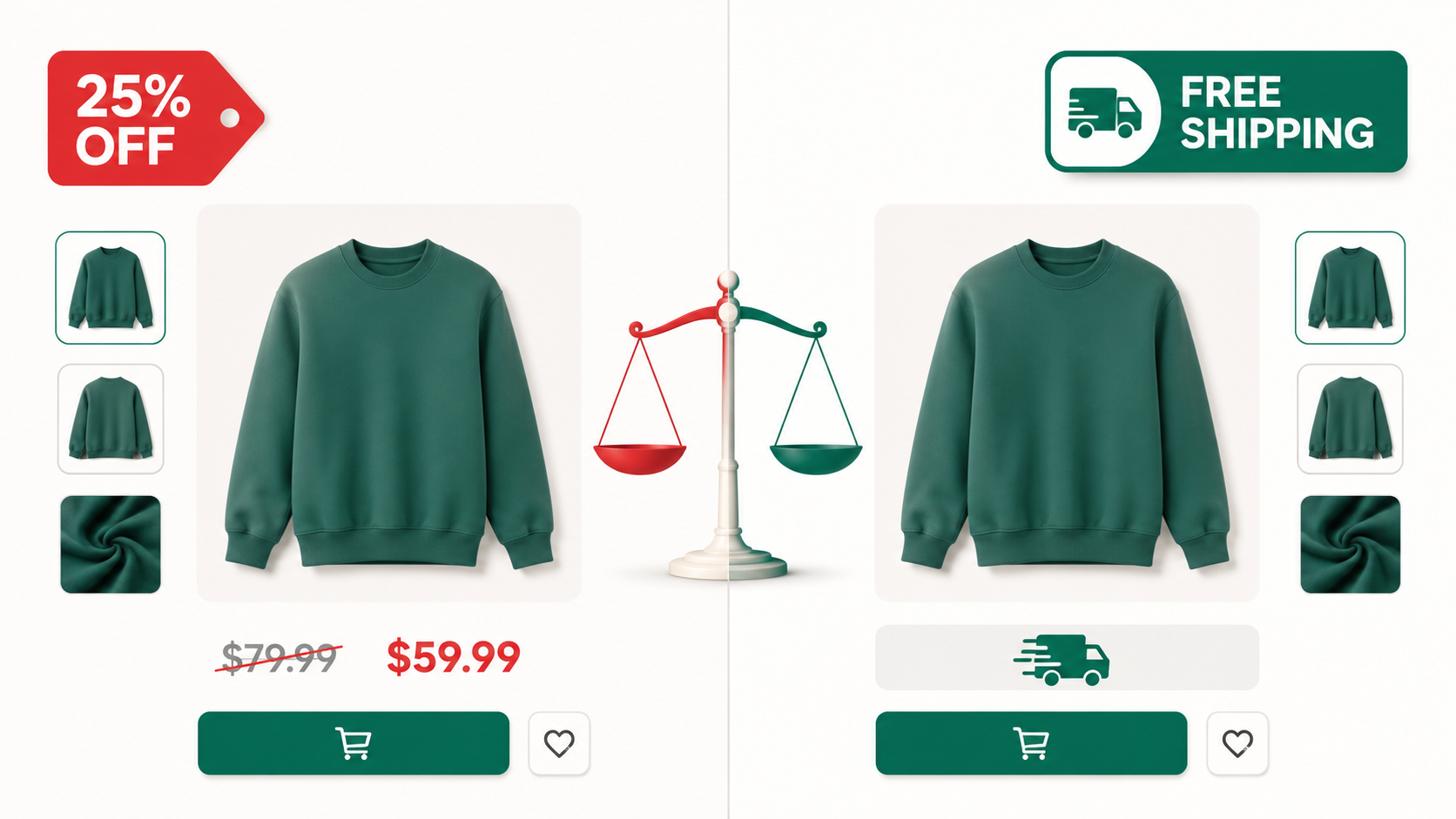
Most Shopify merchants settle the discount vs free shipping question the same way they pick a font: gut feel, a glance at a competitor, and whatever sounded reasonable in a Monday planning call. Then they push traffic at the offer, watch revenue tick up, and call it a win. The problem is that “25% off” and “free shipping” are not interchangeable. They pull on different parts of a shopper’s brain, they hit your margin differently, and the one that wins depends almost entirely on what you sell and who is buying it. This guide covers what the research actually shows, when each offer wins, the third option most stores forget, and how to settle it with data instead of instinct.
Why the discount vs free shipping question matters
The discount vs free shipping question matters because the wrong choice quietly taxes every order for the length of the promotion. A blanket 25% off and a free shipping offer can cost roughly the same per order on paper, yet produce wildly different conversion rates, average order values, and repeat-purchase behavior. Pick the weaker one and you are not just leaving conversions on the table, you are paying full margin cost for a result you could have beaten for free.
Here is the uncomfortable part. Both offers usually lift conversion on their own, which is why merchants keep guessing. Free shipping one month, sales go up. 25% off the next, sales go up again. Neither result tells you which offer made more money on the same traffic, and that is the only comparison that pays your bills.
What the research says about discount vs free shipping
Before you reach for an opinion, it helps to know what the discount vs free shipping research has already settled. The headline finding across multiple studies is that “free” carries a psychological weight that a numerically equal discount does not.
Where free shipping wins and where it doesn’t
A 2025 functional MRI study published in PLOS One put 40 shoppers in a brain scanner and asked them to choose between a product with free shipping and a cheaper product with a shipping fee, while holding the total cost identical. Behaviorally, participants leaned clearly toward free shipping, and the brain imaging showed distinct neural responses when they chose it. In plain terms, “free shipping” felt better than paying the same total a different way. That is the zero-price effect at work: a cost of zero reads as a reward, not just a smaller number.
The catch is that this pull is not universal, and a peer-reviewed quasi-experiment by Ahmad and Callow in the International Journal of Electronic Commerce Studies pins down where. They found that a free shipping offer outperforms a dollar-off discount of the same economic value for lower-priced goods, while for higher-priced goods the two performed about the same. When the item is cheap, the shipping fee looks large next to the product, so removing it feels like a big deal. When the item is expensive, a few dollars of shipping is noise, and the explicit discount competes evenly.
Then there is the abandonment angle, which is the same story from the other direction. Baymard Institute’s cart abandonment research consistently finds that the average documented cart abandonment rate sits around 70%, and that the single most-cited reason shoppers bail at checkout is unexpected extra costs such as shipping, taxes, and fees, named by close to half of abandoners. We break down the full list in our Shopify cart abandonment statistics 2026 roundup, but the implication is direct: if shipping cost is what pushes people out of your funnel, free shipping attacks the problem at its source in a way a product discount does not. For more on closing that leak, see our guide to reducing cart abandonment on Shopify.
So the research gives you a useful prior, not a verdict. Free shipping tends to win on cheaper, lighter catalogs and wherever shipping is the friction. A percentage discount holds its own as prices climb. Your store is a sample of one, so treat all of this as a hypothesis worth testing, which is what the back half of this guide is about.
When free shipping wins
Free shipping is usually the stronger play in three situations.
Low AOV, light products, and the discount vs free shipping math
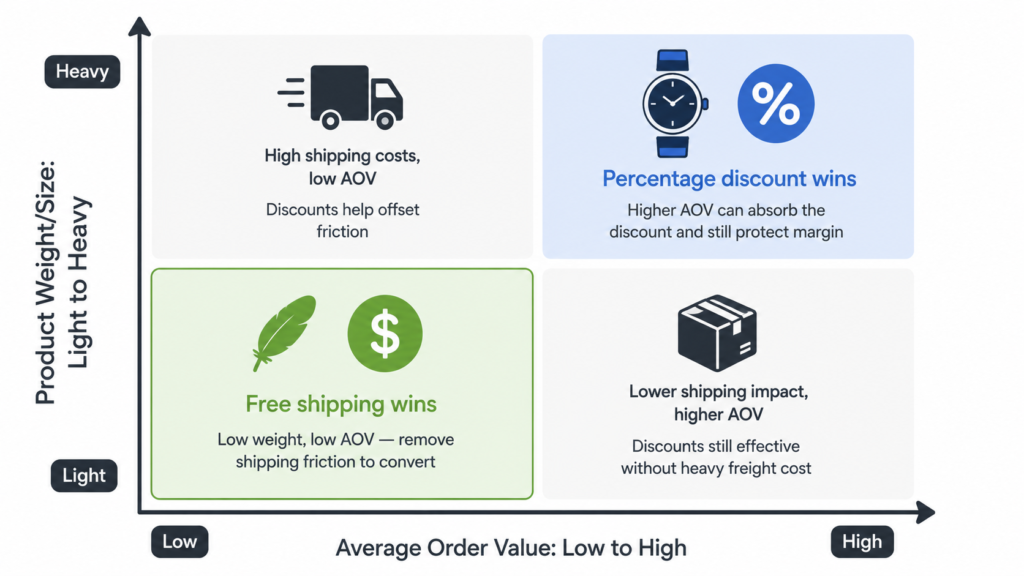
The discount vs free shipping math tilts hardest toward shipping when your average order value is low and your products are small and light. On a $25 order, a $6 shipping fee is nearly a quarter of the price, so removing it feels enormous, while a 25% discount on a $25 item is worth about the same dollars but lands with far less emotional punch. Light, low-cost catalogs are also where shipping is cheapest for you to absorb, so the offer that feels biggest to the customer is the one that costs you least.
The second situation is a mature category where shipping is the standard objection. If you sell supplements, basics, accessories, or anything bought repeatedly, customers have been trained by larger retailers to expect free shipping, so a fee reads as a penalty rather than a normal cost. Matching the category norm removes a reason to leave.
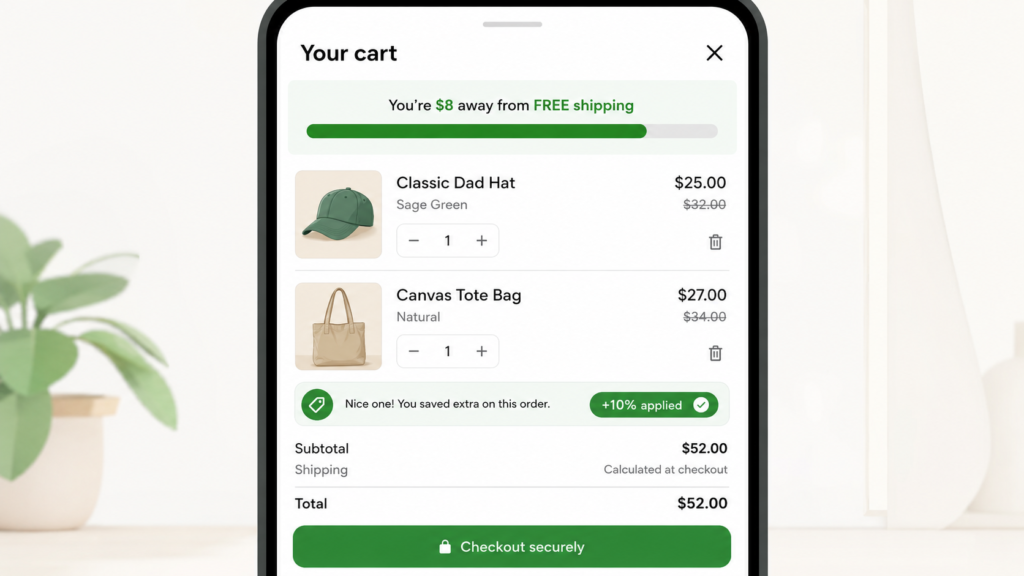
The third is the threshold play, the most profitable version of free shipping. “Free shipping on orders over $50” does two jobs at once: it removes the shipping objection and nudges average order value upward as shoppers add one more item to clear the bar. You get the conversion benefit plus an AOV lift, which a flat percentage discount cannot deliver on its own.
When the percentage discount wins
The percentage discount earns its keep as order values rise and as the purchase becomes less about logistics and more about value or occasion.
On high-AOV stores, shipping is a rounding error and the discount is the headline. A shopper deciding on a $400 jacket is not weighing a $9 shipping fee, they are weighing whether the jacket is worth $400 or $300. A visible 25% off changes the number that drives the decision, while free shipping barely registers. The Ahmad and Callow finding lines up here: as list price climbs, the free shipping advantage fades.
Gift-giving categories are the second case. When someone buys a present, the percentage off is part of the story they tell themselves and the recipient. “I got it on sale” is a satisfying frame in a way that “shipping was free” is not, and the strike-through price is the proof.
New customer acquisition is the third. A bold “25% off your first order” is a sharper hook for a cold audience than free shipping, because it promises a tangible, quantified saving rather than the removal of a fee they may not have noticed yet. The trade-off is margin, so it pays to know exactly what each point of discount does to your bottom line. Our breakdown of how Shopify discounts affect your profit margins shows why a deep percentage off can post a beautiful conversion rate while quietly eating contribution margin, and our roundup of ecommerce sale pricing strategies covers how to frame the offer so it feels earned rather than desperate.
The third option most stores forget: bundle and test
The framing of this whole debate as “either or” is the real mistake. The strongest promotions frequently combine both levers and let the data sort out the weighting.
A free shipping threshold paired with a small percentage discount can outperform either offer alone, because it stacks two different motivations. The discount creates the initial pull, the threshold lifts the basket. “10% off and free shipping over $50” gives a price-sensitive shopper a reason to start and a quantity-sensitive shopper a reason to add. You are no longer betting the whole promotion on one psychological trigger.
The honest answer is that nobody can tell you the right combination for your store from the outside, including this article. The mix that wins depends on your margins, your AOV distribution, your shipping costs, and your customers. So the third option is not a specific offer. It is a discipline: stop arguing about which feels right and run both as a controlled experiment. That is the only way to turn the discount vs free shipping debate into a number instead of an opinion.
How to actually run the test
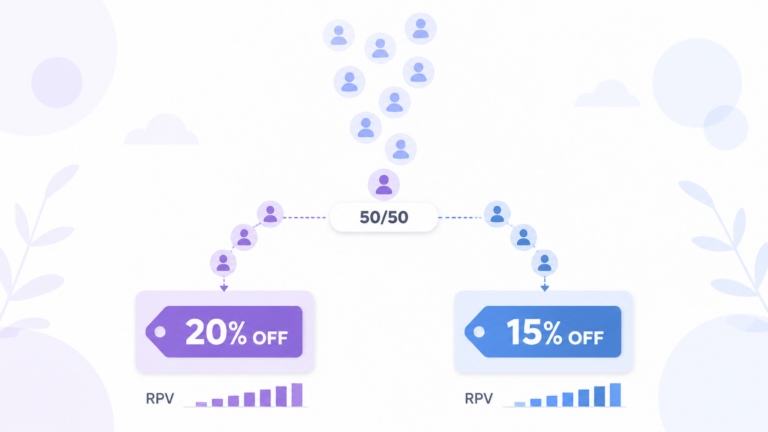
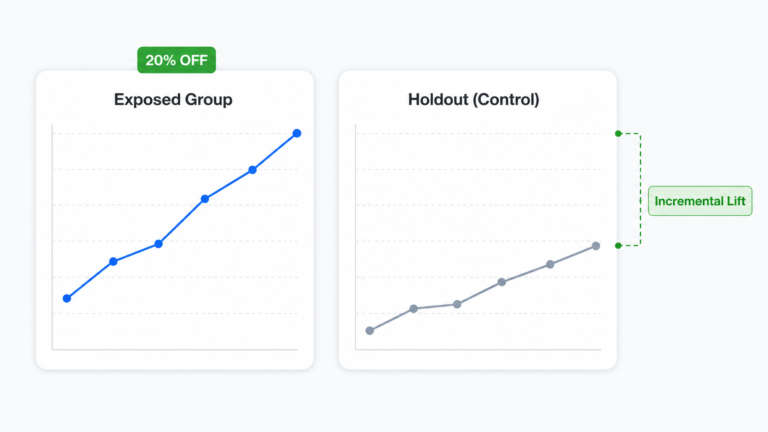
Settling this with data is a proper A/B test, not a “we tried free shipping last month and it seemed fine” comparison. Last month had different traffic, different weather, and a different ad mix, so it tells you almost nothing. A clean test splits your live traffic randomly between the two offers at the same time, so the only thing that differs is the offer itself. Our complete playbook on Shopify A/B testing discounts covers the full methodology, but here are the settings that decide whether your result is real.
Pick one variable. Variant A is your percentage discount, Variant B is free shipping at a comparable margin cost. Do not also change the banner copy or the popup timing, or you will never know which change moved the needle.
Split traffic 50/50. An even split reaches a reliable result fastest because both offers accumulate data at the same rate.
Size the test before you launch
A rough rule is that a store with a 2% baseline conversion rate that wants to detect a 20% relative lift needs somewhere around 7,000 to 8,000 visitors per variant at 95% confidence. Evan Miller’s free sample size calculator does this math in seconds, and it is worth doing, because an undersized test cannot detect a realistic difference and will just produce noise you mistake for a winner.
Run it for at least one full week, ideally two, because buying behavior swings hard between weekdays and weekends and a shorter test measures half your store. Then resist the urge to stop early the moment the dashboard looks good. Peeking and calling it on the first promising day is the most common way DIY tests produce false winners.
This is where doing it inside Adsgun’s built-in A/B testing module saves you from the usual fragile workaround of URL splits and spreadsheets. You create both promotions, the percentage discount and the free shipping offer, flag each for testing (which locks them to draft so they cannot accidentally go live alone), then build a “Promotion vs Promotion” test. Set a minimum duration with a 7-day default, choose your 50/50 split, and start. Two guardrails stop you calling it too soon: the minimum duration has to elapse, and each variant needs at least 100 visitors before you can declare a winner. Because the promotion engine and the testing engine are the same system, you are testing the real offer in the real storefront, free shipping included as a native discount type, with no flicker between variants.
What to measure (revenue per visitor, not conversion rate)
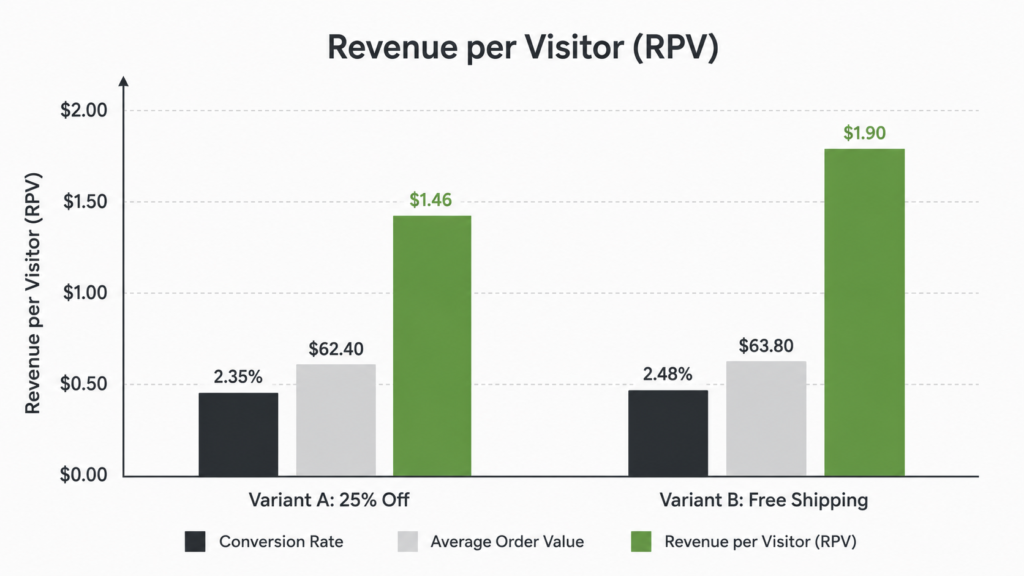
Here is the part most merchants get wrong, and it is the difference between a real answer and a flattering one. Do not declare the winner on conversion rate. A deeper or more generous offer almost always lifts conversions while quietly dragging down average order value or margin. The metric that matters is revenue per visitor, or RPV. It rolls conversion rate and average order value into a single number, which is what your profit and loss statement actually reflects. An offer can win on conversion rate and still lose on RPV if it pulls in lower-intent shoppers or shrinks the basket.
A quick illustration, with invented numbers to show the shape of the problem rather than a benchmark. Say the discount variant converts at 2.1% with an $80 AOV, an RPV of about $1.68. The free shipping threshold variant converts at 2.3% with a $90 AOV, because the threshold lifted baskets, an RPV of about $2.07. Free shipping wins, even though the conversion gap looked modest. But flip the AOV: if free shipping converted at 2.4% while dropping AOV to $66, its RPV falls to about $1.58 and it loses despite the better conversion rate. Same dashboard, opposite decision, depending on which metric you trust. Always compute RPV, and ideally contribution margin per order, before you ship the winner. For the wider set of metrics that feed this, our A decision framework if you are too early to test
Testing assumes you have the traffic. If you are doing a few hundred sessions a week, a clean test could take months, and you need to ship something now. In that case, use the research as a default and revisit once you have volume.
Lean toward free shipping if your average order value is under about $50, your products are small and light, you are in a category where free shipping is the norm, or your analytics already flag shipping cost as a top abandonment reason. Pair it with a threshold a little above your current AOV to capture the basket lift.
Lean toward a percentage discount if your average order value is high, you sell gift-friendly or considered purchases, or you are running first-order acquisition where a bold number is the hook. Watch your margin and keep the depth honest.
When genuinely unsure, default to a free shipping threshold with a light percentage discount layered on, since it hedges across both motivations. Then, the moment you have the traffic to run a real 50/50 experiment, run it. Every promotion you launch without a test is a guess priced in margin, and the discount vs free shipping question is one of the highest-value guesses you will ever get to replace with a measurement.
Show your discounts everywhere. Adsgun displays strike-through pricing on product pages, collections, cart, and checkout automatically, and its built-in A/B testing lets you put your discount up against free shipping and ship the one that actually makes more money. Try Adsgun free on the Shopify App Store.