5 Shopify Promotion A/B Tests to Run in 2026
Five high-impact Shopify promotion A/B tests for 2026, each with a hypothesis, setup steps, what to measure, common pitfalls, and honest result ranges.
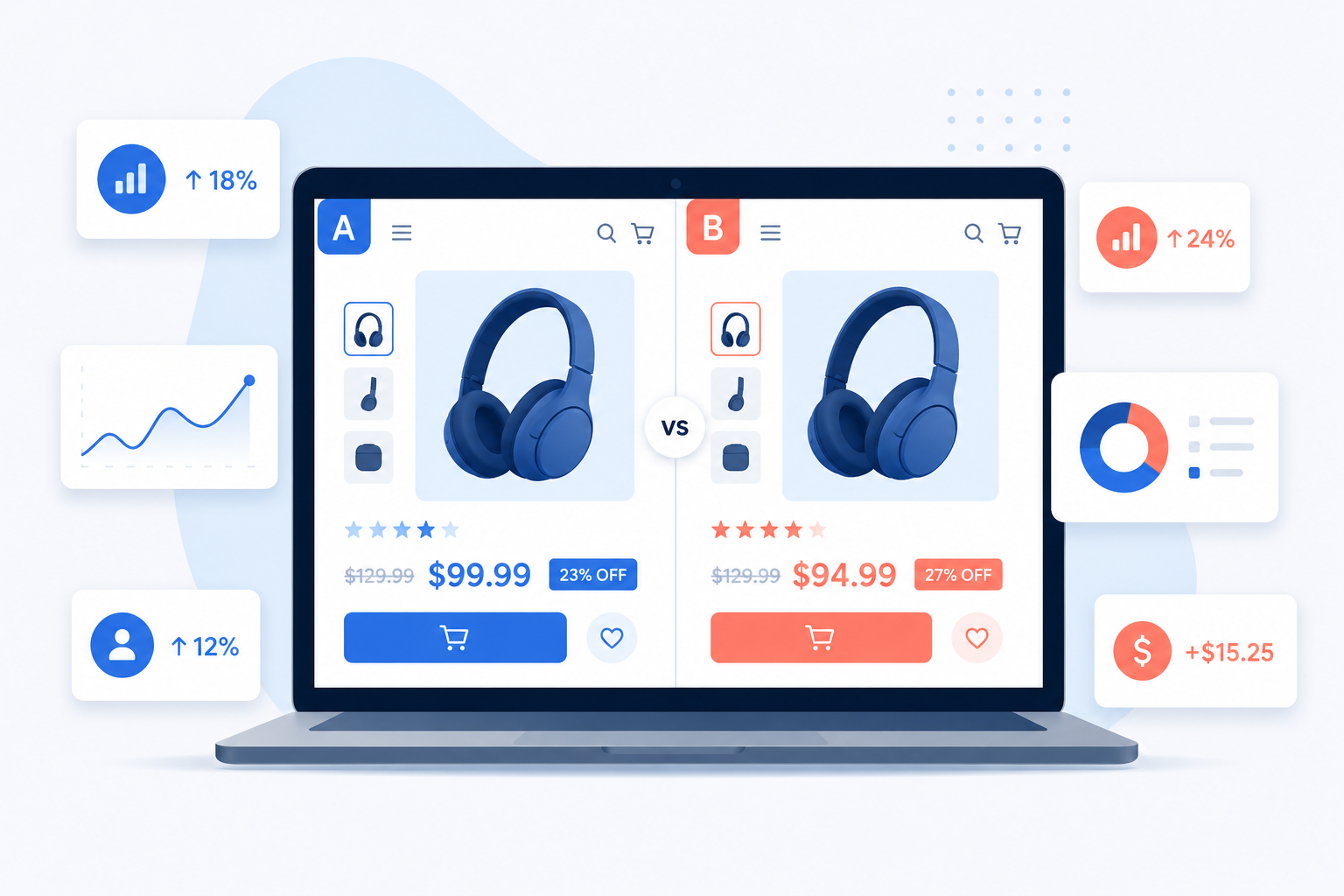
Most Shopify stores run promotions on instinct. They pick a discount, launch it, watch sales move, and assume the number they chose was the right one. The reality is that small changes to how a promotion is built can swing conversion and profit in ways you would never guess from a dashboard. That is exactly why Shopify promotion A/B tests are worth your time. Instead of arguing about whether 20 percent off beats 30 percent off, you let real customers settle it with real money on the line.
This guide walks through five tests that consistently move the needle: discount depth, promotion framing, urgency mechanics, auto-apply versus code entry, and free gift thresholds. For each one you get a clear hypothesis, a setup you can copy, the metrics that actually matter, the pitfalls that quietly ruin results, and honest outcome ranges. The ranges are directional on purpose, because your category, margins, traffic, and brand will shift every number.
Why Shopify Promotion A/B Tests Beat Guessing
Shopify promotion A/B tests work because they isolate one variable and measure its true effect on real behavior. Change the discount depth and nothing else, and any difference in results can be traced back to that single decision. Change three things at once, and you learn nothing you can repeat. Because a clean test compares two variants at a time, treat multi-option questions as a series: test your current setting against one challenger, keep the winner, then run the next pairwise round.
A clean test follows a few rules. Calculate your required sample size before you launch, using your baseline conversion rate and the smallest lift you would care about, so you know how long the test needs to run rather than stopping the moment the numbers look good. Aim for 95 percent statistical significance before you call a winner, and resist the temptation to peek and end early, since early results are usually noise. Run each test for at least two weeks, and ideally a full purchase cycle, so weekend and weekday behavior both land in the data. The Nielsen Norman Group has a solid primer on the mechanics of A/B testing if you want the statistical detail.
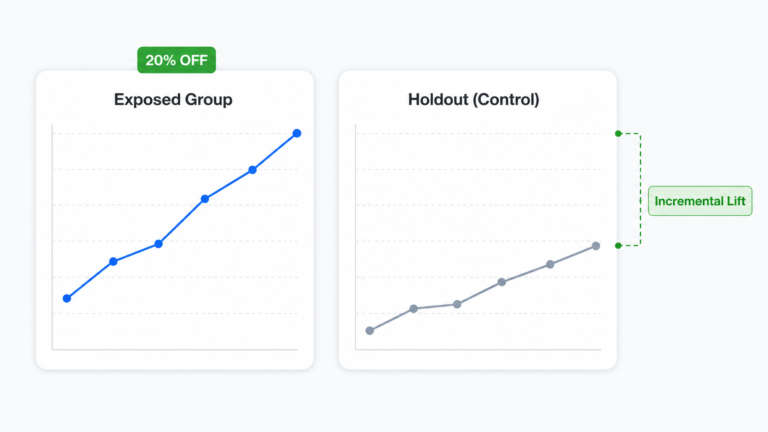
If you are new to structured testing, start with our complete Shopify A/B testing discounts guide, then come back here for the specific experiments. And once a test ends, read how to measure Shopify promotion lift the right way so you do not mistake normal sales for a real effect.
Test 1: Discount Depth, 20% vs 30% Off
Hypothesis. A deeper discount lifts conversion, but the gain is not linear. Somewhere along the way, the extra margin you give up stops buying enough extra orders to be worth it.
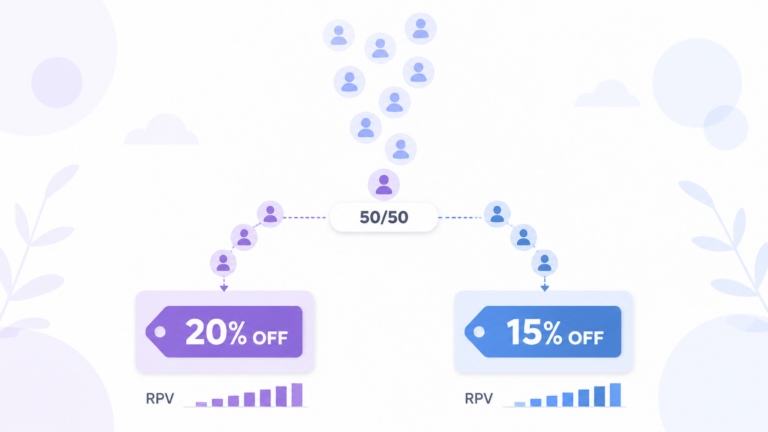
How to set it up. Build two identical promotions that differ only in depth — your current 20% against a 30% challenger. Same products, same audience, same dates. Split traffic 50/50 and let them run side by side, then run a follow-up round (the winner versus 10%) to map the curve rather than one after another, so seasonality does not skew the comparison.
What to measure. Do not stop at conversion rate. Track revenue per visitor and gross profit per visitor as well. A bigger discount almost always wins on conversion rate while quietly losing on profit, which is the metric that pays your bills.
Common pitfalls. Judging the test on conversion rate alone is the classic mistake. Ending the test in three days is another. So is launching a competing promotion mid-test, which contaminates the data.
Expected outcome. In most stores, conversion rate climbs as the discount deepens, but profit per visitor tends to peak somewhere in the middle rather than at the steepest discount. Where that peak sits depends heavily on your margins, so model the numbers first with our breakdown of how Shopify discounts affect profit margins.
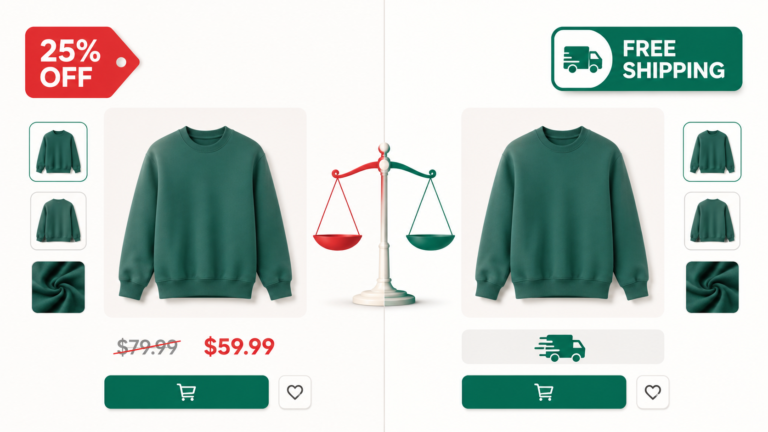
Test 2: Promotion Framing, 25% Off vs Was $99 Now $74
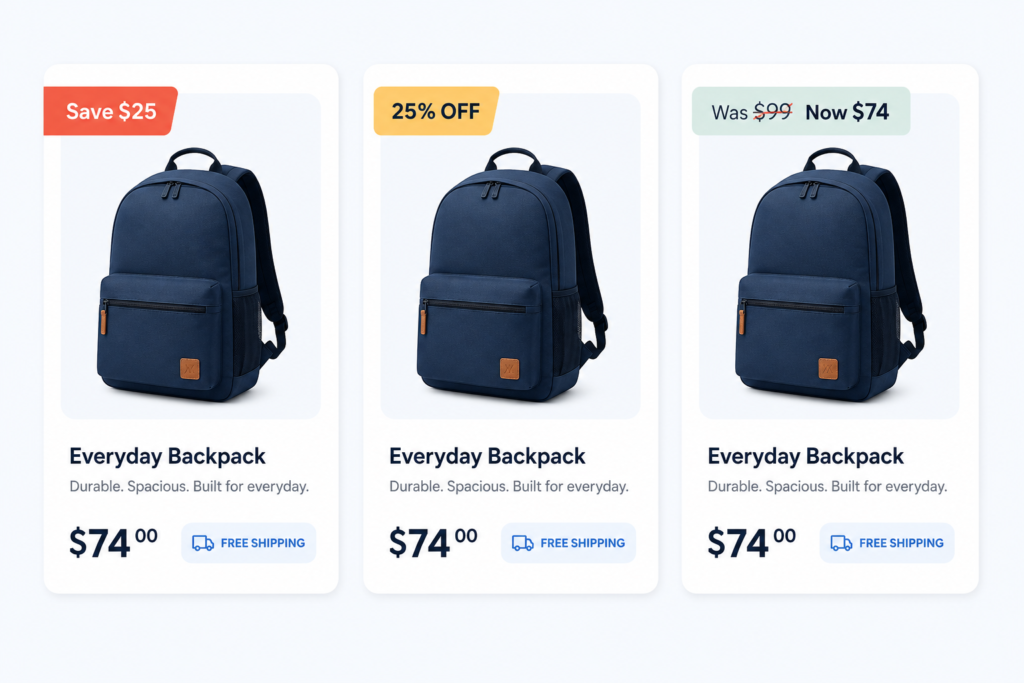
Hypothesis. The same discount framed three different ways converts at three different rates, because shoppers react to how a number looks, not what it calculates to.
How to set it up. Take one discount value and express it two ways — a percentage against a strike-through “Was, Now” price — then run a follow-up round against the fixed-dollar framing. Run the test within a single price band, because the winning frame changes with price.
What to measure. Conversion rate and add-to-cart rate, segmented by product price point. Mixing a $30 product and a $300 product in one test will hide the real signal.
Common pitfalls. Testing framing across a catalog with wildly different prices is the big one. Forgetting that a “Was, Now” frame needs the original price visible on the page is another.
Expected outcome. The well-known Rule of 100, popularized by marketing professor Jonah Berger, predicts the pattern: below $100, a percentage usually looks bigger and wins, while above $100, the dollar amount usually wins. A visible “Was, Now” price often performs strongly at any tier because it anchors the saving. Conversion.com has a clear explainer on this pricing psychology, and our guide to Shopify discount copy that converts covers how to write each frame.
Test 3: Urgency Mechanics, Countdown vs None
Hypothesis. Genuine urgency reduces hesitation and pushes undecided shoppers to act, lifting conversion. Fake or aggressive urgency does the opposite by eroding trust.
How to set it up. Run two variants: a countdown timer tied to a real deadline against a clean control with no urgency. In a follow-up round, pit the winner against scarcity text such as “only 7 left,” shown only when it is true. Everything else stays identical.
What to measure. Conversion rate and time to purchase, plus return and refund rates as a trust signal. A variant that lifts conversion but spikes returns is not a real win.
Common pitfalls. Timers that reset on page reload are the worst offender. They damage trust and can create consumer-protection problems. Adding urgency to an evergreen promotion that never actually ends feels dishonest and tends to underperform over time.
Expected outcome. Honest urgency often delivers a modest conversion lift, while manufactured urgency can backfire and depress repeat purchases. The effect size varies a lot by audience, so pair this test with our Shopify cart abandonment statistics for 2026 to understand why shoppers hesitate in the first place.
Test 4: Auto-Apply via URL vs Code-Entry-Required
Hypothesis. Removing the manual code-entry step recovers discounts that shoppers would otherwise forget, lifting both redemption and conversion.
How to set it up. Variant A sends campaign traffic to a link that auto-applies the code and shows the discounted price before checkout. Variant B uses the same offer but requires the customer to type the code at checkout. Keep the code value and traffic source identical so the only difference is friction.
What to measure. Redemption rate, checkout completion, conversion rate, and average order value. Use campaign-specific codes so you can attribute every result cleanly.
Common pitfalls. Weak attribution is the main trap, which is why unique codes matter. The second is treating auto-apply as a checkout-only feature. The lift is strongest when the discounted price is also visible on product and collection pages, not just at the final step.
Expected outcome. Auto-apply usually wins decisively, because a meaningful share of shoppers never enter a code they technically have. Shopify supports passing codes through URLs natively, as covered in the Shopify discounts documentation, and our full walkthrough on how to auto-apply Shopify discount codes shows how to combine that with pre-checkout pricing. This is the gap Adsgun was built to close, since it reads the code from the link, shows the savings across the store, and applies it at checkout automatically.
Test 5: Free Gift Threshold, At AOV vs Above AOV
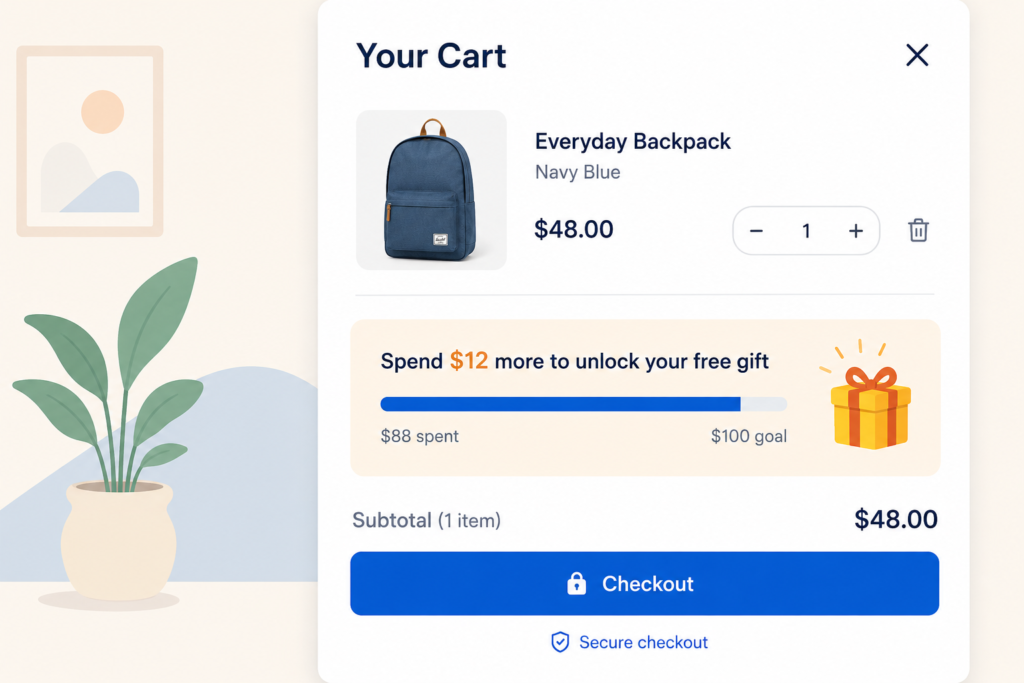
Hypothesis. A gift threshold set slightly above your average order value nudges incremental spend, while a threshold set too high suppresses conversion and one set too low gives away margin for free.
How to set it up. Run two variants with the threshold placed at and slightly above your current average order value, then test the winner against a below-AOV threshold in a second round. Use the same gift in every variant and show clear progress messaging such as “spend $12 more to unlock your free gift.”
What to measure. Average order value, conversion rate, gross margin per order, and the cost of the gift as a share of the incremental revenue it generates.
Common pitfalls. Choosing a gift that is too expensive eats the entire gain. Setting the bar so high that few shoppers qualify kills the motivation. Hiding the progress bar removes the nudge that makes the whole mechanic work.
Expected outcome. A threshold set just above average order value often maximizes profit, but the sweet spot is store-specific and worth testing rather than assuming. Our Shopify BOGO setup guide covers the mechanics, and Adsgun can display the gift offer and progress bar before checkout so shoppers actually see the deal while they shop.
How to Run These Shopify Promotion A/B Tests Cleanly
Running good experiments is more about discipline than tools. The stores that compound gains over time treat testing as a habit, not a one-off, and they protect the integrity of every test from start to finish.
Your Shopify Promotion A/B Tests Checklist
Before you launch any of the five tests above, confirm each of these. Change one variable at a time. Calculate the sample size before you start. Wait for 95 percent significance and never stop on a hunch. Run the test across a full purchase cycle. Segment results by device and traffic source so a desktop win does not hide a mobile loss. Write down the result either way, because losing tests teach you as much as winning ones.
The practical blocker for most merchants is execution: schedule the variants, route each one to the right audience, show the offer before checkout, and read clean numbers afterward. That is the everyday job Adsgun handles, and our complete Adsgun guide shows how visible pricing, scheduling, channel links, and built-in analytics fit together. Pick one test, run it properly, and let your customers tell you what works.
Start your free Adsgun trial and turn your next promotion into an experiment instead of a guess.