Shopify A/B Testing Discounts: The Complete 2026 Guide
A practical 2026 playbook for Shopify A/B testing discounts: what to test, how to size a clean experiment, and the mistakes that quietly waste your traffic.
Most Shopify merchants are running the wrong promotion right now, and they have no idea. They picked “15% off sitewide” because last year’s 15% off worked, or because a competitor ran one, or because it sounded reasonable in a Tuesday strategy meeting. Then they pumped paid traffic at it, watched the dashboard, and called the result “fine.” That is not strategy. That is guessing with extra steps. Shopify A/B testing discounts is the difference between guessing and knowing, and in 2026 it is the single highest-leverage habit you can build inside your store.
What Shopify A/B testing discounts actually means
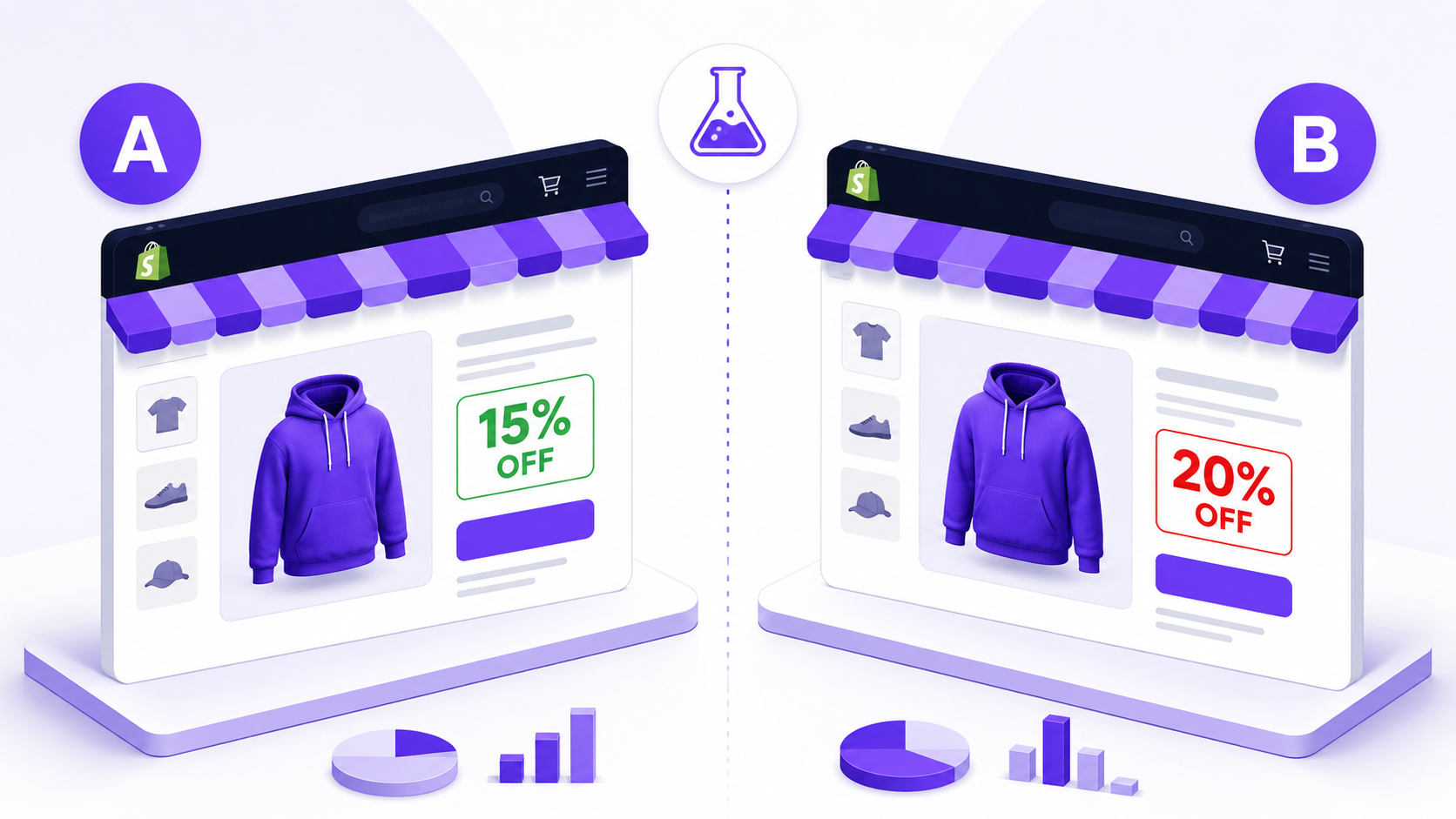
Shopify A/B testing discounts is the practice of running two promotion variants in parallel, splitting your traffic randomly between them, and measuring which one produces more revenue per visitor before you commit to it sitewide. You are not testing a button color. You are testing the offer itself: 20% off versus 30% off, free shipping versus a flat $10 off, a single sitewide deal versus a BOGO bundle, a banner above the fold versus a popup at exit intent.
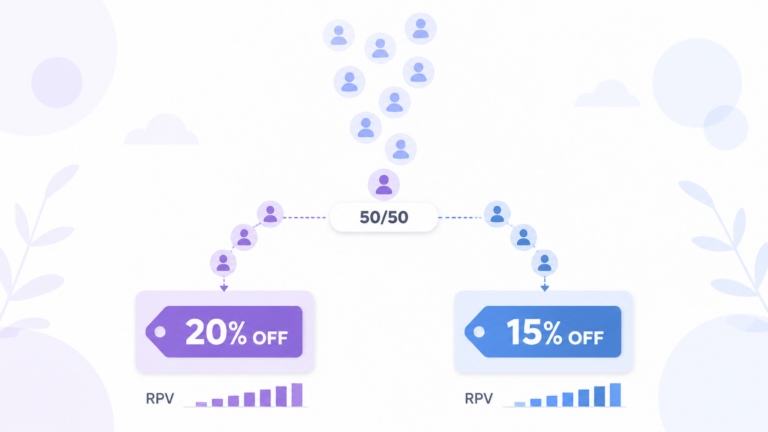
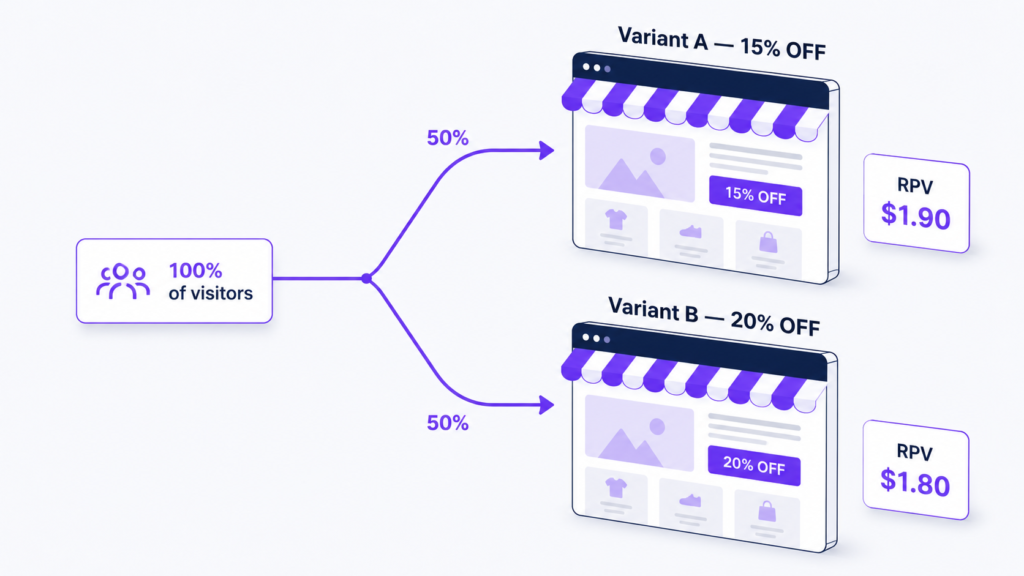
The mechanic is simple. Half your visitors see Promotion A, half see Promotion B (or no promotion at all, the “control”). After enough traffic has passed through both variants, the data tells you which offer made more money, which one was just noise, and which one you should ship. Done well, this turns every promotion you run into a learning event instead of a one-shot bet.
It is worth being precise about the distinction with the rest of the CRO universe. Testing a hero image is conversion rate optimization. Testing a discount is the same discipline, but the lever is your margin, which means the stakes per test are an order of magnitude higher. A bad button color costs you almost nothing. A bad blanket 30% off can erase a quarter of profit. That is exactly why Shopify A/B testing discounts is worth doing properly rather than improvising.
Why most Shopify merchants never test their promotions
The honest answer is that it feels expensive and complicated. To run a clean test you need to split traffic, hold a variable still, wait, and resist the urge to call it early. Most merchants would rather just launch the discount and check Shopify Analytics on Monday. That habit has a real cost.
The average Shopify store converts at 1.4%, with the top 20% above 3.2% and the top 10% above 4.7%, according to Littledata’s 2023 benchmark of 2,800 Shopify sites. If you sit at 1.8% and a well-designed promotion test moves you to 2.2%, that is a 22% relative lift in revenue from the same traffic. On a store doing $50,000 a month, that is $11,000 you would otherwise have left on the table. Across a year, it is a six-figure decision.
There is a second cost that is even more invisible. When you ship an untested promotion and revenue ticks up, you assume the discount caused the lift. It might have. It might also have been a weekend, a viral TikTok, a paid ad refresh, or a seasonal tailwind. Without a control group, you cannot know. So you keep repeating offers that may never have been profitable in the first place, and the bad strategy compounds. A/B testing is the only way to break that loop.
Finally, deeper discounts almost always lift conversion rate on their own, which is misleading. A 30% off promo can post a beautiful conversion rate while quietly destroying contribution margin, an effect we cover in detail in our breakdown of how Shopify discounts affect your profit margins. Testing forces you to compare promotions on revenue per visitor and margin, not vanity metrics.
What to actually test
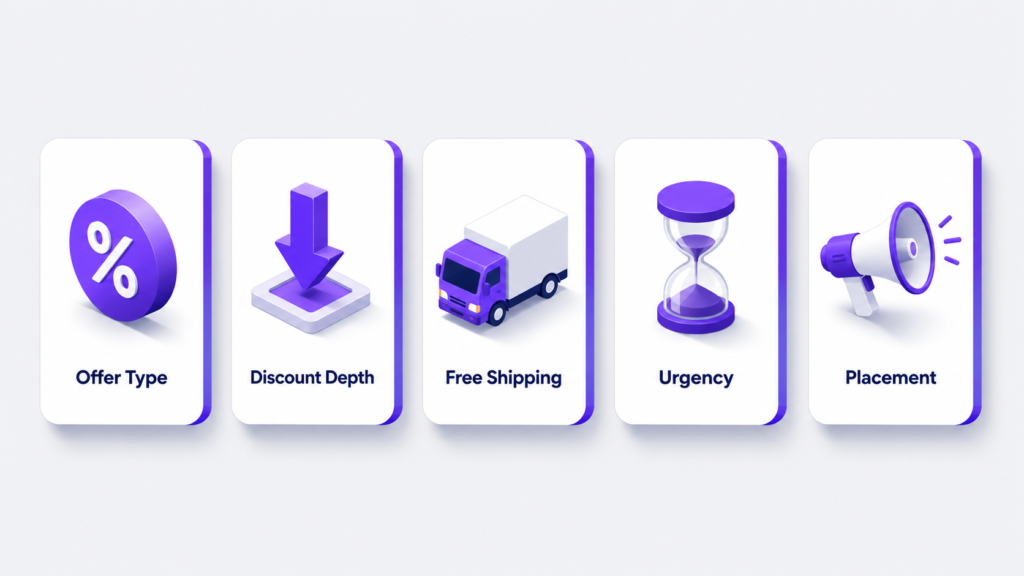
You can test almost anything inside a promotion, but five levers move the needle far more than the rest. Start here.
Offer type
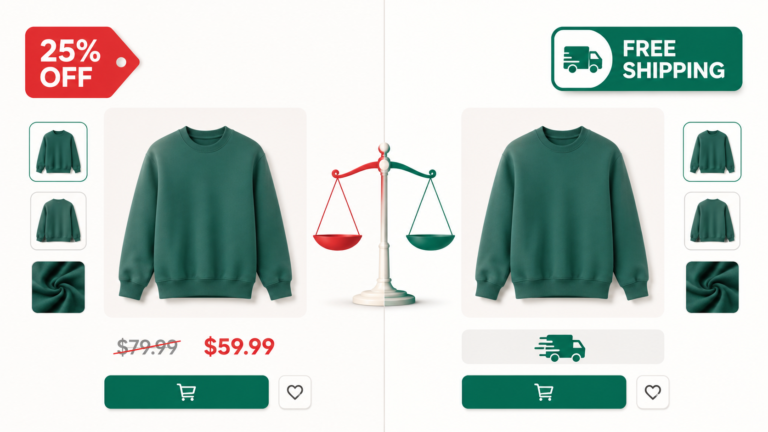
The offer type is the frame, not just the math. “20% off,” “$20 off,” “Free shipping,” “Buy One Get One,” and “Spend $100, save $20” can all deliver the same nominal discount with wildly different conversion rates and AOV. A peer-reviewed quasi-experiment by Ahmad and Callow (International Journal of Electronic Commerce Studies, 2018) found that “the free shipping offer works better than a dollar-off discount for lower-priced goods, but there is no difference between the two for higher-priced goods.” That is a useful prior, not a verdict for your store. Test it.
Practical pairings to start with: percentage off versus dollar off (often the percentage frame wins on AOV above $100, dollar off wins below that), free shipping versus a comparable percentage discount, and BOGO versus a flat sitewide percentage at the same margin cost.
Discount depth
Depth is where margin lives or dies. 10% off versus 15% off versus 20% off rarely produces a linear lift in conversions. There is usually a sweet spot where each additional percentage point of discount stops producing a proportional bump in orders, and your margin starts hemorrhaging. That sweet spot is store-specific and category-specific, which is exactly why you have to test it.
A simple, high-value test: hold everything else constant and run 15% off against 20% off as your two variants. Measure revenue per visitor and contribution margin per order, not just conversion rate. You will frequently find the shallower discount makes more money.
Free shipping framing
Free shipping is a discount in disguise, and it is often the most powerful one. Baymard Institute’s cart abandonment research consistently shows that “extra costs” (shipping, tax, fees) is the single most-cited reason shoppers abandon checkout, cited by 48% of US online shoppers who left a cart in the past quarter. Reframing a 10% discount as a free shipping threshold (“Free shipping on orders over $50”) frequently lifts both conversion and AOV at the same time.
Test free shipping above a threshold against an equivalent percentage off. Test “Free shipping” wording against “$0 shipping” wording. Both can move conversion meaningfully.
Urgency and framing
Urgency is the modifier that changes the same discount into a different offer in the customer’s head. “20% off this weekend,” “20% off ends tonight,” and “20% off, last 4 hours” produce different conversion curves. Countdown timers, expiry language, and session-based windows all qualify as urgency tests, and they are some of the cleanest to run because the underlying discount stays constant. Our Shopify flash sale guide covers the urgency mechanics that pair well with a test, and the psychology of discounts post explains why loss aversion makes urgency framing so effective.
Visibility and placement
The same discount placed differently is functionally a different promotion. Strike-through pricing on every product page versus a banner only on the homepage. A popup on entry versus a popup at exit intent. A discount badge on the collection grid versus only on the product page. Visibility tests are particularly underrated because they cost you nothing in margin. You are testing presentation, not depth.
How to set up proper Shopify A/B testing discounts
A test is only as good as its design. Five settings determine whether your result is real or noise.
Sample size. Before you launch, decide how many visitors per variant you need. Sample size depends on three numbers: your baseline conversion rate, the minimum detectable effect (MDE) you care about, and your confidence level. A store with a 2% baseline that wants to detect a 20% relative lift at 95% confidence needs roughly 7,000 to 8,000 visitors per variant. Evan Miller’s free sample size calculator is the industry standard for this math.
Statistical significance. The convention is 95% confidence, which means a 5% probability that your observed difference is random noise. For high-stakes pricing decisions, push to 99%. Below 90%, you do not have a result, you have a hunch.
Traffic split. 50/50 is the default and almost always the right choice. It reaches significance fastest because both variants accumulate data at the same rate. The only good reason to skew the split is to limit exposure to a more aggressive discount that could damage margin if it underperforms.
Test duration. Run for a minimum of one full week, and ideally two. Customer behavior cycles strongly by day of the week, and a Tuesday-to-Friday test misses your weekend buyers entirely. Two full business cycles, seven days each, is the safe floor.
One variable at a time. This is the rule everyone breaks. If you simultaneously change the discount depth and the banner copy and the popup timing, you will learn nothing about which of the three caused the difference. Hold everything else identical between variants and change exactly one thing.
A useful primary metric for Shopify A/B testing discounts is revenue per visitor (RPV), not raw conversion rate. RPV combines conversion rate and average order value into one number, which is what your P&L actually cares about. A variant can win on conversion rate and lose on RPV if it cannibalizes AOV.
Common Shopify A/B testing discounts mistakes
These are the failure modes we see most often.
Peeking and stopping early. This is the single biggest validity threat to A/B testing. Standard significance tests are designed to be evaluated once, at a pre-set sample size. If you check the dashboard daily and stop the moment p drops below 0.05, you have inflated your false positive rate dramatically. As Evan Miller puts it in his canonical essay, “How Not to Run an A/B Test”, “if you peek at an ongoing experiment ten times, then what you think is 1% significance is actually just 5% significance.” Set the sample size before you launch and do not stop until you hit it.
Too many variants at once. A four-variant test (A/B/C/D) needs roughly two to three times the per-variant sample size of a clean A/B, plus a Bonferroni-style correction to alpha. Most Shopify stores do not have the traffic. Start with two variants. Always.
Tiny sample sizes. A 200-visitor test cannot detect anything smaller than a 30%+ lift, which is rarely realistic for discount changes. If your traffic is low, you have to test bigger swings (10% off versus 25% off, not 18% versus 20%) and accept longer test durations.
Ignoring seasonality and traffic mix. A discount test that runs through Black Friday is not a discount test, it is a Black Friday test. Schedule experiments during stable traffic windows when possible, and avoid running them across major calendar events unless you specifically want to test holiday behavior. Segment by traffic source where you can, because email subscribers and cold paid traffic respond to discounts very differently.
Not accounting for novelty. The first few days of a new promotion always look better than the steady state because returning customers respond to “new.” Let the test run past the novelty bump.
Optimizing the wrong metric. A test that maximizes conversion rate at the cost of margin is a loss disguised as a win. Always compute revenue per visitor and contribution margin per order before declaring a winner.
Three example test scenarios (illustrative numbers)
The numbers below are invented for illustration. Use them as templates, not benchmarks.
Test 1: Discount depth. Baseline conversion rate 2.1%, AOV $80. Variant A: 15% off sitewide. Variant B: 20% off sitewide. MDE of 15% relative lift on RPV. Required sample size: roughly 6,500 visitors per variant at 95% confidence and 80% power. Expected duration on a store with 800 daily visitors: about 16 days, or two full weekly cycles. Realistic outcome: Variant B converts at 2.5% versus 2.2% for A, but AOV drops from $82 to $76 because the deeper discount pulls in lower-intent shoppers. RPV is $1.90 versus $1.80. Variant B wins on revenue but by a thinner margin than the conversion rate suggested.
Test 2: Free shipping versus percentage off. Baseline 1.8%, AOV $65. Variant A: 10% off everything. Variant B: Free shipping on orders over $50. Same expected margin impact. Sample needed: roughly 9,000 per variant for a 20% MDE. On a 1,200-daily-visitor store, about 15 days. Realistic outcome: Variant B converts at 2.3% with AOV $72 (the threshold pulls AOV up), while Variant A converts at 2.1% with AOV $66. RPV $1.66 versus $1.39. Free shipping wins decisively.
Test 3: Promotion versus no promotion (control). This is the test most merchants never run and learn the most from. Baseline 2.0%, AOV $90. Variant A: 20% off sitewide. Variant B: Full price, no promotion. For 14 days. Realistic outcome: Variant A converts at 2.6%, AOV $74, RPV $1.92. Variant B converts at 2.0%, AOV $90, RPV $1.80. The promotion is genuinely profitable, but only marginally. Now you know the offer is worth running and roughly what lift to expect. Without the control, you would have credited the entire 30% revenue lift to the discount when only about 7% of it was incremental.
How Adsgun makes Shopify A/B testing discounts simple
Most Shopify merchants either skip discount testing or build a fragile workaround with code, URL splits, and a spreadsheet. Adsgun has a built-in A/B testing module designed specifically for promotions, so the test sits next to the discounts it is testing, not in a separate tool.
Inside Adsgun, you create the two promotions you want to compare, flag each one for A/B testing in the promotion editor (which locks them to Draft so they cannot accidentally go live as standalone), and then create a test in the A/B Testing section. You pick the test type, “Promotion vs Promotion” for head-to-head offer comparisons or “Promotion vs Control” to measure incremental lift over no promotion at all. You set a minimum duration (the default is 7 days, which matches industry best practice for cycling through a full week of buyer behavior), choose a traffic split (50/50 by default), and start the test. Adsgun randomly assigns each visitor to a variant and tracks the result.
The live results panel shows visitors, page views, product views, add-to-carts, orders, conversion rate, AOV, and revenue per visitor side by side. Orders and revenue update in real time. Visitor-level metrics come from GA4 and may lag 24 to 48 hours, which is normal. Adsgun enforces two guardrails before you can declare a winner: the minimum duration must elapse, and each variant must have received at least 100 visitors. Those rules exist to prevent the most common error in DIY testing, which is calling the result on day three because the dashboard looked good.
Compared to other apps, the advantage is integration. The promotion engine and the testing engine are the same engine. You are testing the actual discount you would ship, in the actual storefront blocks where it would appear, with the same scheduling and visibility rules. There is no parallel system to maintain and no flicker between variants. Alternative solutions can A/B test creative or theme changes well, but most third-party tools are not built around the offer itself as the unit of experimentation.
For a deeper view of how visible discounts feed into the same conversion stack, see our Shopify discount analytics and Shopify conversion rate optimization 2026 guides, plus our roundup of Shopify promotion ideas for offer hypotheses you can drop straight into a test.
What a real Shopify discount test looks like: Tire Streets
You can read the full breakdown in our Tire Streets Black Friday case study, but the short version is the cleanest natural experiment we have on file. Same store, same Black Friday weekend, same product mix, same approximate traffic (about 19,000 sessions both years). The only material change between 2024 and 2025 was making the discount visible across product pages, collections, and cart instead of hidden until checkout.
Conversion rate moved from 2.78% to 3.17%, a 14% relative lift. Orders rose from 617 to 728, an 18% increase. Revenue went from $228,500 to $266,300, a $37,800 improvement, or 16.5%. No additional ad spend. No additional sessions. The discount was the same. The visibility of the discount was the variable.
That is not a formal A/B test, it is a year-over-year before-and-after. But it illustrates exactly what a controlled discount visibility test on a single weekend would have shown faster and with more certainty. If you run that as a true 50/50 split inside Adsgun today, you remove the year-over-year noise (different ad mix, different inventory, different macro environment) and isolate the variable cleanly. That is the difference between a story and a measurement.
Start testing before your next promotion
Every promotion you launch without a test is a guess priced in margin. Shopify A/B testing discounts is not optional in 2026, it is how serious merchants stop arguing about which offer “feels right” and start shipping the one that actually makes more money. Pick one lever this month: offer type, depth, or visibility. Run a clean 50/50 test for 14 days. Decide on revenue per visitor. Ship the winner. Then do it again with the next promotion.
You can set up your first test today inside Adsgun’s built-in A/B testing module. Two flagged promotions, a 50/50 split, a 7-day minimum, and you are running real experiments instead of guesses.