Shopify Marketing Strategy for 2026: From Traffic to Conversion
A complete Shopify marketing strategy 2026 playbook covering the five core channels, customer journey stages, ROI measurement, and the visibility lever that lifts conversion across every channel.
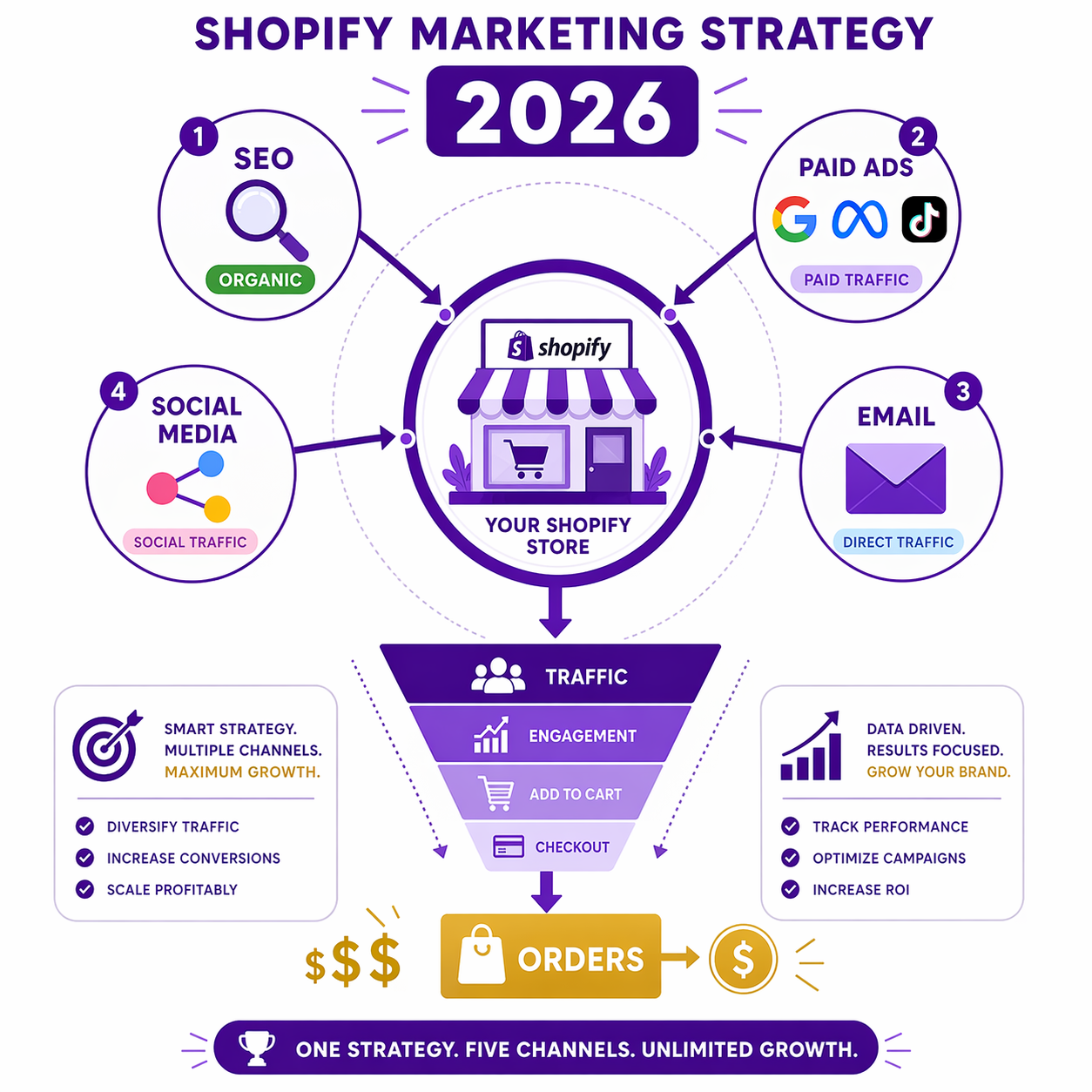
Marketing a Shopify store in 2026 is no longer about winning a single channel. It is about building a coordinated stack where SEO, paid ads, email, social, and influencer work together across every stage of the customer journey. This Shopify marketing strategy 2026 guide breaks down the five core channels, how to map each one to the awareness through retention funnel, the discount depth that fits each one, and the measurement framework that tells you exactly where to put your next dollar of budget.
The Shopify Marketing Strategy 2026 Stack: Five Core Channels
A complete Shopify marketing strategy 2026 stack relies on a combination of five channels. Most stores run a mix of these, weighted by their stage and goals:
- SEO (Organic Search): Long-term, high-lifetime-value traffic. Customers are actively searching for your products. Free after the content investment.
- Paid Ads (Google, Meta, TikTok): Short-term, performance-based. You pay per click or impression. Best for fast scaling and testing new offers.
- Email Marketing: Retention-focused. Send to your list of customers and subscribers. Highest ROI channel, with industry data putting it at 4000%+ for established lists.
- Social Media: Awareness and discovery. TikTok, Instagram, and Pinterest carry awareness. Community-building and content live here.
- Influencer and Affiliate: Trust transfer. Someone your audience already trusts endorses your product.
The best Shopify stores use all five, balanced by their stage and goals.
Matching Channels to Customer Journey Stages
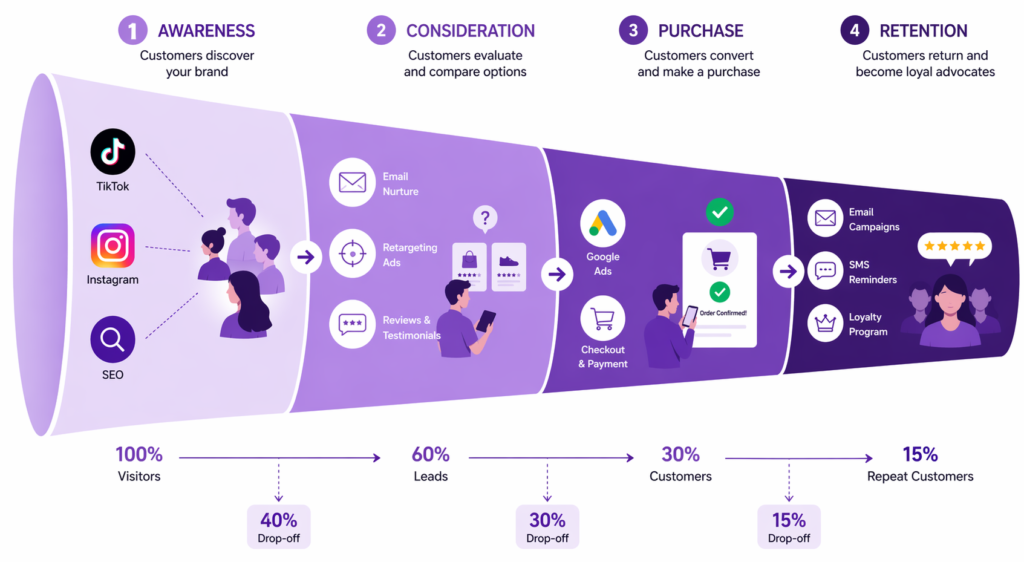
Most stores over-invest in awareness and under-invest in retention. The fix is mapping each channel to the funnel stage where it actually performs.
Awareness Stage
The customer doesn’t know your brand exists yet.
- Best channels: SEO, TikTok and Instagram, YouTube, display ads, influencer
- Goal: Get in front of large audiences
- Measurement: impressions, reach, brand search growth
Consideration Stage
The customer knows about you and is evaluating options.
- Best channels: Email, retargeting ads, reviews, social proof content
- Goal: Move from awareness to intent
- Measurement: engagement, click-through rate, email opens
Purchase Stage
The customer is ready to buy.
- Best channels: Google Ads (high-intent), email, direct, retargeting with discount
- Goal: Convert
- Measurement: conversion rate, AOV, ROAS
Retention Stage
The customer has already bought. The job now is loyalty.
- Best channels: Email, SMS, loyalty program with tag-based discounts, community
- Goal: Repeat purchase, referral
- Measurement: repeat purchase rate, LTV, referral rate
Channel-Specific Strategies and Discount Tactics
Each channel deserves a different discount depth based on its customer acquisition cost. The pattern: lower CAC, shallower discount; higher CAC, deeper discount.
SEO Organic Traffic
Organic traffic is the lowest customer acquisition cost you have. You do not pay per click. The goal is to rank for keywords like “best running shoes” or “eco-friendly yoga pants” and turn that ranking into orders.
Discount strategy: SEO traffic deserves shallower discounts because it is low-cost. You do not need 20% off to convert organic traffic. Those visitors have already decided they want to buy. A 5 to 10% strategic discount is plenty. For the deeper math on discount depth and margin, see our breakdown of Shopify discount profit margin.
Google Ads
High-intent traffic. Customers search “buy running shoes online” or “eco-friendly yoga pants sale” and your ad appears. You pay per click, with $1-5 per click typical depending on category.
Discount strategy: Google Ads traffic justifies deeper discounts (15 to 25%) because your customer acquisition cost is high. If the ad costs $3 and the order value is $100, you can afford a 20% discount and still profit. Use URL-targeted discounts to show the offer specifically to Google Ads traffic, without leaking it to organic visitors.
Meta and TikTok Ads
Lower intent but higher reach. You are interrupting someone scrolling with an ad for your product. Conversion rate is lower (0.5 to 2%), but the audience is very scalable.
Discount strategy: These channels need compelling offers. 20 to 30% off is common. Use an audience-specific incentive (new customer, first-time discount). URL-targeted promotions show the discount only to people who click your ad, so the offer stays exclusive to that audience.
Email Marketing
A warm audience. These people have already interacted with your brand as subscribers or past customers.
Discount strategy: Email audiences are warm, so smaller discounts work. 10 to 15% off for general campaigns, and 5 to 10% for past customers (they are already loyal). Use private promotions with a unique link for each email send. That prevents codes from being scraped to public coupon sites and from being shared outside your list. For full campaign mechanics, see our Shopify email discount strategy guide.
Influencer and Affiliate
Trust transfer. An influencer recommends your product to their audience and their endorsement carries weight your ads never will.
Discount strategy: Influencers often request a discount code to give their audience (“My followers get 20% off”). Use a unique code per influencer like INFLUENCER_NAME_20 so you can attribute every order back to its source. If the influencer has 50K followers and converts 2%, that is 1,000 clicks and roughly 20 orders. At $150 AOV, that is $3,000 in revenue. If the discount cost is $600, the campaign ROI is healthy.
The Conversion Layer: Making Every Channel Perform Better
Regardless of which channel drives traffic, conversion on your store depends on one factor: is the discount visible?
An organic visitor from SEO sees full prices. A Google Ads visitor sees the same full prices, or a code that has to be entered at checkout. An influencer follower clicks the link and sees full prices.
The result: baseline conversion rate across all channels.
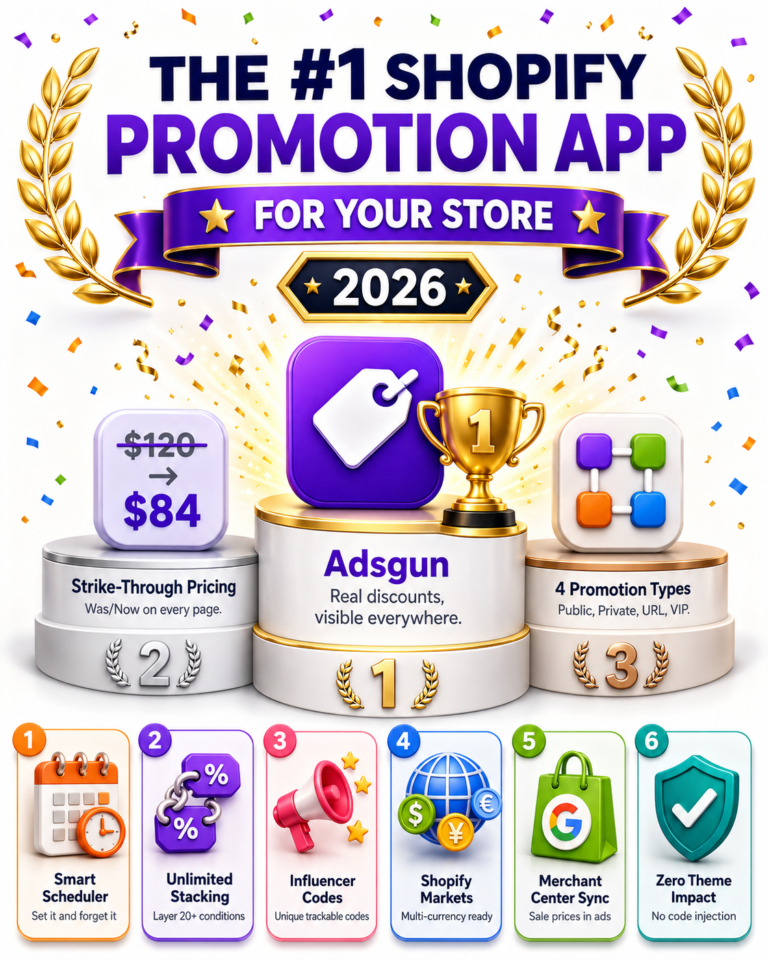
But if you add visible pricing (Adsgun) to every channel:
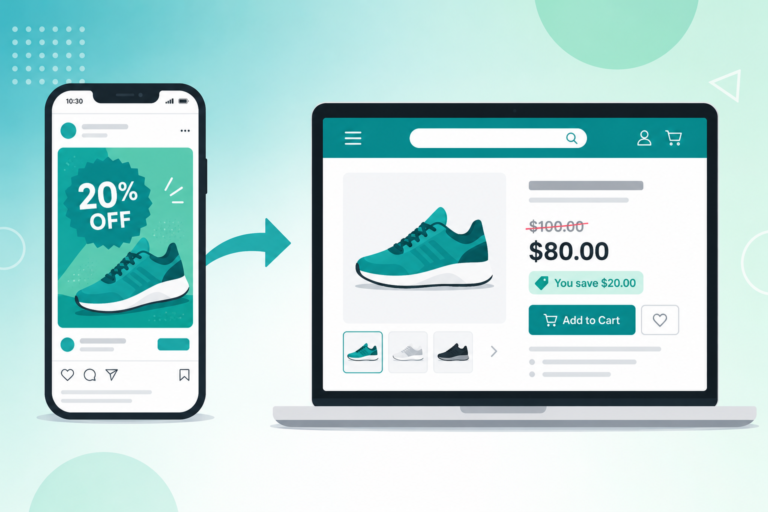
- The organic visitor sees “Was $99, Now $79” and is more likely to buy
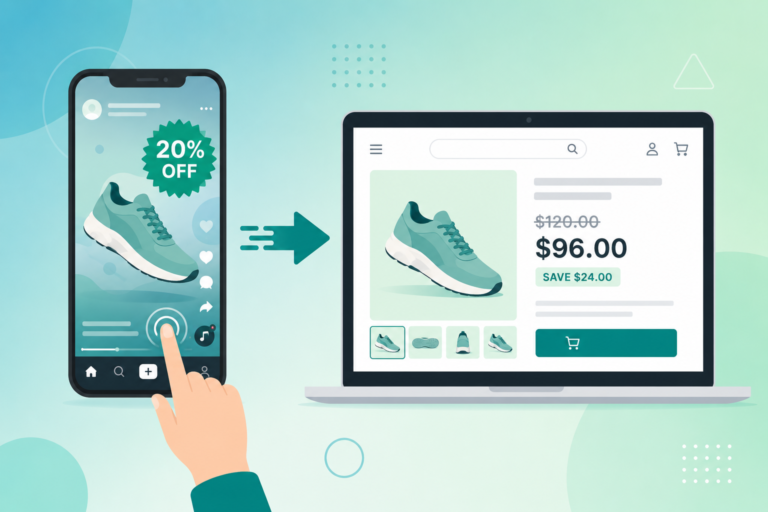
- The Google Ads visitor sees the promotional price immediately and converts higher
- The influencer follower sees the discount prominently and converts higher
The research is consistent. Visible discounts improve conversion by 10 to 25% across all channels. This compounds on top of channel-specific ROI. For a real-world example, the Tire Streets Black Friday case study shows a 14% conversion lift and $37,800 in additional revenue with zero change in ad spend.
Scenario:
- 10,000 monthly traffic from all channels combined
- 3% baseline conversion = 300 orders
- With visible discount display = 4% conversion (14% uplift, average) = 400 orders
- 100 incremental orders × $150 AOV = $15,000 additional revenue
This $15,000 is net new revenue. You did not spend more on ads or content. You just displayed your existing discounts better.
Building a Measurement Framework for Your Shopify Marketing Strategy 2026
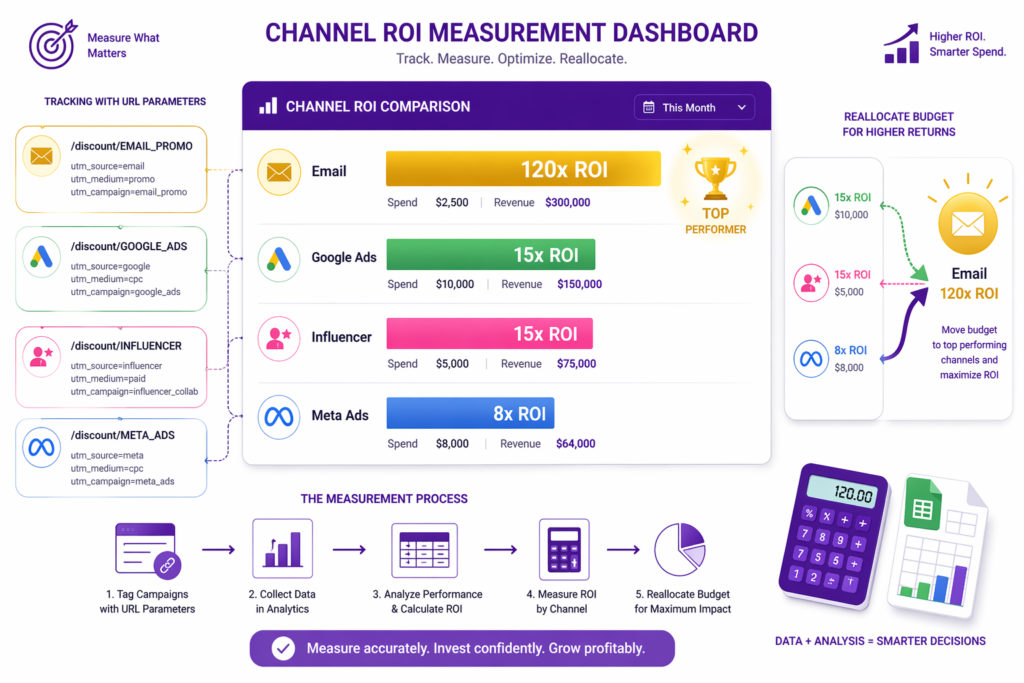
To optimize your Shopify marketing strategy 2026 stack, you have to measure which channels actually drive revenue. Attribution without per-channel tagging is a guess. With tagging, it becomes a budget decision.
Step 1: Tag each marketing channel distinctly
Create a unique discount code or URL parameter for each channel:
- Organic: /discount/ORGANIC_SEO
- Google Ads: /discount/GOOGLE_ADS
- Meta Ads: /discount/META_ADS
- Email: /discount/EMAIL_PROMO
- Influencer: /discount/INFLUENCER_NAME
Step 2: Track in Shopify
Navigate to Shopify’s native discount reporting, where you can see performance per code. Example readout: “GOOGLE_ADS code was used 250 times and generated $37,500 in revenue.”
Step 3: Calculate ROI per channel
- Google Ads: Ad spend $2,500 ÷ revenue $37,500 = 15x ROI
- Email: Email platform cost $100 ÷ revenue $12,000 = 120x ROI
- Influencer: Influencer payment $500 ÷ revenue $7,500 = 15x ROI
Step 4: Reallocate budget to highest-ROI channels
If email is 120x and Google Ads is 15x, the question is not whether to spend more on Google Ads. The question is whether you can scale email further before its returns start to compress.
The 2026 Landscape: New Channels and Shifts
AI Shopping (Google SGE, ChatGPT, and Friends)
In 2026, a real portion of product discovery happens through AI assistants. Users ask ChatGPT “where can I buy sustainable running shoes” and get recommendations with direct links. These are new traffic sources with their own ranking rules, optimized for content depth, structured data, and brand mentions rather than backlinks alone.
TikTok Shop Threat
TikTok Shop lets creators sell directly inside TikTok, competing with your Shopify store for the same audience. To stay competitive, you need both strong TikTok marketing (the awareness layer) and a compelling reason for buyers to come back to your own store rather than complete the purchase inside the app.
First-Party Data
Third-party cookies are dying. Marketing is moving toward first-party data: email lists, loyalty members, customer tag segments. Email and SMS are becoming more important, not less, because they are the channels you actually own.
Video as Default
Short-form video (TikTok, Instagram Reels, YouTube Shorts) is where awareness happens now. Text and static images are declining for top-of-funnel discovery. If you are not creating short-form video, you are functionally invisible to the awareness layer of the funnel.
A Balanced Portfolio Approach
The best 2026 plans do not bet everything on one channel. They build layered redundancy.
The Four Layers of a Modern Shopify Marketing Strategy 2026
- Awareness Layer: SEO (long-term), TikTok (short-term), YouTube (evergreen)
- Consideration Layer: Email (warm audience), retargeting ads (people who visited)
- Conversion Layer: Google Ads (high-intent), influencer (trust), email (calls to action)
- Retention Layer: Email, SMS, loyalty program
This structure creates redundancy (if one channel dies, the others compensate) and efficiency (each channel targets the audience stage where it actually performs).
And underlying every layer of it: make discounts visible everywhere so every channel converts better.