Shopify Email vs SMS: Which Channel Drives More Sales?
A side-by-side comparison of email and SMS for Shopify discount campaigns, with benchmarks, the best use cases for each channel, and a practical strategy for running them together.
Every Shopify store eventually faces the same question: should the next promotion go out by email, by SMS, or both? Shopify email vs SMS is not a winner-takes-all decision. The two channels behave very differently and they work best when you pick the right one for the right kind of campaign. This guide compares the benchmarks, breaks down when each channel wins, and shows how to combine them so the same discount gets compounding lift instead of cannibalized opens.
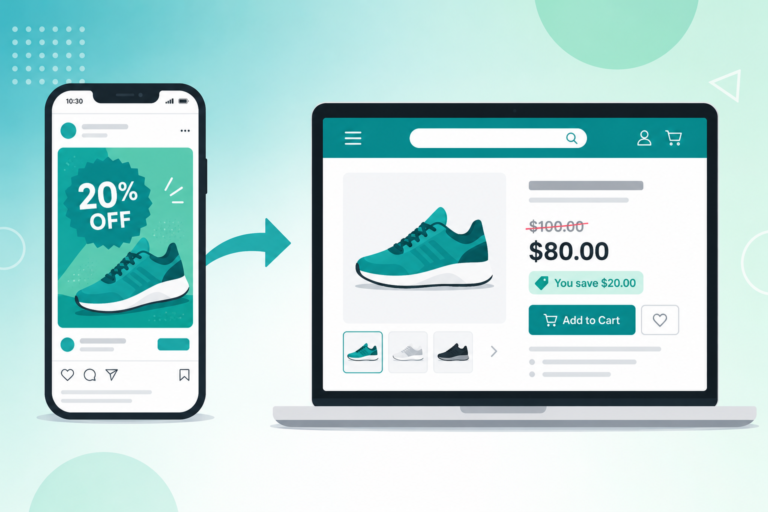
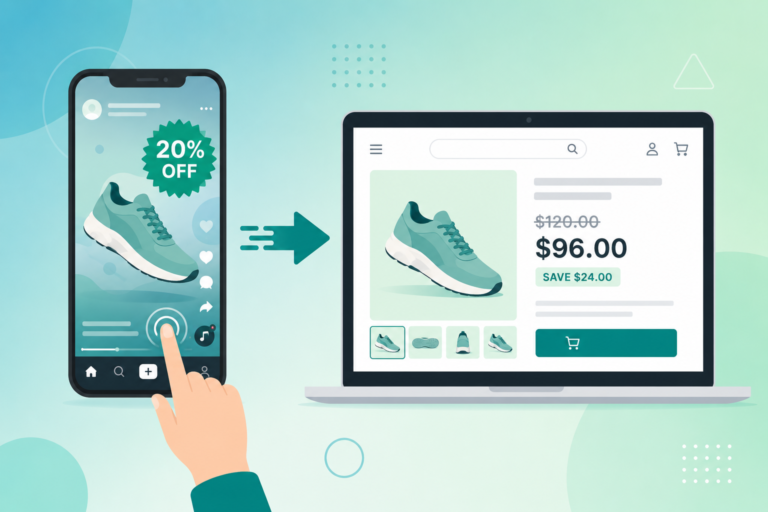
Both channels share one limit: a discount only converts if the customer actually sees it once they land on your store. Pairing whichever channel you choose with visible discount pricing on product pages, collections, cart, and checkout is what turns the open or the click into an order.
Email Marketing Stats for Ecommerce
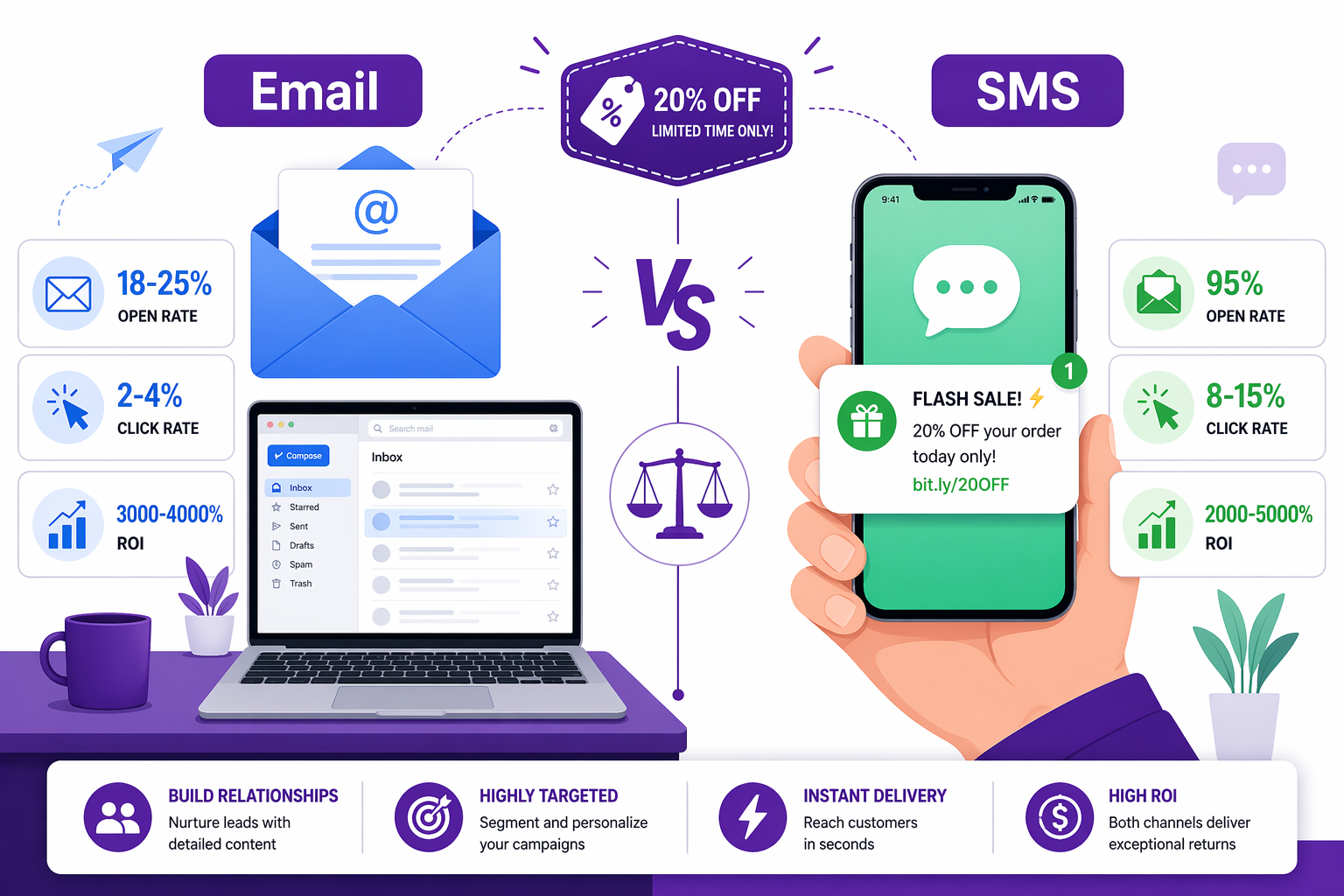
- Open rate: 18 to 25 percent (average across ecommerce)
- Click rate: 2 to 4 percent (average across ecommerce)
- Conversion rate from email: 0.5 to 2 percent (depends on audience warmth and offer)
- ROI: 3000 to 4000 percent (for every 1 dollar spent on email, you make 30 to 40 dollars back)
Email open rates have held steady in 2026 despite Gmail’s promotions tab, because engaged subscribers find promotional emails anyway. The most recent benchmarks confirm this in the Klaviyo email marketing benchmarks report.
SMS Marketing Stats for Ecommerce
- Open rate: 95 percent plus (SMS is opened by almost everyone)
- Click rate: 8 to 15 percent (very high relative to email)
- Conversion rate from SMS: 1 to 3 percent
- ROI: 2000 to 5000 percent plus (one of the highest-ROI channels available)
SMS has much higher click rates because you are interrupting someone directly through a phone notification, and they have to take action. Email is background noise until they check it.
Head-to-Head: Shopify Email vs SMS for Discount Campaigns
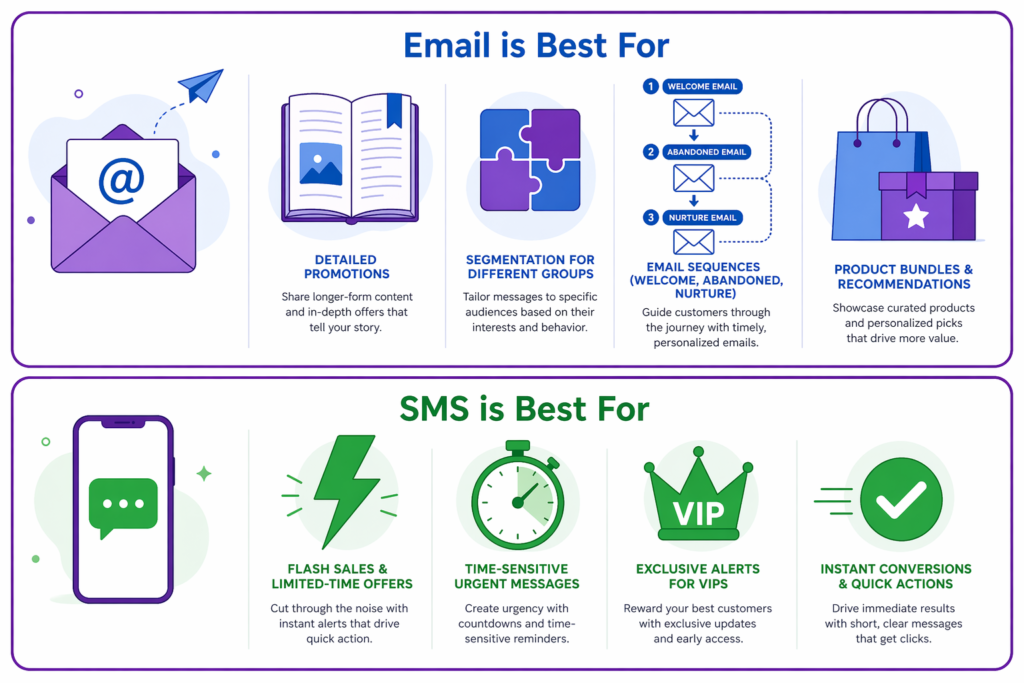
The simplest way to choose between Shopify email vs SMS is to match the channel to the type of campaign. Both channels can carry the same discount, but they perform very differently depending on what kind of message you wrap around it.
Email Is Best For
- Longer-form promotions – explain why the discount is happening, the story behind it.
- Segmentation – different discounts for different customer groups based on tags or purchase history.
- Series campaigns – welcome sequence, abandoned cart series, post-purchase nurture, all of which are covered in detail in the Shopify email discount strategy guide.
- Detailed product recommendations – bundle offers, cross-sells, related items.
SMS Is Best For
- Flash sales – 24-hour and 6-hour windows. The Shopify flash sale guide covers the full timing playbook.
- Time-sensitive urgency – “Sale ends in 3 hours.”
- VIP alerts – high-value customers only, exclusive deals delivered to a private promotion link.
- Quick conversions – customers who are already engaged and just need a reminder.
The Friction Factor: Why the Two Channels Convert Differently
Email allows longer decision time. A customer receives your email, reads it, maybe saves it for later, and comes back. The friction is moderate: they have to click a link, come to your store, and complete checkout.
SMS demands immediate action. A customer gets a text, sees “FLASH SALE: 30% OFF FOR 6 HOURS,” and either clicks now or loses the offer. The friction is lower (one tap) but the time window is narrower.
This friction difference explains why SMS converts higher for flash sales (urgency plus immediacy) and email converts higher for planned promotions (time to consider, lower pressure). It also explains why the copy you write for each channel has to differ, a topic covered in Shopify discount copy that converts.
The Email Plus SMS Channel Combination Strategy
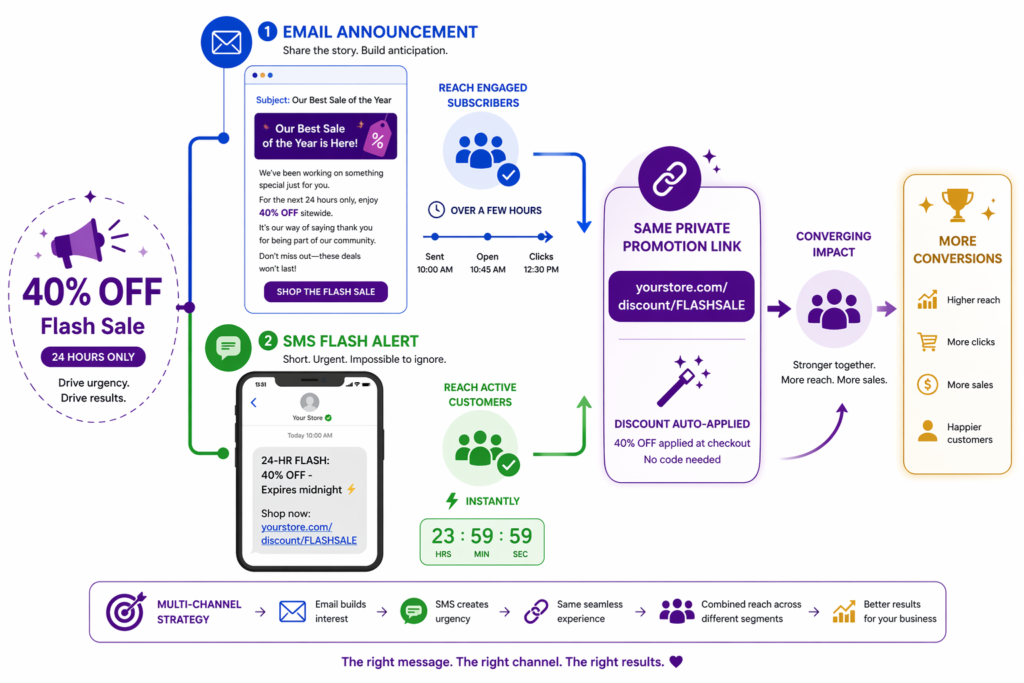
The best merchants use Shopify email vs SMS as a false dichotomy: they use both, strategically, with each channel doing what it does best.
Email announces the promotion:
- Subject: “Our Best Sale of the Year: 40% Off Everything”
- Body: Story about why (overstock, founder appreciation, seasonal change)
- CTA: Private link from Adsgun that auto-applies the discount
SMS sends the flash sale alert:
- “24-HOUR FLASH SALE: 40% OFF. Link below. Expires midnight.”
- CTA: Same private link, creates urgency with a countdown
Same discount, different messaging for different channels.
Result: email reaches engaged subscribers over a few hours. SMS reaches active customers in real time. Combined, you hit your entire audience at different touchpoints, capturing the planners through email and the impulse buyers through SMS.
Integration: Email Platforms Plus Adsgun Private Links
Most email platforms (Klaviyo, Mailchimp, Postscript) allow custom links in emails. The integration with Shopify discount mechanics is straightforward:
- Create a discount in Shopify (for example, 40 percent off).
- Create a private promotion in Adsgun: yourstore.com/discount/EMAILPROMO using the auto-apply discount setup.
- In your Klaviyo email, insert the link as the CTA: a “Shop Now” button that links to the Adsgun private link.
- The discount auto-applies when subscribers click.
- In Shopify reporting, the discount is tracked as a separate code so you keep full channel attribution.
For SMS:
- Use the same private link.
- Shorten it (bit.ly/flashsale or similar).
- Send the SMS: “FLASH SALE: 40% OFF. Get it: bit.ly/flashsale. Expires midnight.”
- Customers tap the link and the discount applies immediately.
The private link approach works for both channels because the link itself is the promotion. No codes required, no typing on mobile, no friction at checkout. For the full naming and tracking layer on top of this, see the Shopify discount codes explained guide.
Testing: Which Channel Drives More ROI for Your Store?
Every store’s data is different. Your email list might be more engaged than industry average, or your SMS list might be cold. Run the three tests below before locking in a channel mix.
Test 1: Same Offer, Email Only
- Send to 10,000 email subscribers.
- Track opens, clicks, and conversions.
- Calculate ROI.
Test 2: Same Offer, SMS Only
- Send to 5,000 SMS subscribers.
- Track opens, clicks, and conversions.
- Calculate ROI.
Test 3: Both Channels, Same Offer
- Send to both lists simultaneously.
- Track whether the same customers are converting from both (overlap) or different ones (additive lift).
After three tests, you will have data specific to your audience. The usual pattern: SMS shows a higher click rate, email reaches higher volume. Combined ROI is higher than either channel alone.
Best Practices: Time and Frequency
Email Cadence
- Send promotional emails 1 to 3 times per week. More than that increases unsubscribe rate.
- Best times: Tuesday through Thursday, 9 to 11 AM or 7 to 9 PM. Exact timing varies by audience.
- Segmentation: new customers should get a different offer than loyal customers. Customer tag-based discounts make this easy to set up.
SMS Cadence
- Send 1 to 2 times per week maximum. The SMS list is far more sensitive to frequency than email.
- Send during business hours, not late at night unless it is a genuine emergency alert.
- VIP customers should get exclusive SMS alerts before the public sale opens.
FAQ: Shopify Email vs SMS
Should I use email or SMS for my first discount campaign?
Start with email. The list is usually larger, easier to unsubscribe from if recipients do not want it, and forgives mistakes more gracefully than SMS does. SMS is more powerful per send but also more intrusive.
How do I grow my SMS list?
Offer an incentive at checkout: “Get SMS alerts for exclusive deals. 10 percent off your next order.” Loyalty members and repeat buyers should be the first to be invited to opt in.
Can I use the same discount code for email and SMS?
Yes, but you lose channel attribution. Better practice: use a unique code per channel (EMAIL40, SMS40) so you can measure which channel drove what. The bulk discount code generation guide covers this pattern in depth.
What is the best discount depth for email vs SMS promotions?
10 to 20 percent for regular email promotions, 20 to 30 percent for seasonal or flash sales. SMS audiences usually expect deeper discounts (25 percent plus) because the urgency signal sets a higher expectation.
Does SMS marketing have legal compliance requirements I should know about?
Yes. SMS marketing is regulated under the TCPA in the United States and GDPR in the EU. Always get explicit opt-in consent and include opt-out instructions in every message. The FTC’s official guidance on text message marketing is a useful primer on what compliance looks like from the recipient side.
Bottom Line: Shopify Email vs SMS Is Not Either-Or
The cleanest answer to Shopify email vs SMS is to stop framing it as a choice. Email builds the story and reaches the planners. SMS creates urgency and captures the impulse buyers. Run them in sequence on the same private promotion link, attribute each campaign to its source, and you get compounding lift instead of channel cannibalization.
Run Your Next Email and SMS Campaign With Adsgun
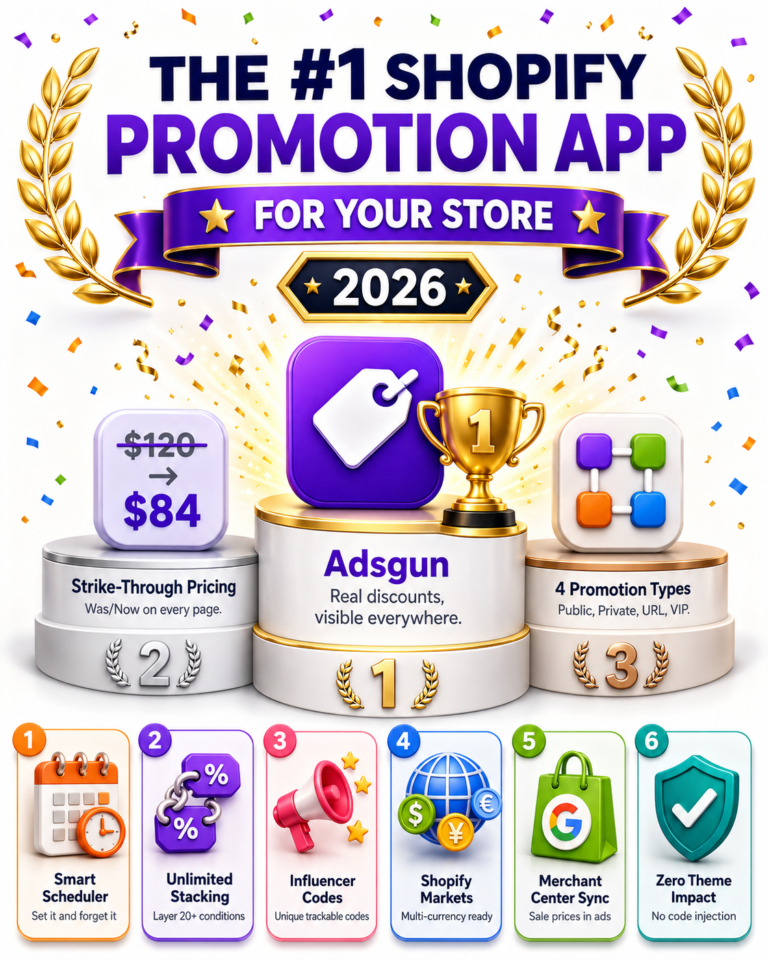
Adsgun creates the private promotion link that powers both channels, displays the discount visibly on every step of the customer journey, and keeps attribution intact in Shopify reporting. One discount, two channels, full visibility.
Try Adsgun Free and turn email and SMS into a coordinated revenue engine.